


Amphiregulin-deficient mice develop spasmolytic polypeptide expressing metaplasia and intestinal metaplasia
- PMID: 19230855
- PMCID: PMC2844775
- DOI: 10.1053/j.gastro.2008.12.037
Amphiregulin-deficient mice develop spasmolytic polypeptide expressing metaplasia and intestinal metaplasia
Abstract
Background & aims: The loss of parietal cells from the fundic mucosa leads to the emergence of metaplastic lineages associated with an increased susceptibility to neoplastic transformation. Both intestinal metaplasia (IM) and spasmolytic polypeptide (TFF2/SP) expressing metaplasia (SPEM) have been identified in human stomach, but only SPEM is present in most mouse models of gastric metaplasia. We previously determined that loss of amphiregulin (AR) promotes SPEM induced by acute oxyntic atrophy. We have now examined whether SPEM in the AR-/- mouse predisposes the stomach to gastric neoplasia.
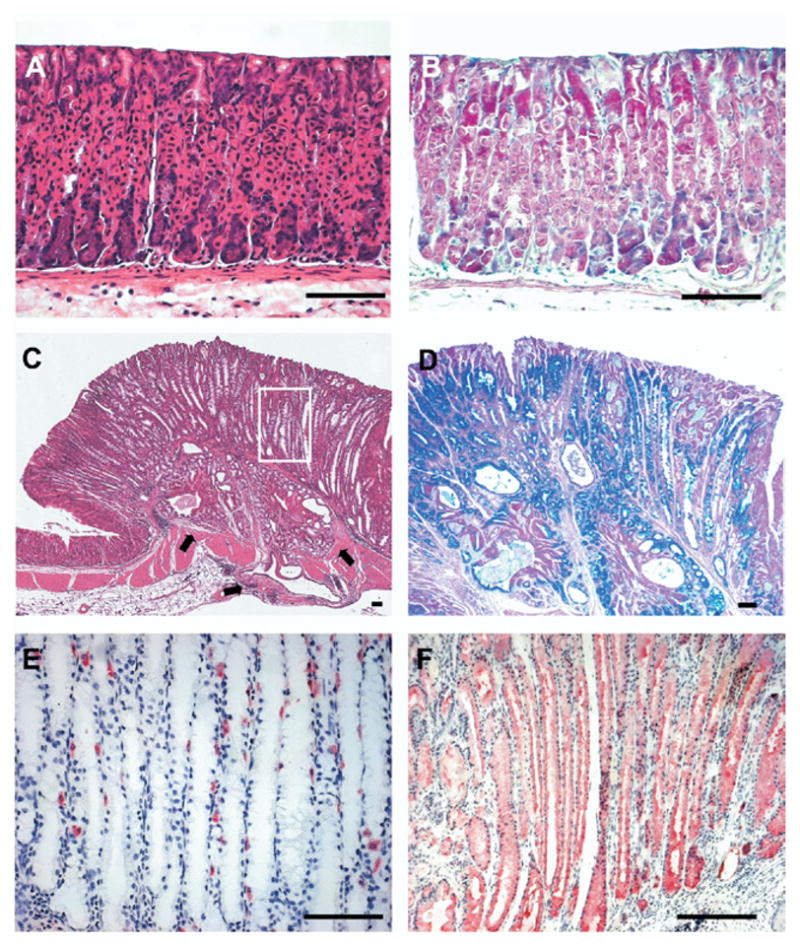
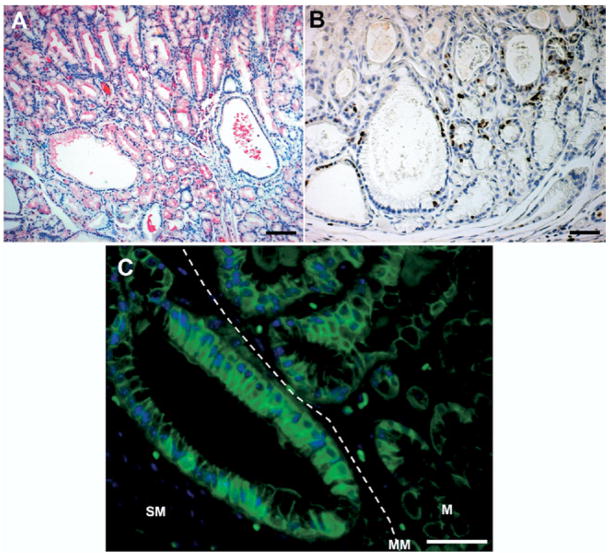
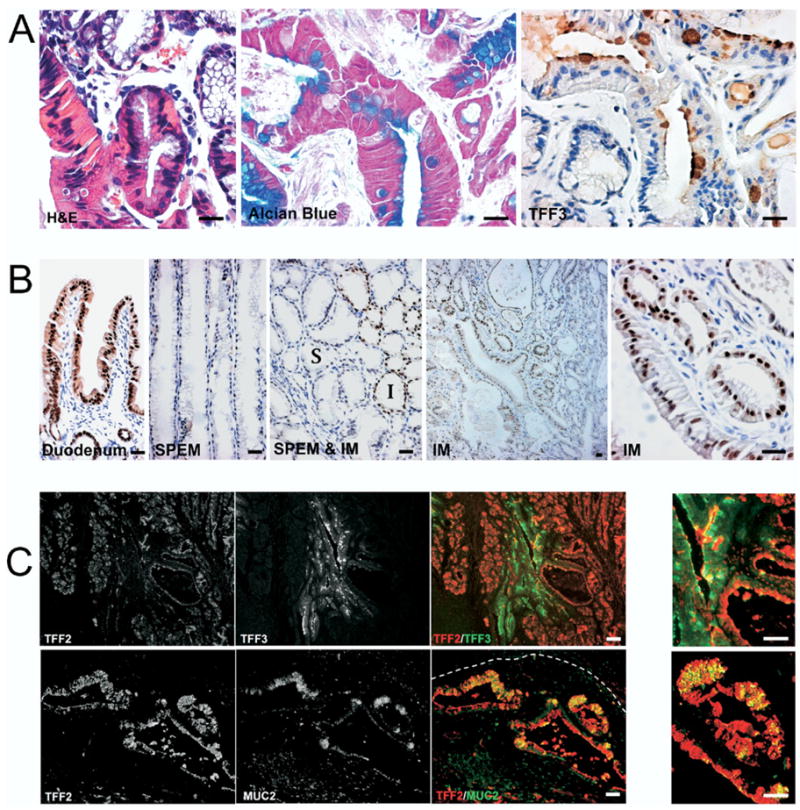
Methods: Gross pathology of 18-month-old wild-type, AR-/-, and TGF-alpha-/- mice were examined. Ki-67, beta-catenin, Pdx-1, TFF3, and TFF2/SP expression was analyzed by immunohistochemistry. Metaplastic gastric mucosa was analyzed by dual immunostaining for TFF2/SP with MUC2 or TFF3.
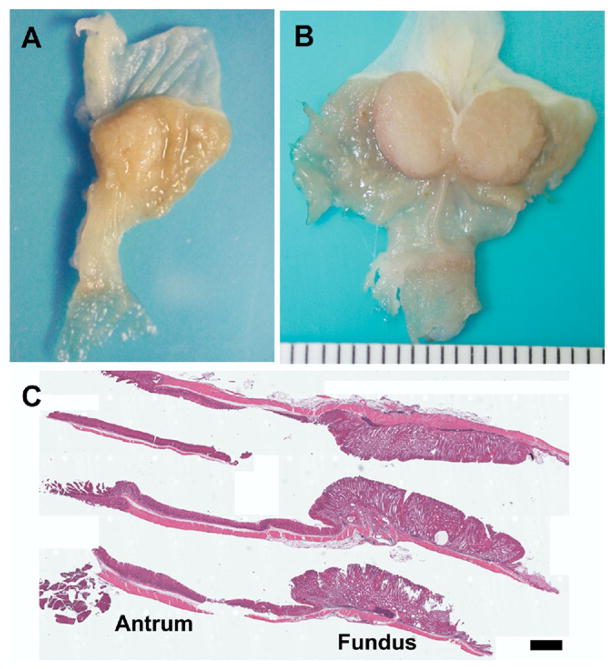
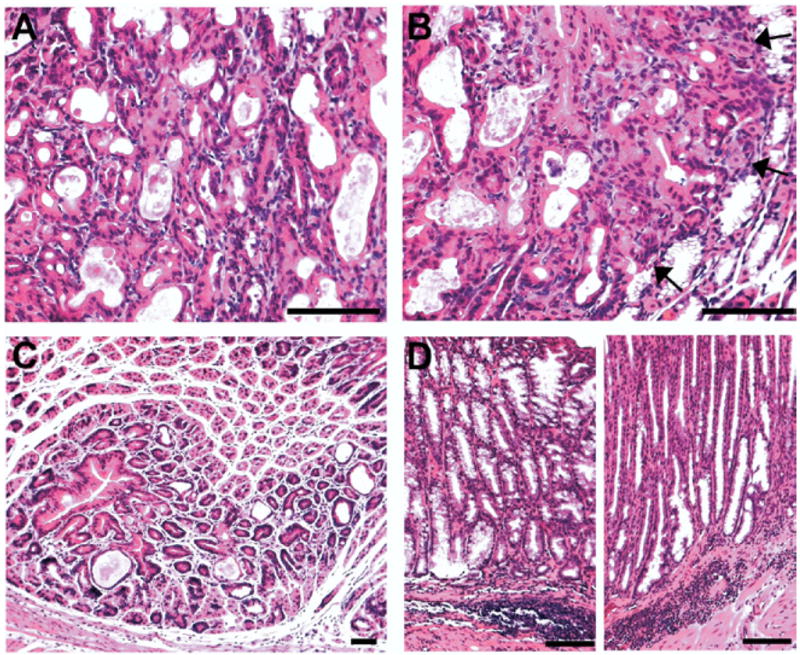
Results: By 18 months of age, more than 70% of AR-/- mice developed SPEM while 42% showed goblet cell IM labeled with MUC2, TFF3, and Pdx-1. A total of 28% had invasive gastric lesions in the fundus. No antral abnormalities were observed in AR-/- mice. Metaplastic cell lineages in AR-/- mice showed increases in cell proliferation and cytosolic beta-catenin expression. Dual staining for TFF2/SP with MUC2 or TFF3 showed glands containing both SPEM and IM with intervening cells expressing both TFF2/SP and MUC2 or TFF2/SP and TFF3.
Conclusions: AR-/- mice develop SPEM, which gives rise to goblet cell IM and invasive fundic dysplastic lesions. The AR-/- mouse represents the first mouse model for spontaneous development of fundic SPEM with progression to IM.
Conflict of interest statement
The authors disclose no conflicts.
Figures
References
-
- Karam SM, Leblond CP. Dynamics of epithelial cells in the corpus of the mouse stomach. I. Identification of proliferative cell types and pinpointing of the stem cell. Anat Rec. 1993;236:259–279. - PubMed
-
- Karam SM, Leblond CP. Dynamics of epithelial cells in the corpus of the mouse stomach. III. Inward migration of neck cells followed by progressive transformation into zymogenic cells. Anat Rec. 1993;236:297–313. - PubMed
-
- El-Zimaity HM, Ota H, Graham DY, et al. Patterns of gastric atrophy in intestinal type gastric carcinoma. Cancer. 2002;94:1428–1436. - PubMed
-
- Correa P. A human model of gastric carcinogenesis. Cancer Res. 1988;48:3554–3560. - PubMed
-
- Filipe MI, Munoz N, Matko I, et al. Intestinal metaplasia types and the risk of gastric cancer: a cohort study in Slovenia. Int J Cancer. 1994;57:324–329. - PubMed
Publication types
MeSH terms
Substances
Grants and funding
- P50 CA095103/CA/NCI NIH HHS/United States
- R01 CA077955/CA/NCI NIH HHS/United States
- R01 DK071590/DK/NIDDK NIH HHS/United States
- P50 CA95103/CA/NCI NIH HHS/United States
- P30 DK058404/DK/NIDDK NIH HHS/United States
- R01 DK073902/DK/NIDDK NIH HHS/United States
- DK77955/DK/NIDDK NIH HHS/United States
- K01 DK077955/DK/NIDDK NIH HHS/United States
- DK071590/DK/NIDDK NIH HHS/United States
- R01 DK058587/DK/NIDDK NIH HHS/United States
- DK73902/DK/NIDDK NIH HHS/United States
- DK058404/DK/NIDDK NIH HHS/United States
- DK58587/DK/NIDDK NIH HHS/United States
LinkOut - more resources
Full Text Sources
Molecular Biology Databases
Research Materials
Miscellaneous
