


[Health problems also explain social services use in home care]
- PMID: 19231704
- PMCID: PMC7021950
- DOI: 10.1016/j.aprim.2008.06.001
[Health problems also explain social services use in home care]
Abstract
Objective: To identify which social and health variables are associated with receiving social services in patients included in home care programmes with the implementation of the Dependence Law.
Design: Cross-sectional study.
Setting: 72 primary health care teams in Catalonia.
Patients: Patients over 64 years old with chronic diseases in home care programmes in Catalonia.
Measurements: Health status variables: Charlson, Barthel, Pfeiffer, Braden and Gijon, data from their carer (Zarit), self perception of health (SF-12), health professional visits, as well as: emergency visits, temporary admissions, and final results such as death or definitive admission in a nursing home or a hospital.
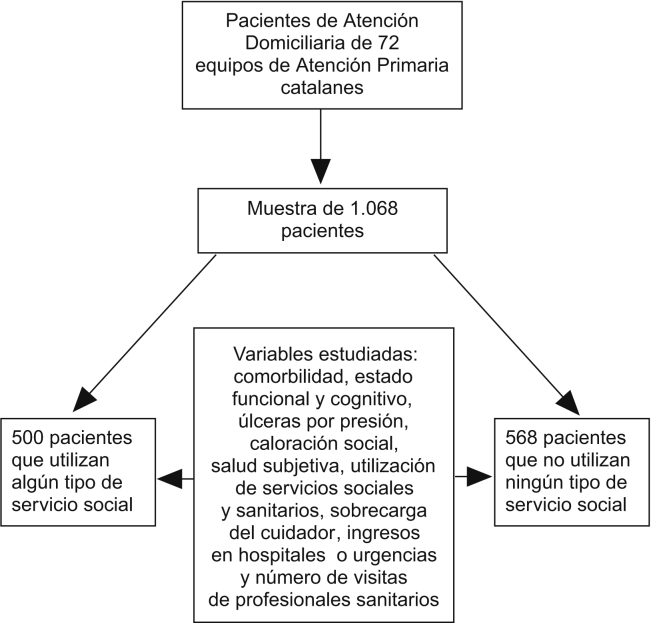
Results: A total of 1068 patients were included, 46.8% of the patients received some kind of social service, public or private. We observed that the variables related to receive some kind of social services are: high dependence (Barthel test), pressure sores and home care rehabilitation. Barthel test is highly associated with having social problems (Gijon test), living without an informal carer, more than 2 GP visits and having additional private health care.
Conclusions: To be more fair, the evaluation of the provisions of the Dependence Law should also consider the health status of the patient. With the implementation of this law we can observe difficulties in access to social services for middle class patients. These patients do not have access to public social assistance and cannot pay for a private one. Social services are still an alternative to family care.
Objetivo: identificar las variables relacionadas con el hecho de recibir servicios sociales de carácter público o privado antes de la implantación de la Ley de Dependencia en pacientes recluidos en sus domicilios.
Diseño: estudio descriptivo transversal.
Emplazamiento: 72 equipos de atención primaria de Cataluña (EAP).
Participantes: pacientes mayores de 64 años, no institucionalizados atendidos por un programa de atención domiciliaria de los EAP.
Mediciones principales: de cada paciente se registraron: comorbilidad, estado funcional, estado cognitivo, si tenía úlceras por presión, salud subjetiva, valoración social, utilización de servicios sociales y sanitarios formales e informales, sobrecarga del cuidador, ingresos en residencias, hospitales o urgencias, además del número de visitas de profesionales santiarios.
Resultados: participan 1.068 pacientes, el 46,8% recibe algún servicio social. Las variables relacionadas con la prestación de servicios sociales son: el grado de dependencia (Barthel), las úlceras por presión y recibir rehabilitación a domicilio. El test de Barthel está firmemente asociado a la problemática social (Gijón), carecer de cuidador informal, más de dos visitas de médico de familia y tener sanidad privada adicional.
Conclusiones: para ser más equitativa, la valoración de las prestaciones de la Ley de Dependencia debería considerar también el estado de salud. Antes de la aplicación de esta ley se intuye una dificultad de acceso a los servicios sociales formales para las clases medias que no acceden a las prestaciones públicas ni pueden pagarlas. Las prestaciones sociales son todavía una alternativa a la atención familiar.
Figures
Comment in
-
[Definition of "functional dependency". Implications for health and social policy].Aten Primaria. 2010 Jun;42(6):344-5. doi: 10.1016/j.aprim.2009.08.001. Epub 2009 Oct 15. Aten Primaria. 2010. PMID: 19833414 Free PMC article. Spanish. No abstract available.
References
-
- Carretero S., Garcés J., Ródenas F. Evaluation of the home help service and its impact on the informal caregiver's burden of dependent elders. Int J Geriatr Psychiatry. 2007;22:738–749. - PubMed
-
- Otero A., Zunzunegui M.V. La importancia de identificar las necesidades de servicios sanitarios y sociales de las personas mayores. Rev Esp Geriatr Gerontol. 2001;36:41–42.
-
- BOE n.o 96, sábado 21 abril 2007; p. 17646–85.
-
- Kadushin G. Home health care utilization: a review of the research for Social Work. Health & Social Work; 2004. p. 219. - PubMed
Publication types
MeSH terms
LinkOut - more resources
Full Text Sources
Medical
