Contrast enhancement of stimulus intermittency in a primary olfactory network and its behavioral significance
- PMID: 19232128
- PMCID: PMC2687775
- DOI: 10.1186/jbiol120
Contrast enhancement of stimulus intermittency in a primary olfactory network and its behavioral significance
Abstract
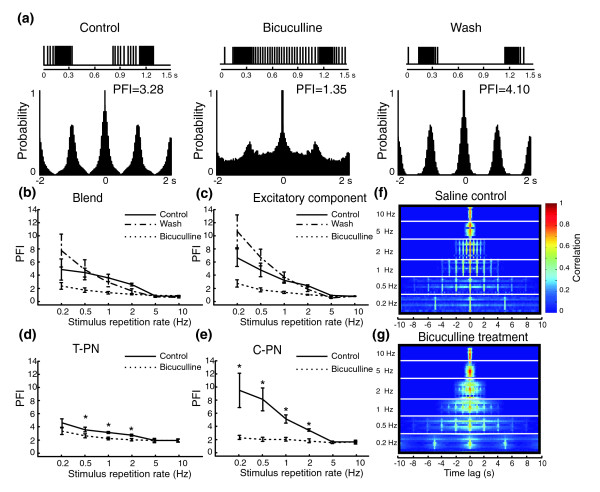
Background: An animal navigating to an unseen odor source must accurately resolve the spatiotemporal distribution of that stimulus in order to express appropriate upwind flight behavior. Intermittency of natural odor plumes, caused by air turbulence, is critically important for many insects, including the hawkmoth, Manduca sexta, for odor-modulated search behavior to an odor source. When a moth's antennae receive intermittent odor stimulation, the projection neurons (PNs) in the primary olfactory centers (the antennal lobes), which are analogous to the olfactory bulbs of vertebrates, generate discrete bursts of action potentials separated by periods of inhibition, suggesting that the PNs may use the binary burst/non-burst neural patterns to resolve and enhance the intermittency of the stimulus encountered in the odor plume.
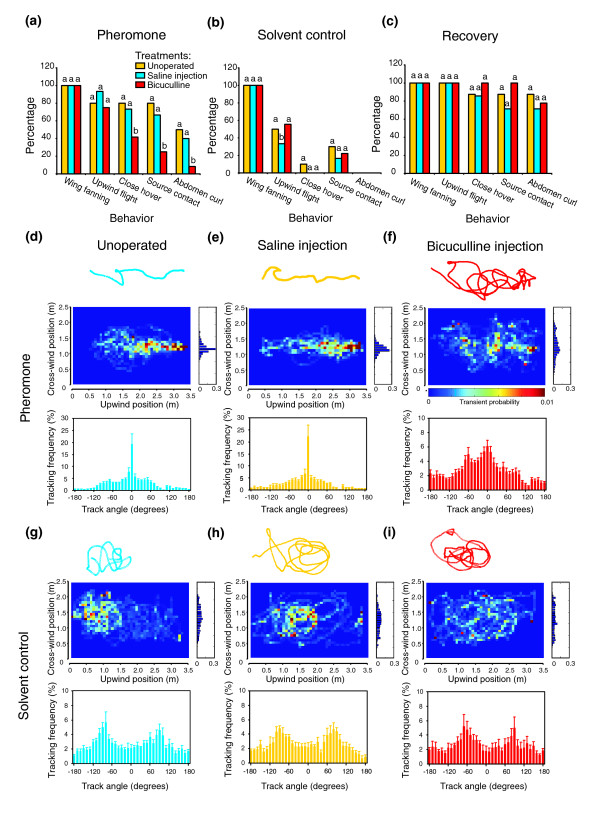
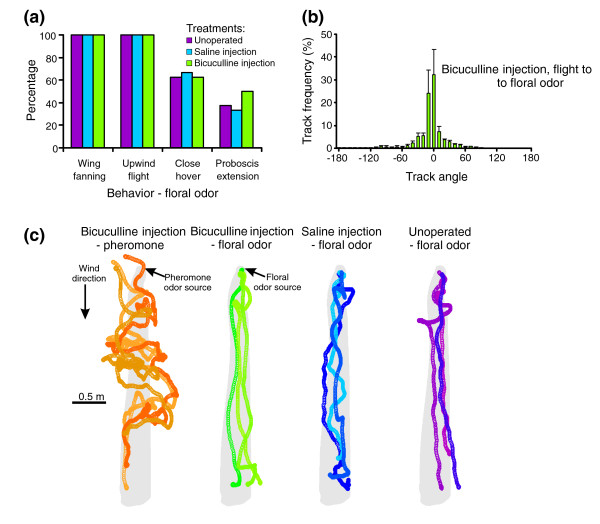
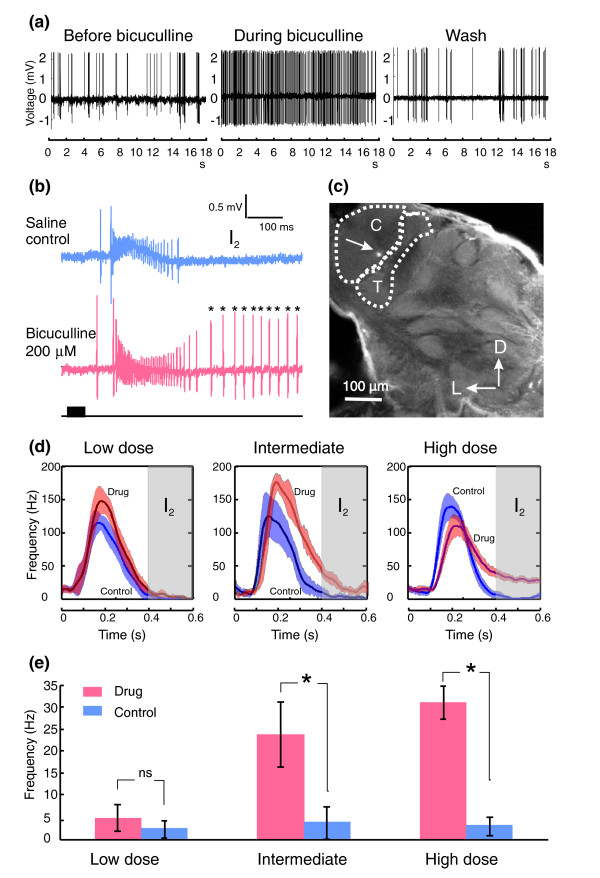
Results: We tested this hypothesis first by establishing that bicuculline methiodide reliably and reversibly disrupted the ability of PNs to produce bursting response patterns. Behavioral studies, in turn, demonstrated that after injecting this drug into the antennal lobe at the effective concentration used in the physiological experiments animals could no longer efficiently locate the odor source, even though they had detected the odor signal.
Conclusions: Our results establish a direct link between the bursting response pattern of PNs and the odor-tracking behavior of the moth, demonstrating the behavioral significance of resolving the dynamics of a natural odor stimulus in antennal lobe circuits.
Figures
Comment in
-
Representations of odor plume flux are accentuated deep within the moth brain.J Biol. 2009;8(2):16. doi: 10.1186/jbiol122. Epub 2009 Feb 20. J Biol. 2009. PMID: 19239722 Free PMC article. Review.
Similar articles
-
Multitasking in the olfactory system: context-dependent responses to odors reveal dual GABA-regulated coding mechanisms in single olfactory projection neurons.J Neurosci. 1998 Aug 1;18(15):5999-6008. doi: 10.1523/JNEUROSCI.18-15-05999.1998. J Neurosci. 1998. PMID: 9671685 Free PMC article.
-
Normal glomerular organization of the antennal lobes is not necessary for odor-modulated flight in female moths.J Comp Physiol A. 1995 Feb;176(2):205-16. doi: 10.1007/BF00239923. J Comp Physiol A. 1995. PMID: 7884684
-
Temporal tuning of odor responses in pheromone-responsive projection neurons in the brain of the sphinx moth Manduca sexta.J Comp Neurol. 1999 Jun 21;409(1):1-12. J Comp Neurol. 1999. PMID: 10363707
-
GABAergic mechanisms that shape the temporal response to odors in moth olfactory projection neurons.Ann N Y Acad Sci. 1998 Nov 30;855:475-81. doi: 10.1111/j.1749-6632.1998.tb10608.x. Ann N Y Acad Sci. 1998. PMID: 9929641 Review.
-
Winging it: moth flight behavior and responses of olfactory neurons are shaped by pheromone plume dynamics.Chem Senses. 2006 Feb;31(2):155-66. doi: 10.1093/chemse/bjj011. Epub 2005 Dec 8. Chem Senses. 2006. PMID: 16339269 Review.
Cited by
-
Use of bilateral information to determine the walking direction during orientation to a pheromone source in the silkmoth Bombyx mori.J Comp Physiol A Neuroethol Sens Neural Behav Physiol. 2012 Apr;198(4):295-307. doi: 10.1007/s00359-011-0708-8. Epub 2012 Jan 8. J Comp Physiol A Neuroethol Sens Neural Behav Physiol. 2012. PMID: 22227850
-
Effects of Mechanosensory Input on the Tracking of Pulsatile Odor Stimuli by Moth Antennal Lobe Neurons.Front Neurosci. 2021 Oct 7;15:739730. doi: 10.3389/fnins.2021.739730. eCollection 2021. Front Neurosci. 2021. PMID: 34690678 Free PMC article.
-
Neuroethology of Olfactory-Guided Behavior and Its Potential Application in the Control of Harmful Insects.Front Physiol. 2016 Jun 30;7:271. doi: 10.3389/fphys.2016.00271. eCollection 2016. Front Physiol. 2016. PMID: 27445858 Free PMC article. Review.
-
Neural correlates of behavior in the moth Manduca sexta in response to complex odors.Proc Natl Acad Sci U S A. 2009 Nov 17;106(46):19219-26. doi: 10.1073/pnas.0910592106. Epub 2009 Nov 11. Proc Natl Acad Sci U S A. 2009. PMID: 19907000 Free PMC article.
-
Pheromone responsiveness threshold depends on temporal integration by antennal lobe projection neurons.Proc Natl Acad Sci U S A. 2013 Sep 17;110(38):15455-60. doi: 10.1073/pnas.1313707110. Epub 2013 Sep 4. Proc Natl Acad Sci U S A. 2013. PMID: 24006366 Free PMC article.
References
-
- Adrian ED. Electrical activity of the nervous system. Arch Neurol Psychiatry. 1934;32:1125–1136.
-
- Murlis J, Jones CD. Fine-scale structure of odor plumes in relation to insect orientation to distant pheromone and other attractant sources. Physiol Entomol. 1981;6:71–86. doi: 10.1111/j.1365-3032.1981.tb00262.x. - DOI
Publication types
MeSH terms
Substances
Grants and funding
LinkOut - more resources
Full Text Sources