Comparative Study
. 2009 Apr;47(4):283-90.
doi: 10.1016/j.ymeth.2009.02.005. Epub 2009 Feb 20.

Quantitative analysis of HIV-1 preintegration complexes

Affiliations
Comparative Study

Quantitative analysis of HIV-1 preintegration complexes

Alan Engelman et al. Methods. 2009 Apr.

Abstract

Retroviral replication proceeds through the formation of a provirus, an integrated DNA copy of the viral RNA genome. The linear cDNA product of reverse transcription is the integration substrate and two different integrase activities, 3' processing and DNA strand transfer, are required for provirus formation. Integrase nicks the cDNA ends adjacent to phylogenetically-conserved CA dinucleotides during 3' processing. After nuclear entry and locating a suitable chromatin acceptor site, integrase joins the recessed 3'-OHs to the 5'-phosphates of a double-stranded staggered cut in the DNA target. Integrase functions in the context of a large nucleoprotein complex, called the preintegration complex (PIC), and PICs are analyzed to determine levels of integrase 3' processing and DNA strand transfer activities that occur during acute virus infection. Denatured cDNA end regions are monitored by indirect end-labeling to measure the extent of 3' processing. Native PICs can efficiently integrate their viral cDNA into exogenously added target DNA in vitro, and Southern blotting or nested PCR assays are used to quantify the resultant DNA strand transfer activity. This study details HIV-1 infection, PIC extraction, partial purification, and quantitative analyses of integrase 3' processing and DNA strand transfer activities.


Figures
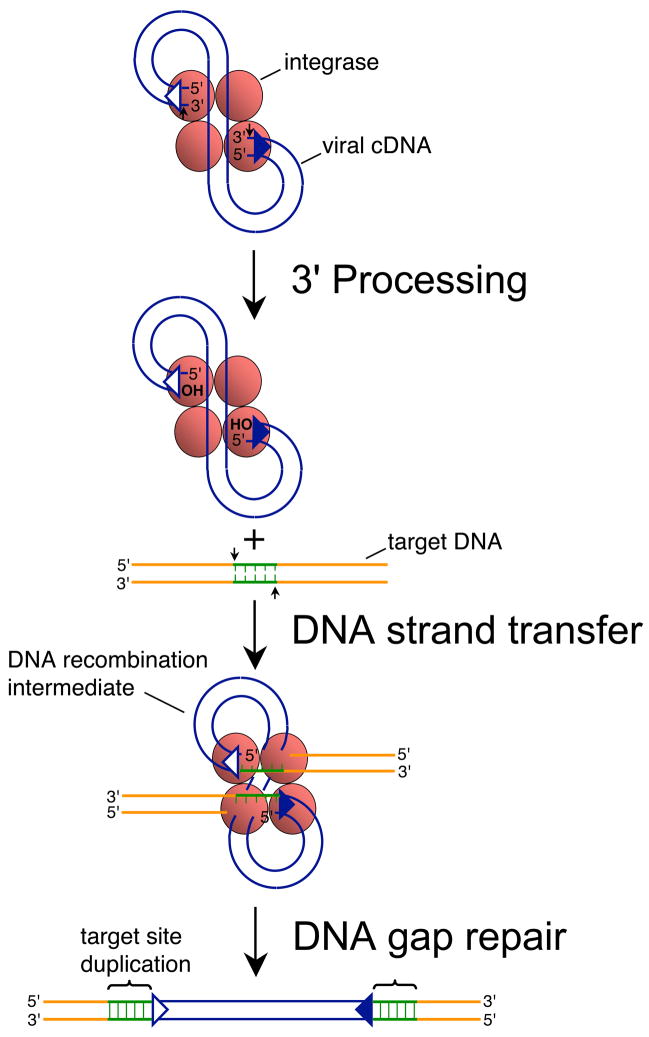
Fig. 1
Fig. 1
Mechanism of retroviral DNA integration. Reverse transcription yields linear cDNA with a copy of U3/R/U5 sequences, also known as the long terminal repeat (LTR), at each end. Integrase recognizes approximately 15–20 bp of each end region [39, 40]. The upstream recognition or attachment (att) site is therefore comprised of U3 sequences (open triangle) whereas the downstream att site is U5 (filled blue triangle). Integrase (red shaded ball) cleaves each att site adjacent to the invariant sequence 5′-CA-3′ during 3′ processing (marked by small vertical arrows), removing the dinucleotide GT from each end of HIV-1 cDNA [4, 6]. Integrase uses the oxygen nucleophiles at the exposed CAOH ends during DNA strand transfer to cut the target DNA at the small vertical arrows, which at the same time joins the viral ends to the resultant 5′-phosphates [6]. The DNA recombination intermediate, with unjoined viral DNA 5′ ends, is the structure formed in in vitro PIC integration assays [1, 2, 5]. DNA repair yields the integrated provirus flanked by the sequence duplication of the target DNA staggered cut (green lines), which is 5 bp for HIV-1 [41, 42]. Integrase functions as a multimer in vitro and in vivo, though the precise make-up of the active multimer during infection is unknown. It is depicted here as a tetramer for simplicity.
Fig. 2
Fig. 2
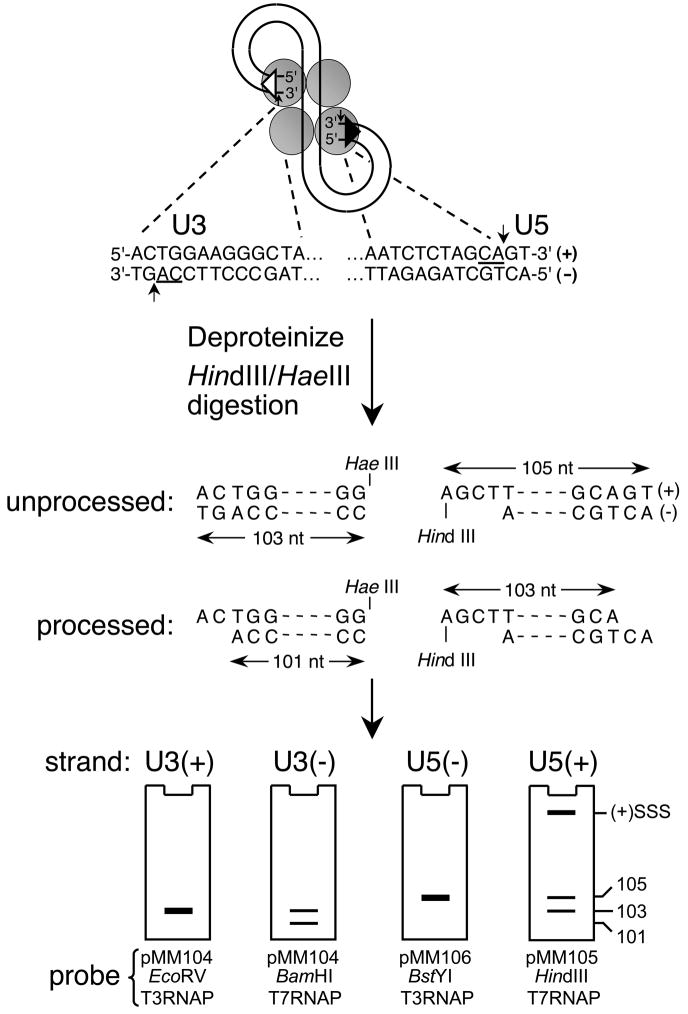
Indirect end-labeling of HIV-1 cDNA end structures. The terminal 13 bp of the U3 and U5 DNA att sites are shown beneath the HIV-1 PIC, with the phosphodiester bonds cleaved during 3′ processing and invariant CA dinucleotides marked by vertical arrows and underlines, respectively. The viral DNA ends are isolated as approximate 100 bp regions upon digestion with HindIII and HaeIII. The initial U3 minus-strand is 103 nucleotides, whereas integrase processing yields a 101 nt product. The unprocessed U5 plus-strand is 105 bases, with 3′ processing generating a shortened 103 nt strand. The U3 plus- and U5 minus-strands by contrast remain unchanged during 3′ processing. The various end structures are visualized by indirect end-labeling using riboprobes generated from the indicated linearized plasmid DNA templates, with the cartoon gels depicting the approximate mobilities of the different strands/3′ processing reaction products. (+)SSS, plus-strand strong-stop DNA; RNAP, RNA polymerase.
Fig. 3
Fig. 3
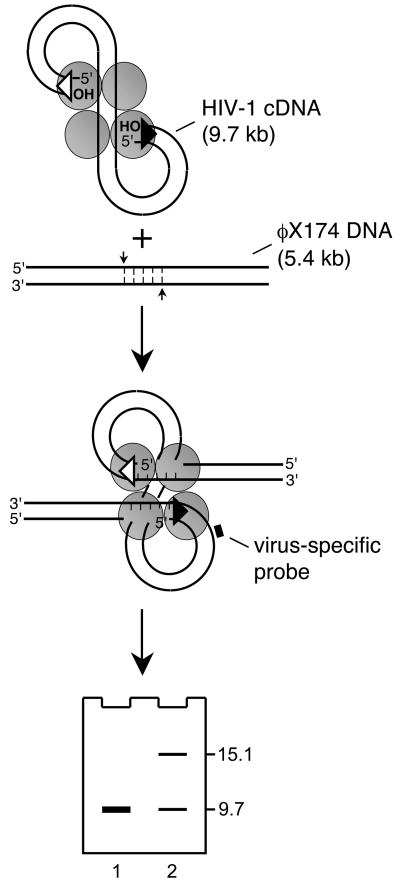
Southern blot assay for PIC function. Integration of 9.7 kb HIV-1 cDNA into linearized 5.4 kb φX174 yields a 15.1 kb DNA recombination intermediate. Reaction mixtures following deproteinization are fractionated by agarose gel electrophoresis. After Southern blotting with a virus-specific probe, DNA strand transfer activity is defined as the percent of cDNA substrate converted into reaction product (lane 2; φX174 DNA was omitted from the integration reaction analyzed in lane 1). Though integration occurs essentially throughout the φX174 genome, the resulting population of recombinants displays an electrophoretic mobility consistent with linear double-stranded 15.1 kb DNA.
Fig. 4
Fig. 4
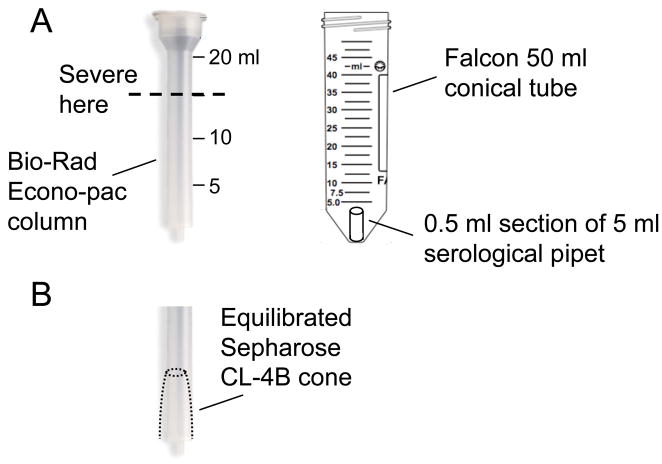
Partial PIC purification by spin column chromatography. (A) To accommodate the Bio-Rad Econo-Pac column in an appropriate centrifuge, it may be necessary to severe off the top as indicated. An approximate 0.5 ml section of a 5 ml serological pipet is used to prop the column up from the bottom of a 50 ml conical tube during centrifugation. (B) The spun bed should appear as a contracted cone with flattened top.
Fig. 5
Fig. 5
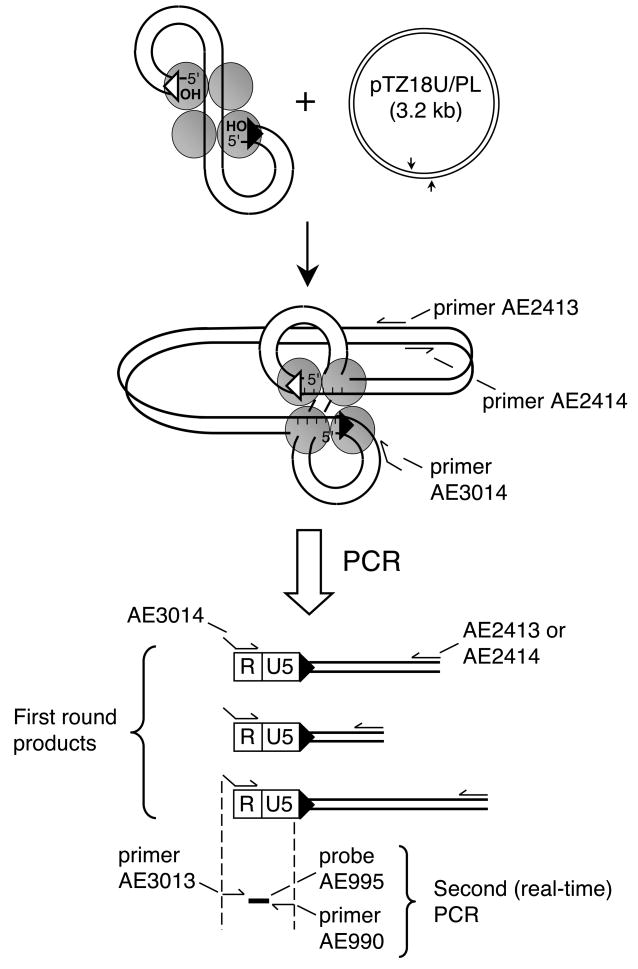
PCR assay for PIC function. Integration of HIV-1 cDNA (9.7 kb) into circular 3.2 kb pTZ18U/PL yields a 12.9 kb circular DNA recombination intermediate. Following deproteinization, reaction mixtures are subjected to two PCR rounds to specifically amplify newly-formed HIV-target DNA junctions. Primers AE2413 and AE2414 anneal to opposite strands of pTZ18U/PL in tail-to-tail fashion [16], whereas primer AE3014 is a hybrid composed of lambda and HIV-1 R DNA sequences. First round reaction products are a population of fragments with a fixed viral R end abutting variably-lengthened pTZ18U/PL sequences. The level of HIV-1-specific DNA in this population is quantified in the second real-time PCR using primers AE3013 and AE990 with probe AE995.

References

    1. Fujiwara T, Mizuuchi K. Cell. 1988;54:497–504. - PubMed
    1. Brown PO, Bowerman B, Varmus HE, Bishop JM. Proc Natl Acad Sci USA. 1989;86:2525–2529. - PMC - PubMed
    1. Roth MJ, Schwartzberg PL, Goff SP. Cell. 1989;58:47–54. - PubMed
    1. Pauza C. Virology. 1990;179:886–889. - PubMed
    1. Lee YM, Coffin JM. Mol Cell Biol. 1991;11:1419–1430. - PMC - PubMed

Publication types

Substances

LinkOut - more resources