


Beneficial and harmful effects of anthracyclines in the treatment of childhood acute lymphoblastic leukaemia: a systematic review and meta-analysis
- PMID: 19236609
- PMCID: PMC2812732
- DOI: 10.1111/j.1365-2141.2009.07624.x
Beneficial and harmful effects of anthracyclines in the treatment of childhood acute lymphoblastic leukaemia: a systematic review and meta-analysis
Abstract
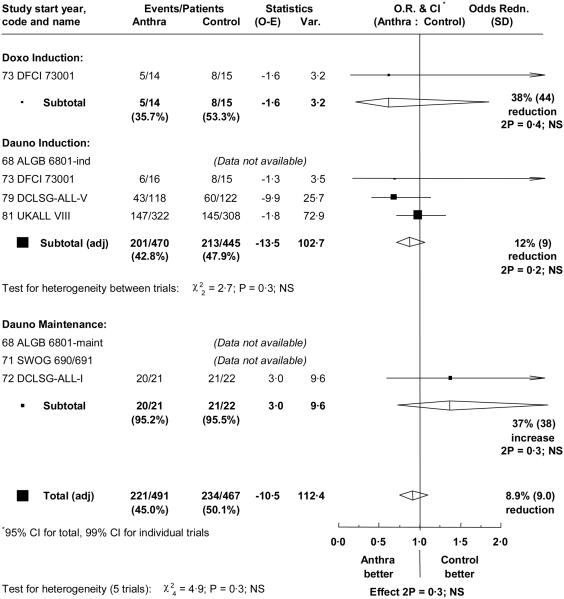
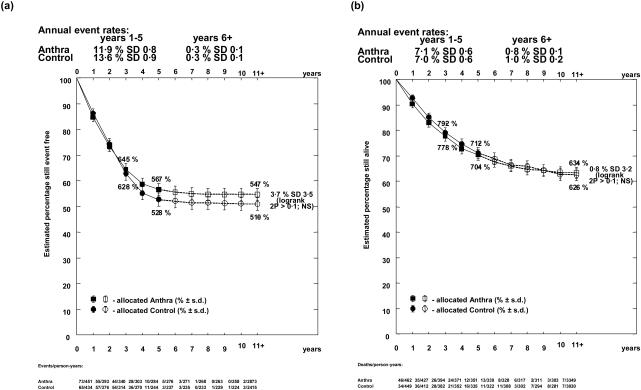
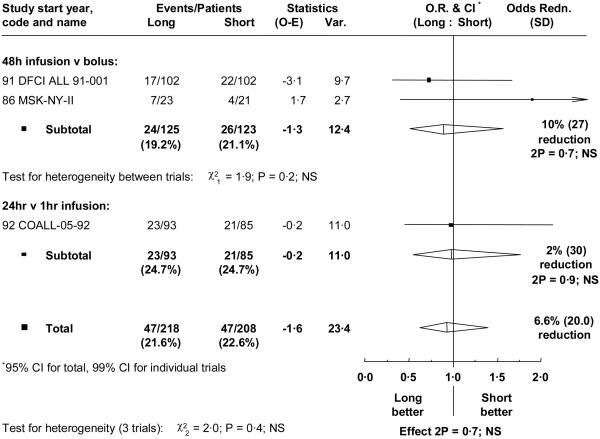
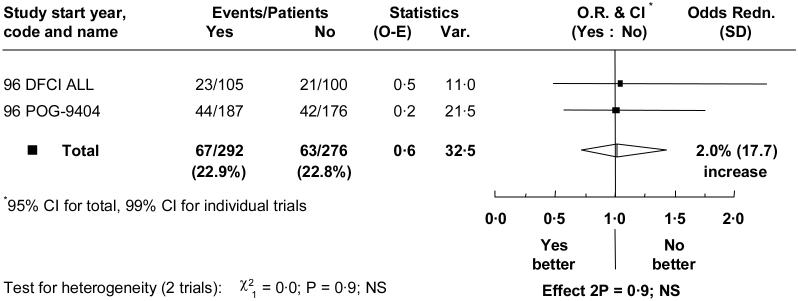
Anthracyclines are used to treat childhood acute lymphoblastic leukaemia (ALL) but non-randomized studies suggest that cardiotoxicity may be a problem. Individual patient data from trials in childhood ALL that randomized anthracyclines or methods of reducing cardiotoxicity were analysed by standard meta-analysis methods. Results were grouped and combined according to: addition of an anthracycline to standard therapy, type of anthracycline, mode of administration, and the use of a cardioprotectant. Data from 958 patients in 4 trials, recruiting between 1972 and 1984, showed that addition of an anthracycline reduced bone marrow relapse and, non-significantly, non-bone marrow relapse, resulting in an increased relapse-free interval. However there was a non-significant increase in induction failures, and in deaths in first remission. Event-free survival at 5 years was 56.7% with anthracycline versus 52.8% without (Odds Ratio = 0.91; 95% Confidence Interval = 0.76-1.10; P = 0.3). There were no significant differences found in other treatment comparisons. The limited data from trials did not demonstrate differences in clinically evident cardiotoxicity. Anthracyclines are effective against bone marrow relapse but have not been shown to significantly increase event free survival in childhood ALL. The evidence on type of anthracycline, method of administration or use of cardioprotectant was insufficient to be able to rule out important differences.
Figures
References
-
- Barry EV, Vrooman LM, Dahlberg SE, Neuberg DS, Asselin BL, Athale UH, Clavell LA, Larsen EC, Moghrabi A, Samson Y, Schorin MA, Cohen HJ, Lipshultz SE, Sallan SE, Silverman LB. Absence of secondary malignant neoplasms in children with high-risk acute lymphoblastic leukemia treated with dexrazoxane. Journal of Clinical Oncology. 2008;26:1106–11. - PubMed
-
- Batist G, Ramakrishnan G, Rao CS, Chandrasekharan A, Gutheil J, Guthrie T, Shah P, Khojasteh A, Nair MK, Hoelzer K, Tkaczuk K, Park YC, Lee LW. Reduced cardiotoxicity and preserved antitumor efficacy of liposome-encapsulated doxorubicin and cyclophosphamide compared with conventional doxorubicin and cyclophosphamide in a randomized, multicenter trial of metastatic breast cancer. Journal of Clinical Oncology. 2001;19:1444–54. - PubMed
-
- Bhutani M, Kumar L, Vora A, Bhardwaj N, Pathak AK, Singh R, Kochupillai V. Randomized study comparing 4′-epi-doxorubicin (epirubicin) versus doxorubicin as a part of induction treatment in adult acute lymphoblastic leukemia. American Journal of Hematology. 2002;71:241–7. - PubMed
-
- EBCTCG . In: Treatment of early breast cancer: worldwide evidence 1985-1990. by Early Breast Cancer Trialists' Collaborative Group, editor. Oxford University Press; 1990.
Publication types
MeSH terms
Substances
Grants and funding
LinkOut - more resources
Full Text Sources
