


Sensitizing regimens of (+/-)3, 4-methylenedioxymethamphetamine (ecstasy) elicit enduring and differential structural alterations in the brain motive circuit of the rat
- PMID: 19236907
- PMCID: PMC2669702
- DOI: 10.1016/j.neuroscience.2009.02.025
Sensitizing regimens of (+/-)3, 4-methylenedioxymethamphetamine (ecstasy) elicit enduring and differential structural alterations in the brain motive circuit of the rat
Abstract
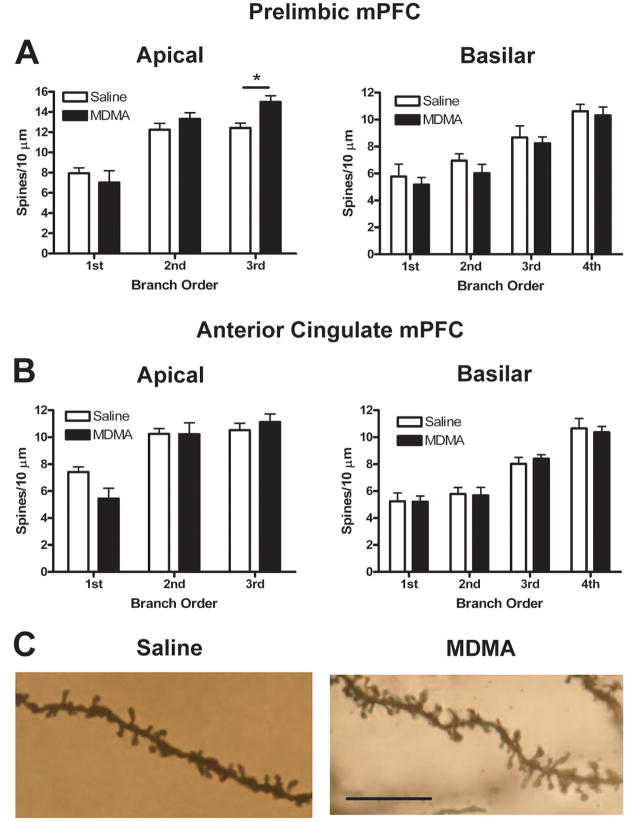
Repeated, intermittent exposure to the psychomotor stimulants amphetamine and cocaine induces a progressive and enduring augmentation of their locomotor-activating effects, known as behavioral sensitization, which is accompanied by similarly stable adaptations in the dendritic structure of cortico-striatal neurons. We examined whether repeated exposure to the increasingly abused amphetamine derivative 3,4-methylenedioxymethamphetamine (MDMA; ecstasy) also results in long-lasting behavioral and morphological changes in mesocortical (medial prefrontal cortex) and ventral striatal (nucleus accumbens) neurons. Rats received two daily injections of either 5.0 mg/kg (+/-)-MDMA or saline vehicle, approximately 6 h apart, for 3 consecutive days, followed by 4 drug-free days for a total of 3 weeks. Following a 4-week drug-free period, MDMA-pretreated rats displayed behavioral sensitization, as well as large increases in spine density and the number of multiple-headed spines on medium spiny neurons in core and shell subregions of nucleus accumbens. In medial prefrontal cortex, the prelimbic subregion showed increased spine density on distal dendrites of layer V pyramidal neurons, while the anterior cingulate subregion showed a change in the distribution of dendritic material instead. Collectively, our results show that long-lasting locomotor sensitization to MDMA is accompanied by reorganization of synaptic connectivity in limbic-cortico-striatal circuitry. The differential plasticity in cortical subregions, moreover, suggests that drug-induced structural changes are not homogeneous and may be specific to the circuitry underlying long-term changes in drug-seeking and drug-taking behavior.
Figures
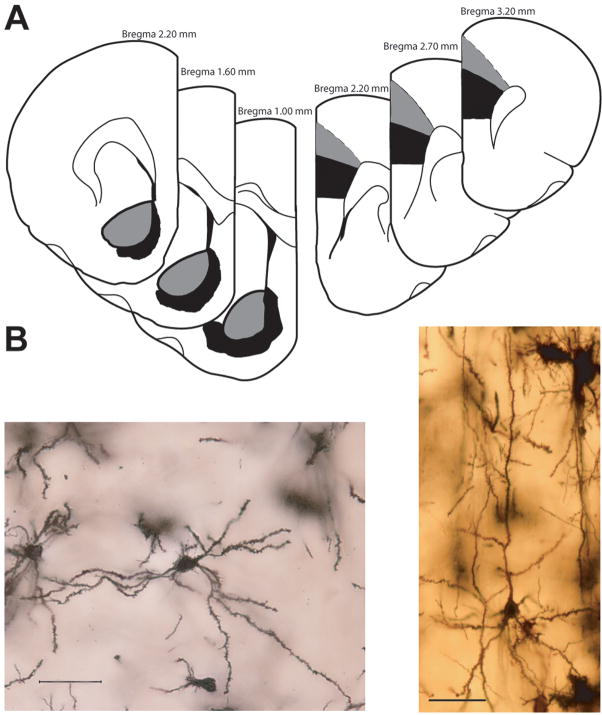
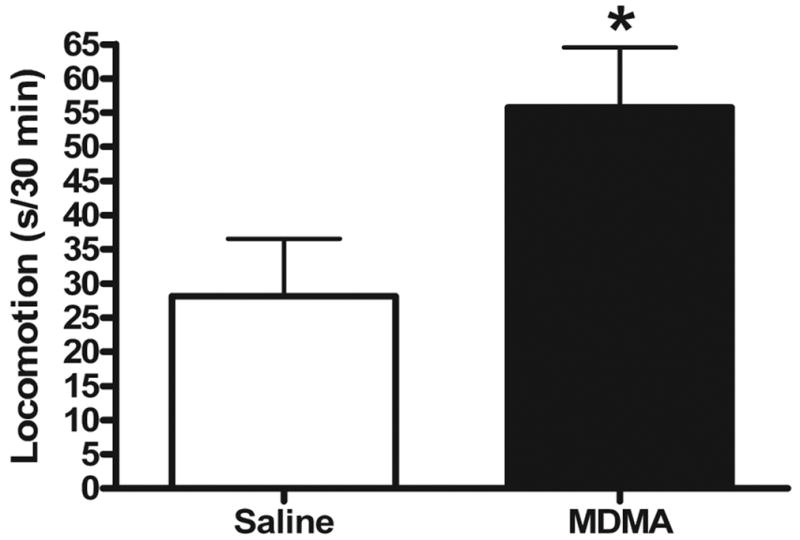
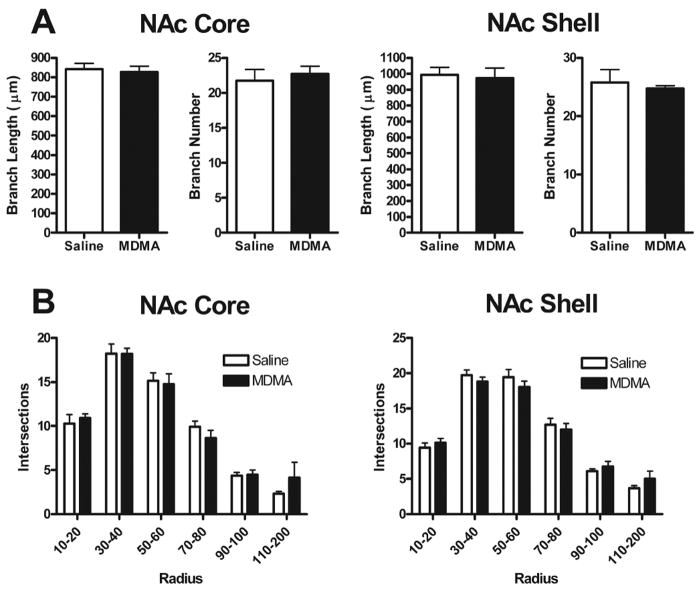

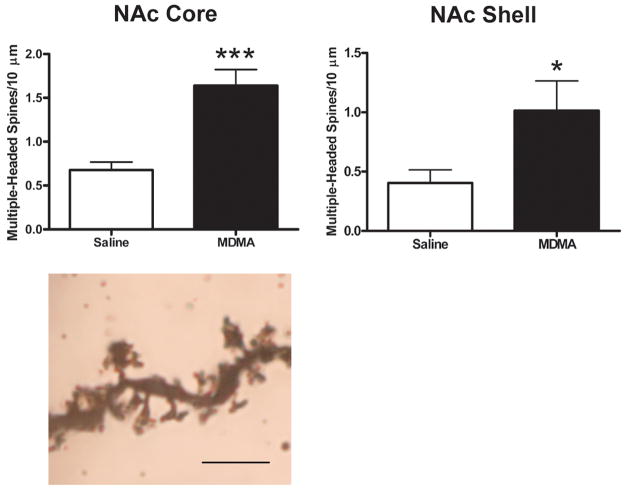

References
-
- Academies NRCotN. Guidelines for the care and use of mammals in neuroscience and behavioral research. Washington, DC: The National Academies Press; 2003. - PubMed
-
- Andersen P, Soleng AF. Long-term potentiation and spatial training are both associated with the generation of new excitatory synapses. Brain Res Rev. 1998;26:353–359. - PubMed
-
- Ball KT, Budreau D, Rebec GV. Acute effects of 3,4-methylenedioxymethamphetamine on striatal single-unit activity and behavior in freely moving rats: differential involvement of dopamine D(1) and D(2) receptors. Brain Res. 2003;994:203–215. - PubMed
-
- Ball KT, Budreau D, Rebec GV. Context-dependent behavioural and neuronal sensitization in striatum to MDMA (ecstasy) administration in rats. Eur J Neurosci. 2006;24:217–228. - PubMed
-
- Ball KT, Rebec GV. Role of 5-HT2A and 5-HT2C/B receptors in the acute effects of 3,4-methylenedioxymethamphetamine (MDMA) on striatal single-unit activity and locomotion in freely moving rats. Psychopharmacology. 2005;181:676–687. - PubMed
Publication types
MeSH terms
Substances
Grants and funding
LinkOut - more resources
Full Text Sources
Medical
