Clinical Trial
. 2009 Sep;64(9):763-9.
doi: 10.1136/thx.2008.110916. Epub 2009 Feb 22.

Adverse effects of salmeterol in asthma: a neuronal perspective

Affiliations
Clinical Trial

Adverse effects of salmeterol in asthma: a neuronal perspective

M Lommatzsch et al. Thorax. 2009 Sep.

Abstract

Background: Regular use of inhaled beta(2)-agonists has been associated with a paradoxical loss of asthma control and a deterioration of airway hyper-responsiveness, but the underlying mechanism is unknown. The neurotrophin brain-derived neurotrophic factor (BDNF) has recently been identified as a mediator of airway hyper-responsiveness in asthma.

Methods: Eighteen patients with mild allergic asthma who did not use any regular antiasthmatic therapy inhaled the long-acting beta(2)-agonist salmeterol for 2 weeks followed by 2 weeks of combination therapy with salmeterol and the corticosteroid fluticasone. Airway responsiveness to histamine and BDNF concentrations in blood were assessed prior to entry, after 14 days of salmeterol therapy and after 14 days of combination therapy. In a separate experiment, salmeterol effects on BDNF release by human peripheral blood mononuclear cells were assessed.

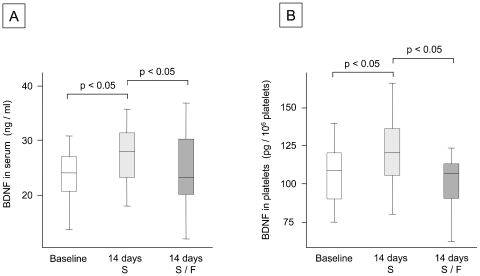
Results: Monotherapy with salmeterol significantly increased BDNF concentrations in serum and platelets. This increase was abolished by the addition of fluticasone to the treatment. The findings were confirmed in vitro: salmeterol increased the release of BDNF by mononuclear cells, and this was inhibited by co-incubation with fluticasone. Increased BDNF concentrations in serum and platelets correlated with the deterioration of airway hyper-responsiveness following salmeterol monotherapy. In contrast, there was no association between beta(2)-receptor polymorphisms and changes in airway responsiveness.

Conclusion: Increased BDNF concentrations may underly the adverse effects of salmeterol monotherapy on airway responsiveness in asthma.

Trial registration number: NCT00736801.


Conflict of interest statement

Competing interests: None.

Figures

Figure 1
Figure 1
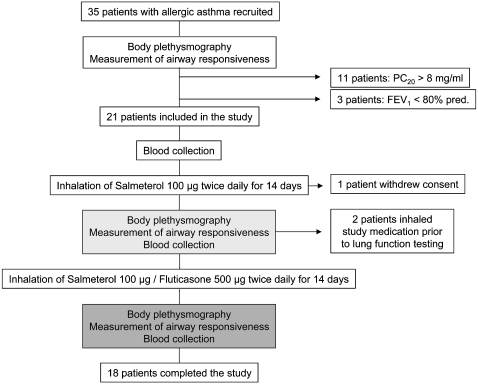
Study design. Body plethysmography, assessment of airway responsiveness to histamine and blood collection for brain-derived neurotrophic factor (BDNF) measurements were performed prior to entry (white box), after 14 days of salmeterol therapy (light grey box) and after 14 days of combination therapy (dark grey box). FEV1, forced expiratory volume in 1 s as a percentage of the predicted value (% pred.); PC20, provocative concentration of histamine causing a 20% fall in FEV1.
Figure 2
Figure 2
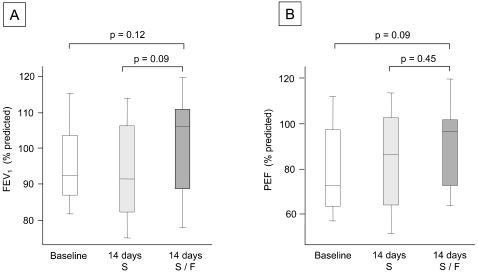
Lung function. Shown are forced expiratory volume in 1 s (FEV1; % predicted) values (A) and peak expiratory flow (PEF; % predicted) values (B) prior to entry (white box), after 14 days of salmeterol therapy (light grey box) and after 14 days of combination therapy (dark grey box) of n = 18 patients with allergic asthma. Boxplot graphs display the median (line within the box), interquartile range (edges of the box) and the range of all values less distant than 1.5 interquartile ranges from the upper or lower quartile (vertical lines). S, salmeterol; F, fluticasone.
Figure 3
Figure 3
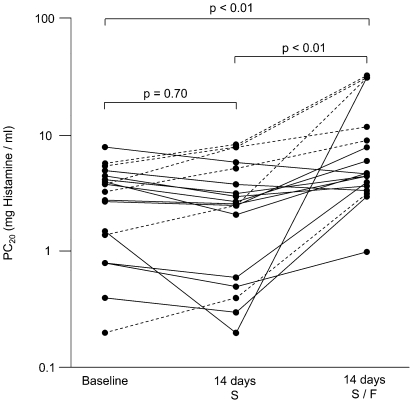
Airway responsiveness to histamine. PC20 (provocative concentration of histamine causing a 20% fall in the forced expiratory volume in 1 s) values are shown for each patient (n = 18 patients) prior to entry (Baseline), after 14 days of salmeterol therapy and after 14 days of combination therapy. Patients with a decrease in PC20 values after 14 days of salmeterol therapy are displayed with continuous lines. Patients with an increase in PC20 values after 14 days of salmeterol therapy are displayed with dashed lines. S, salmeterol; F, fluticasone.
Figure 4
Figure 4
Brain-derived neurotrophic factor (BDNF) concentrations in serum and platelets. Shown are BDNF concentrations in serum (ng BDNF/ml serum) and platelets (pg BDNF/10 platelets) prior to entry (white box), after 14 days of salmeterol monotherapy (light grey box) and after 14 days of combination therapy (dark grey box) of n = 18 patients with allergic asthma. Boxplot graphs display the median (line within the box), interquartile range (edges of the box) and the range of all values less distant than 1.5 interquartile ranges from the upper or lower quartile (vertical lines). S, salmeterol; F, fluticasone.
Figure 5
Figure 5
Association of brain-derived neurotrophic factor (BDNF) with changes in PC20 (provocative concentration of histamine causing a 20% fall in the forced expiratory volume in 1 s). Shown are correlations between changes in BDNF concentrations in serum (A) or platelets (B) and changes in the PC20 values (histamine) after 14 days of salmeterol therapy, as compared with the baseline before therapy. Each dot represents one patient; the line is the regression line calculated with SPSS (Chicago, Illinois, USA). Spearman’s rank correlation coefficient (r) and the significance of the correlation (p) are given above each graph.
Figure 6
Figure 6
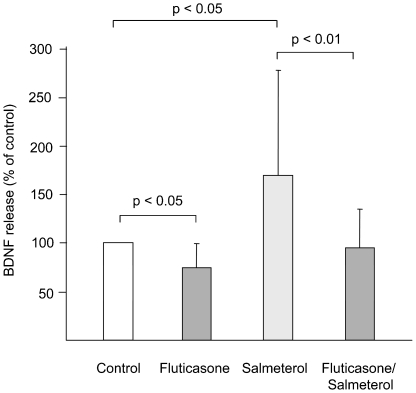
Brain-derived neurotrophic factor (BDNF) release by leucocytes in vitro. Monocyte-enriched human peripheral blood mononuclear cells of n = 22 healthy volunteers were stimulated with tumour necrosis factor α (TNFα, 50 ng/ml) for 24 h. Shown are BDNF concentrations (mean (SD)) in supernatants of wells containing fluticasone propionate (10−7 M), salmeterol xinafoate (10−7 M) and both fluticasone propionate (10−7 M) and salmeterol xinafoate (10−7 M), as compared with BDNF concentrations in the medium control.

Comment in

References

    1. Tattersfield AE, Knox AJ, Britton JR, et al. Asthma. Lancet 2002;360:1313–22 - PubMed
    1. Bateman ED, Hurd SS, Barnes PJ, et al. Global strategy for asthma management and prevention: GINA executive summary. Eur Respir J 2008;31:143–78 - PubMed
    1. Hasford J, Virchow JC. Excess mortality in patients with asthma on long-acting beta2-agonists. Eur Respir J 2006;28:900–2 - PubMed
    1. Taylor DR, Sears MR, Herbison GP, et al. Regular inhaled beta agonist in asthma: effects on exacerbations and lung function. Thorax 1993;48:134–8 - PMC - PubMed
    1. Crane J, Pearce N, Flatt A, et al. Prescribed fenoterol and death from asthma in New Zealand, 1981–83: case–control study. Lancet 1989;333:917–22 - PubMed

Publication types

MeSH terms

Associated data