. 2009 Feb 23;16(3):198-209.
doi: 10.1101/lm.1220309. Print 2009 Mar.

Chronic enhancement of CREB activity in the hippocampus interferes with the retrieval of spatial information

Affiliations

Chronic enhancement of CREB activity in the hippocampus interferes with the retrieval of spatial information

Jose Viosca et al. Learn Mem. .

Abstract

The activation of cAMP-responsive element-binding protein (CREB)-dependent gene expression is thought to be critical for the formation of different types of long-term memory. To explore the consequences of chronic enhancement of CREB function on spatial memory in mammals, we examined spatial navigation in bitransgenic mice that express in a regulated and restricted manner a constitutively active form of CREB, VP16-CREB, in forebrain neurons. We found that chronic enhancement of CREB activity delayed the acquisition of an allocentric strategy to solve the hidden platform task. The ability to turn on and off transgene expression allowed us to dissect the role of CREB in dissociable memory processes. In mice in which transgene expression was turned on during memory acquisition, turning off the transgene re-established the access to the memory trace, whereas in mice in which transgene expression was turned off during acquisition, turning on the transgene impaired memory expression in a reversible manner, indicating that CREB enhancement specifically interfered with the retrieval of spatial information. The defects on spatial navigation in mice with chronic enhancement of CREB function were not corrected by conditions that increased further CREB-dependent activation of hippocampal memory systems, such as housing in an enriched environment. These results along with previous findings in CREB-deficient mutants indicate that the relationship of CREB-mediated plasticity to spatial memory is an inverted-U function, and that optimal learning in the water maze requires accurate regulation of this pathway.


Figures
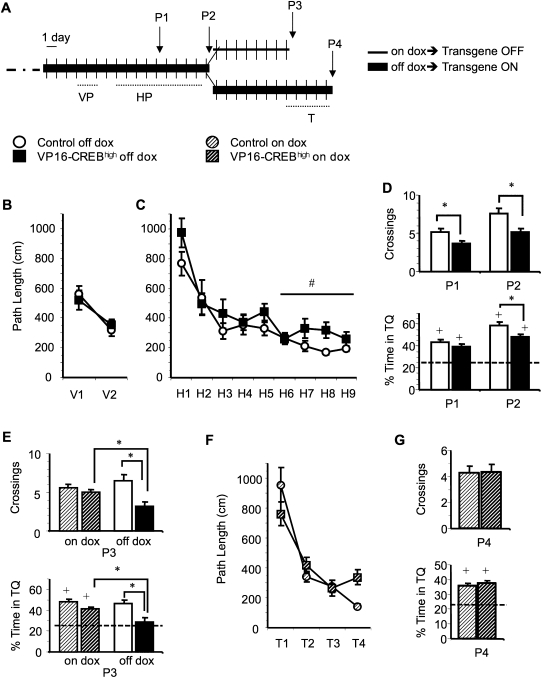
Figure 1.
Figure 1.
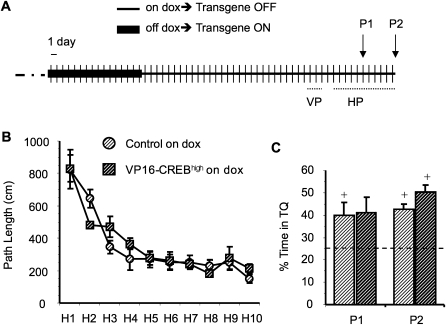
VP16-CREBhigh mice show impaired spatial memory in the water maze. (A) Schematic summary of the experimental protocol. VP16-CREBhigh (n = 35) and control mice (n = 21) were trained in the visible platform (VP) and hidden platform (HP) tasks using a four-trial per day protocol. Dox was removed from the mouse diet 3 d before starting the VP task (8 d before training in the HP task). Probe trials to assess memory acquisition were performed before training on day H5 (P1) and 24 h after concluding training in the hidden platform task (P2). After P2 (day 10 of the HP task), a randomly selected subgroup of VP16-CREBhigh mice (18) and control littermates (15) were fed again with dox food to turn off transgene expression and assess the reversal of memory deficits. The remaining 23 mice (17 VP16-CREBhigh mice and six control siblings) were kept off dox. One week later, we performed an additional probe trial (P3) and started to train the same mice using a new platform location. (T) Transfer task. A last probe trial (P4) was performed 24 h after training on T4. (B) Mice from both genotypes showed similar acquisition curves during training in the visible platform task. (C) Both genotypes also showed similar learning during the first week of training in the hidden platform task. However, VP16-CREBhigh mice failed to improve their performance as much as control littermates during the second week of training. (D) Spatial memory for the HP task was assessed in two probe trials (P1 and P2). Mice expressing constitutively active CREB spent less time in the TQ in P2 than control siblings. The analysis of annulus crossings revealed significant deficits both in P1 and in P2 (top), whereas the analysis of percentage of time in TQ only revealed significant changes in P2 (bottom). (E) The memory defect of bitransgenic mice was readily reversed by turning off transgene expression before performing a third probe trial (P3). This reversal was observed both in the number of annulus crossings (top) and percentage of time in the TQ (bottom). (Left) Mice on dox (transgene turned off); (right) mice off dox (transgene turned on). (F) Bitransgenic mice fed with dox after the second probe trial performed similarly to control littermates in the transfer task. (G) Bitransgenic animals did not show significant defects in annulus crossings (top) and time spent in the TQ (bottom) in the fourth probe trial. (#) Significant difference between genotypes in sessions H5–H9 (P < 0.05, repeated measures ANOVA); (*) significant differences between groups (P < 0.05, t-test); (+) significantly different of the chance value 25% (P < 0.05, t-test).
Figure 2.
Figure 2.
Memory impairment depends on transgene expression. (A) Schematic summary of the experiment. VP16-CREBhigh (n = 6) and control mice (n = 8) were trained in the visible platform (VP, data not shown) and hidden platform (HP) tasks using a four-trial per day protocol. Both groups of mice were kept off dox for 15 d before starting the VP task. Probe trials to assess memory acquisition were performed before training on day H5 (P1) and 24 h after concluding training in the water maze (P2). (B) VP16-CREBhigh mice that had expressed the transgene for 2 wk acquired the task at a similar rate as control littermates. (C) No difference was observed in the two probe trials. (+) A percentage of time statistically different from the chance value 25% (P < 0.05, t-test).
Figure 3.
Figure 3.
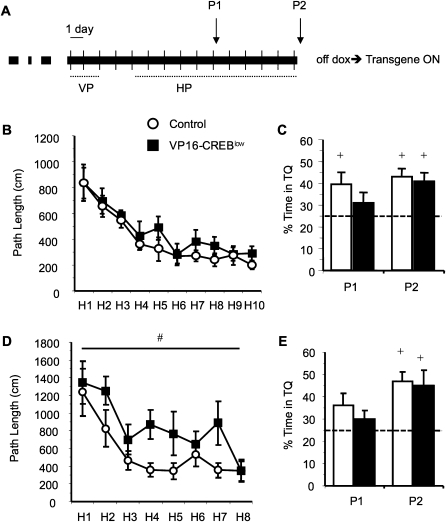
VP16-CREBlow mice show milder deficits in the water maze. (A) Schematic summary of the experimental protocol: VP16-CREBlow bitransgenic mice and control littermates raised and maintained in the absence of dox were trained in the visible (VP, data not shown) and hidden platform tasks (HP). Spatial memory was assessed in two probe trials, P1 and P2. Two independent experiments, in which training consisted of either four (B,C) or two trials (D,E) per day, were performed. (B) When four training trials were given daily (eight mice per genotype), VP16-CREBlow mice showed normal learning in the HP task. (C) No significant difference between genotypes was found in the two probe trials. However, VP16-CREBlow mice did not show a preference for the target quadrant in the first probe trial, whereas their control siblings already showed a significant preference. (D) In an independent experiment, the mice (nine mice per genotype) received only two trials per day. This made the task more difficult and VP16-CREBlow mice showed a significant learning delay in the HP task. (#) Significant genotype effect in repeated measures ANOVA. (E) No significant differences were found in the probe trials. (+) A percentage of time statistically different from the chance value 25% (P < 0.05, t-test).
Figure 4.
Figure 4.
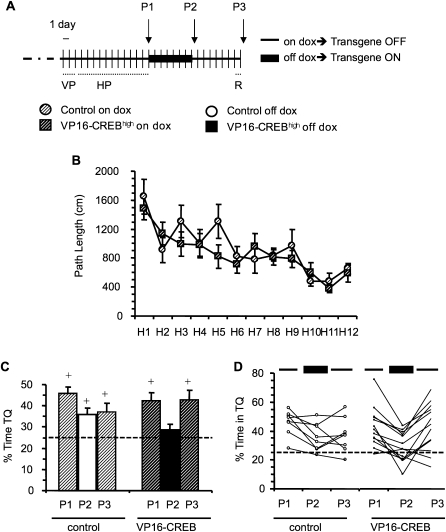
Impaired retrieval. (A) Schematic summary of the experiment. VP16-CREBhigh (n = 13) and control siblings (n = 8) maintained with dox-supplemented food were trained in the visible platform (VP, data not shown) and hidden platform (HP, three trails per day) tasks. Twenty-four hours after the last training session in the HP task, a probe trial was performed (P1). The same day, dox was removed from the mouse diet. Two additional probe trials (P2 and P3) were performed in order to assess the effect of turning on and off the transgene upon memory retrieval. A single training session was performed 24 h before P3 for memory reactivation, because we had found that 2 wk after training neither genotype showed a preference for the target quadrant. Spatial memory was assessed 24 h later. (B) Control and bitransgenic mice, in which VP16-CREB expression was turned off during training, showed similar learning in the visible and hidden platform tasks. (C) Both genotypes showed similar performance in the first probe trial (gene off). VP16-CREBhigh mice had a memory defect in the second probe trial (gene on) and did not show a preference for the target quadrant, whereas their control siblings did. A third probe trial was performed one week after turning off again transgene expression (i.e., 2 wk after concluding training in the HP task); both genotypes showed again a preference for the target quadrant in P3. Repeated measures ANOVA revealed a probe × genotype interaction between P2 and P3 confirming the recovery of VP16-CREBhigh mice when the transgene was turned off. (D) The plot of individual performances across the three probes shows a clearer quadratic tendency in the group of VP16-CREBhigh mice. (+) A percentage of time statistically different from chance (P < 0.05, t-test).
Figure 5.
Figure 5.
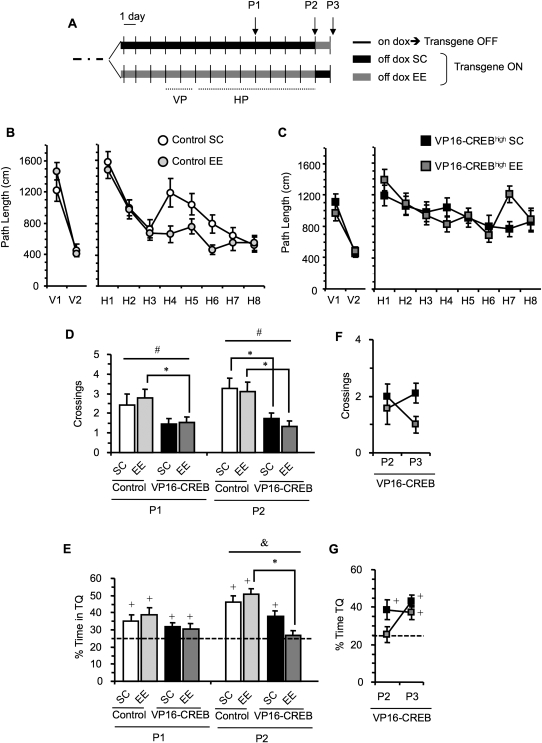
Effect of environmental enrichment in spatial memory. (A) Scheme of the protocol used. VP16-CREBhigh mice (n = 39) and control siblings (n = 38) were trained in the visible platform (VP) and hidden platform tasks (HP). Three days before starting training in the VP task, dox was removed from the mouse diet and half of the mice were housed in enriched environments (EE: 19 VP16-CREBhigh and 19 control littermates), while the other half remained in standard cages (SC: 20 VP16-CREBhigh and 19 control littermates). Spatial memory was assessed in three probe trials: P1 was performed before training on day H5, P2 was performed 24 h after finishing the 8-d training protocol in the HP task. In a subset of the animals (19 VP16-CREBhigh and 19 control littermates), the housing conditions were switched after P2 (VP16-CREBhigh SC→EE = 10, VP16-CREBhigh EE→SC = 9, control SC→EE = 9, and control EE→SC = 10). A third probe trial (P3) was performed 20 h later. (B) Environmental enrichment improved learning in control mice. (C) Both groups of bitransgenic mice showed poor learning. (D) VP16-CREBhigh mice showed reduced number of annulus crossings in P1 and P2. This deficit was especially significant in bitransgenic mice housed in an EE, although bitransgenics housed in SC also showed deficits in P2. (E) The analysis of time spent in the TQ revealed a significant genotype × housing interaction, indicating that environmental enrichment had a differential effect on the performance of control and VP16-CREB mice. Mutant mice housed in an EE, in addition, did not show memory for the platform location in P2. (F) Housing in an EE for 20 h reduced the number of annulus crossings in the VP16-CREB SC→EE group (dark square in P2, gray square in P3). (G) Placing the mice in standard cages ameliorated the deficit observed in %Time in TQ in the VP16-CREBhigh EE→SC group (gray square in P2, dark square in P3). Asterisks indicate statistical differences between groups. (*) P < 0.05; (&) a significant genotype × housing interaction; (#) a general effect of genotype; (+) a percentage of time statistically different from 25% (chance).
Figure 6.
Figure 6.
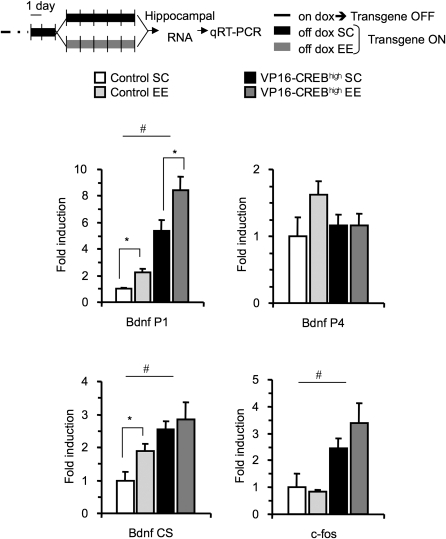
Synergistic effect of VP16-CREB and environmental enrichment on gene expression. VP16-CREBhigh and control mice were housed in an enriched environment (EE: five VP16-CREBhigh and three control littermates) or stayed in their standard cages (SC: four VP16-CREBhigh and four control littermates) for 5 d and were then sacrificed. Dox was removed from the mouse diet 2 d before enrichment. Hippocampal tissue was collected for analysis of gene expression by qRT-PCR using primer pairs targeted to bdnf and c-fos genes. Transcript levels of BDNF and c-fos were increased in VP16-CREB mice. BDNF expression was also enhanced by environmental enrichment. In the case of BDNF, specific primers were used for detecting the transcripts produced from promoter I (BDNF PI) and IV (BDNF P4), as well as primers targeted to a coding sequence common to all transcript (BDNF CS). (*) Significant differences between groups (P < 0.05, t-test); (#) overall differences between genotypes (two-way ANOVA).

References

    1. Aid T., Kazantseva A., Piirsoo M., Palm K., Timmusk T. Mouse and rat BDNF gene structure and expression revisited. J. Neurosci. Res. 2007;85:525–535. - PMC - PubMed
    1. Alarcon J.M., Barco A., Kandel E.R. Capture of the late phase of long-term potentiation within and across the apical and basilar dendritic compartments of CA1 pyramidal neurons: Synaptic tagging is compartment restricted. J. Neurosci. 2006;26:256–264. - PMC - PubMed
    1. Artola A., von Frijtag J.C., Fermont P.C., Gispen W.H., Schrama L.H., Kamal A., Spruijt B.M. Long-lasting modulation of the induction of LTD and LTP in rat hippocampal CA1 by behavioural stress and environmental enrichment. Eur. J. Neurosci. 2006;23:261–272. - PubMed
    1. Balschun D., Wolfer D.P., Gass P., Mantamadiotis T., Welzl H., Schutz G., Frey J.U., Lipp H.P. Does cAMP response element-binding protein have a pivotal role in hippocampal synaptic plasticity and hippocampus-dependent memory? J. Neurosci. 2003;23:6304–6314. - PMC - PubMed
    1. Barco A., Alarcon J.M., Kandel E.R. Expression of constitutively active CREB protein facilitates the late phase of long-term potentiation by enhancing synaptic capture. Cell. 2002;108:689–703. - PubMed

Publication types

MeSH terms

Substances

LinkOut - more resources