Risk factors for end-stage renal disease: 25-year follow-up
- PMID: 19237717
- PMCID: PMC2727643
- DOI: 10.1001/archinternmed.2008.605
Risk factors for end-stage renal disease: 25-year follow-up
Abstract
Background: Few cohort studies have focused on risk factors for end-stage renal disease (ESRD). This investigation evaluated the prognostic value of several potential novel risk factors for ESRD after considering established risk factors.
Methods: We studied 177 570 individuals from a large integrated health care delivery system in northern California who volunteered for health checkups between June 1, 1964, and August 31, 1973. Initiation of ESRD treatment was ascertained using US Renal Data System registry data through December 31, 2000.
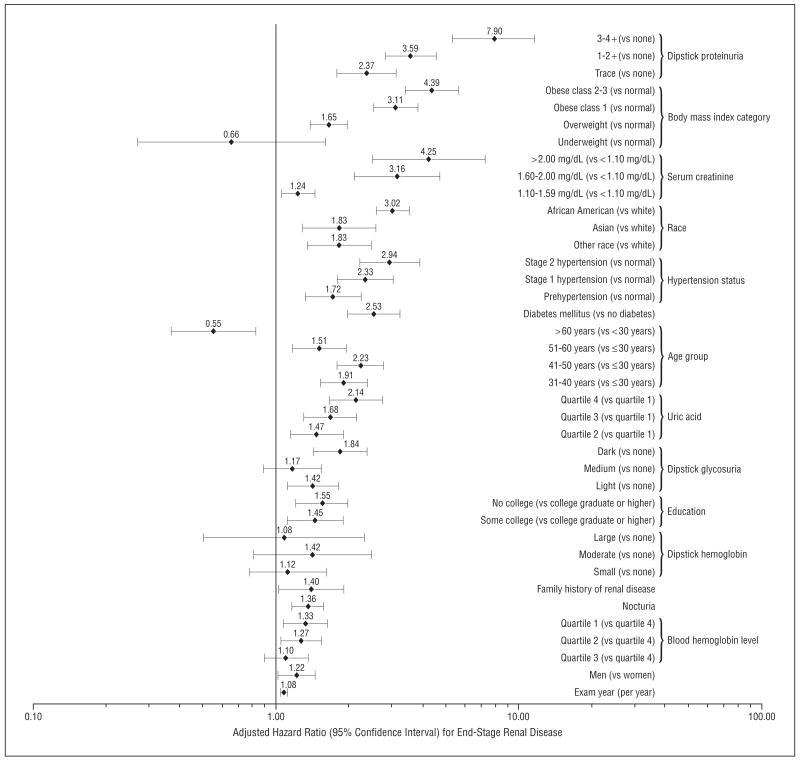
Results: A total of 842 cases of ESRD were observed during 5 275 957 person-years of follow-up. This comprehensive evaluation confirmed the importance of established risk factors, including the following: male sex, older age, proteinuria, diabetes mellitus, lower educational attainment, and African American race, as well as higher blood pressure, body mass index, and serum creatinine level. The 2 most potent risk factors were proteinuria and excess weight. For proteinuria, the adjusted hazard ratios (HRs) were 7.90 (95% confidence interval [CI], 5.35-11.67) for 3 to 4+ on urine dipstick, 3.59 (2.82-4.57) for 1 to 2+ on urine dipstick, and 2.37 (1.79-3.14) for trace vs negative on urine dipstick. For excess weight, the HRs were 4.39 (95% CI, 3.38-5.70) for class 2 to class 3 obesity, 3.11 (2.51-3.84) for class 1 obesity, and 1.65 (1.39-1.97) for overweight vs normal weight. Furthermore, several independent novel risk factors for ESRD were identified, including lower hemoglobin level (1.33 [1.08-1.63] for lowest vs highest quartile), higher serum uric acid level (2.14 [1.65-2.77] for highest vs lowest quartile), self-reported history of nocturia (1.36 [1.17-1.58]), and family history of kidney disease (HR, 1.40 [95% CI, 1.02-1.90]).
Conclusions: We confirmed the importance of established ESRD risk factors in this large cohort with broad sex and racial/ethnic representation. Lower hemoglobin level, higher serum uric acid level, self-reported history of nocturia, and family history of kidney disease are independent risk factors for ESRD.
Figures
References
-
- Gilbertson DT, Liu J, Xue JL, et al. Projecting the number of patients with end-stage renal disease in the United States to the year 2015 [published correction appears in J Am Soc Nephrol. 2006;17(2):591] J Am Soc Nephrol. 2005;16(12):3736–3741. - PubMed
-
- Rosenberg ME, Hsu CY. Chronic kidney disease and progression. NephSAP. 2004;3(6):304–308.
-
- Hsu CY, Schieppati A. Chronic kidney disease and progression. NephSAP. 2006;5(3):156–160.
-
- Hsu CY, McCulloch CE, Iribarren C, Darbinian J, Go AS. Body mass index and risk for end-stage renal disease. Ann Intern Med. 2006;144(1):21–28. - PubMed
-
- Reynolds K, Gu D, Muntner P, et al. Body mass index and risk of ESRD in China. Am J Kidney Dis. 2007;50(5):754–764. - PubMed
Publication types
MeSH terms
Substances
Grants and funding
LinkOut - more resources
Full Text Sources
Other Literature Sources
Medical