


The significance of non-sustained hypotension in emergency department patients with sepsis
- PMID: 19238354
- PMCID: PMC2923927
- DOI: 10.1007/s00134-009-1448-x
The significance of non-sustained hypotension in emergency department patients with sepsis
Abstract
Objective: Few studies have documented the incidence and significance of non-sustained hypotension in emergency department (ED) patients with sepsis. We hypothesized that ED non-sustained hypotension increases risk of in-hospital mortality in patients with sepsis.
Methods: Secondary analysis of a prospective cohort study. ED patients aged > 17 years admitted to the hospital with explicitly defined sepsis were prospectively identified.
Inclusion criteria: Evidence of systemic inflammation (> 1 criteria) and suspicion for infection. Patients with overt shock were excluded. The primary outcome was in-hospital mortality.
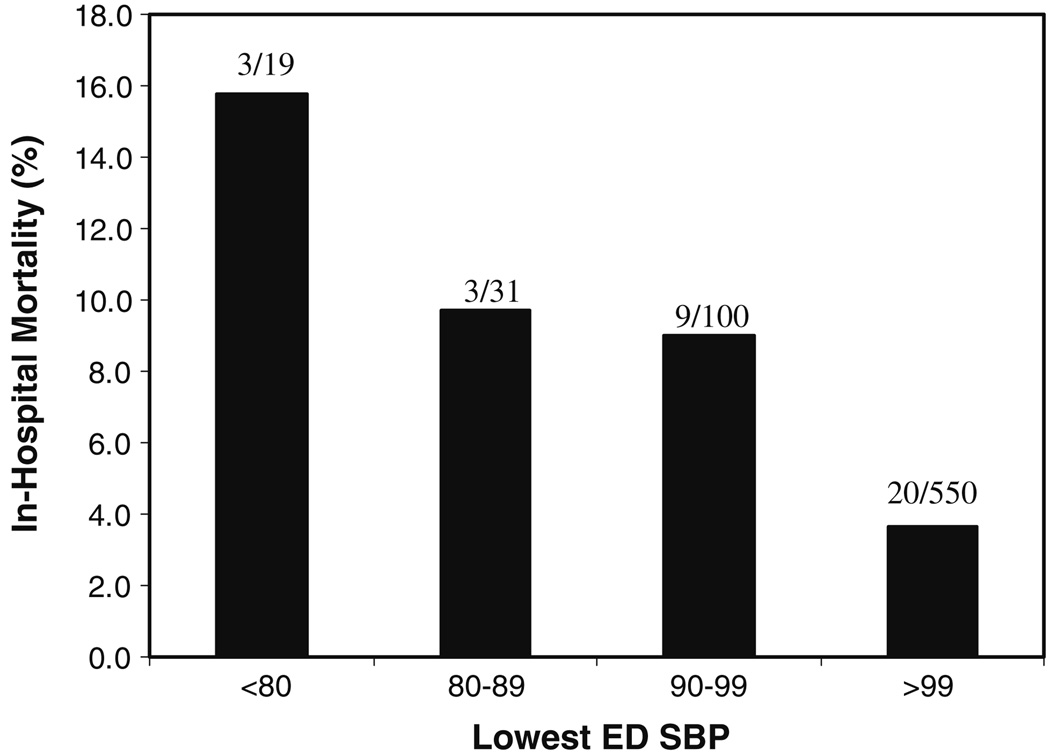
Results: Seven hundred patients with sepsis were enrolled, including 150 (21%) with non-sustained hypotension. The primary outcome of in-hospital mortality was present in 10% (15/150) of patients with non-sustained hypotension compared with 3.6% (20/550) of patients with no hypotension. The presence of non-sustained hypotension resulted in three times the risk of mortality than no hypotension (risk ratio = 2.8, 95% CI 1.5-5.2). Patients with a lowest systolic blood pressure < 80 mmHg had a threefold increase in mortality rate compared with patients with a lowest systolic blood pressure > or = 80 mmHg (5 vs. 16%). In logistic regression analysis, non-sustained hypotension was an independent predictor of in-hospital mortality.
Conclusion: Non-sustained hypotension in the ED confers a significantly increased risk of death during hospitalization in patients admitted with sepsis. These data should impart reluctance to dismiss non-sustained hypotension, including a single measurement, as not clinically significant or meaningful.
Figures
References
-
- Parrillo JE. Pathogenetic mechanisms of septic shock. N Engl J Med. 1993;328:1471–1477. - PubMed
-
- Levy MM, Fink MP, Marshall JC, Abraham E, Angus D, Cook D, Cohen J, Opal SM, Vincent JL, Ramsay G SCCM/ESICM/ACCP/ATS/SIS. 2001 SCCM/ESICM/ACCP/ATS/SIS international sepsis definitions conference. Intensive Care Med. 2003;29:530–538. - PubMed
-
- Guidet B, Aegerter P, Gauzit R, Meshaka P, Dreyfuss D on behalf of the CUB-Rea Study Group. Incidence and impact of organ dysfunctions associated with sepsis. Chest. 2005;127:942–951. - PubMed
-
- Silva E, Pedro M, Sogayar ACB, Mohovic T, Silva CL, Janiszewski M, Cal RG, de Sousa EF, Abe TP, de Andrade J, de Matos JD, Rezende E, Assuncao M, Avezum A, Rocha PCS, de Matos GFJ, Bento AM, Correa AD, Vieira PCBKE. Brazilian sepsis epidemiological study (BASES study) Crit Care. 2004;8:R251–R260. - PMC - PubMed
-
- The EPISEPSIS Study Group. EPISEPSIS: a reappraisal of the epidemiology and outcome of severe sepsis in French intensive care units. Intensive Care Med. 2004;30:580–588. - PubMed
MeSH terms
Grants and funding
LinkOut - more resources
Full Text Sources
Medical
Molecular Biology Databases
