


Phase I study of epirubicin, cisplatin and capecitabine plus matuzumab in previously untreated patients with advanced oesophagogastric cancer
- PMID: 19238629
- PMCID: PMC2538760
- DOI: 10.1038/sj.bjc.6604622
Phase I study of epirubicin, cisplatin and capecitabine plus matuzumab in previously untreated patients with advanced oesophagogastric cancer
Abstract
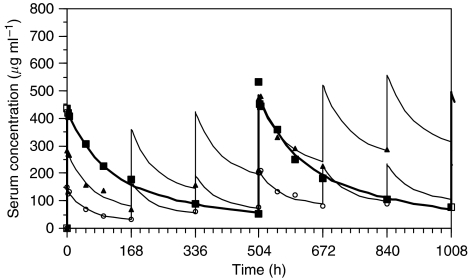
To evaluate the safety, tolerability, efficacy, pharmacokinetics and pharmacodynamics of the humanised antiepidermal growth factor receptor monoclonal antibody matuzumab combined with epirubicin, cisplatin and capecitabine (ECX) in patients as first-line treatment for advanced oesophagogastric cancer that express epidermal growth factor receptor (EGFR). This was a phase I dose escalation study of matuzumab at 400 and 800 mg weekly and 1200 mg every 3 weeks combined with ECX (epirubicin 50 mg m(-2), cisplatin 60 mg m(-2) on day 1 and capecitabine 1000 mg m(-2) daily). Patients were treated until disease progression, unacceptable toxicity or for a maximum of eight cycles. Twenty-one patients were treated with matuzumab at three different dose levels (DLs) combined with ECX. The main dose-limiting toxicity (DLT) was grade 3 lethargy at 1200 mg matuzumab every 3 weeks and thus 800 mg matuzumab weekly was the maximum-tolerated dose (MTD). Other common toxicities included rash, nausea, stomatitis and diarrhoea. Pharmacokinetic evaluation demonstrated that the coadministration of ECX did not alter the exposure of matuzumab. Pharmacodynamic studies on skin biopsies demonstrated inhibition of the EGFR pathway. Objective response rates of 65% (95% confidence interval (CI): 43-82), disease stabilisation of 25% (95% CI: 11-47) and a disease control rate (CR + PR + SD) of 90% were achieved overall. The MTD of matuzumab in combination with ECX was 800 mg weekly, and at this DL it was well-tolerated and showed encouraging antitumour activity. At the doses evaluated in serial skin biopsies, matuzumab decreased phosphorylation of EGFR and MAPK, and increased phosphorylation of STAT-3.
Figures

References
-
- Abubakr Y, Pautret V, Maurel J, Scheithauer W, Kroening H, Zubel A, Lutz M, Wong L, Sobrero A (2006) Cetuximab plus irinotecan for metastatic colorectal cancer (mCRC): safety analysis of 800 patients in a randomized phase III trial (EPIC). In American Society of Clinical Oncology Annual Meetings Proceedings Part 1, Vol. 24, No 18S (June 20 Supplement). pp 3556
-
- Albanell J, Rojo F, Averbuch S, Feyereislova A, Mascaro JM, Herbst R, LoRusso P, Rischin D, Sauleda S, Gee J, Nicholson RI, Baselga J (2002) Pharmacodynamic studies of the epidermal growth factor receptor inhibitor ZD1839 in skin from cancer patients: histopathologic and molecular consequences of receptor inhibition. J Clin Oncol 20: 110–124 - PubMed
-
- Amendt CMO, Peters M, Yezhelyev M, Jauch KW, Geissler E, Bruns CJ (2003) In vivo activity of humanised monoclonal anti-EGFR antibody EMD 72000 in combination with gemcitabine on growth of primary pancreatic tumours and metastases in an orthoptic nude mouse model. In American Association of Cancer Research, Vol. 44
-
- Burger AM, Kreysch HG, Schandelmaier K, Wirth G, Fiebig HH, Grell M (2003) The humanised monoclonal anti-EGFR antibody EMD 72000 potentially inhibits the growth of EGFR-expressing human tumour xenografts insensitive to chemotherapeutic drugs. In American Association for Cancer Research, Vol. 44, pp 5719
Publication types
MeSH terms
Substances
LinkOut - more resources
Full Text Sources
Medical
Research Materials
Miscellaneous
