


Review
doi: 10.1186/jbiol122.
Epub 2009 Feb 20.
Representations of odor plume flux are accentuated deep within the moth brain
Affiliations
- PMID: 19239722
- PMCID: PMC2687776
- DOI: 10.1186/jbiol122
Item in Clipboard
Review
Representations of odor plume flux are accentuated deep within the moth brain
J Biol.
2009.
Abstract
Odor space, the representation of odor quality in the insect brain, is known to be optimally resolved when lateral inhibitory pathways are functioning normally. A new study published in the Journal of Biology now shows that odor time resolution also depends on the normal functioning of such pathways.
Figures
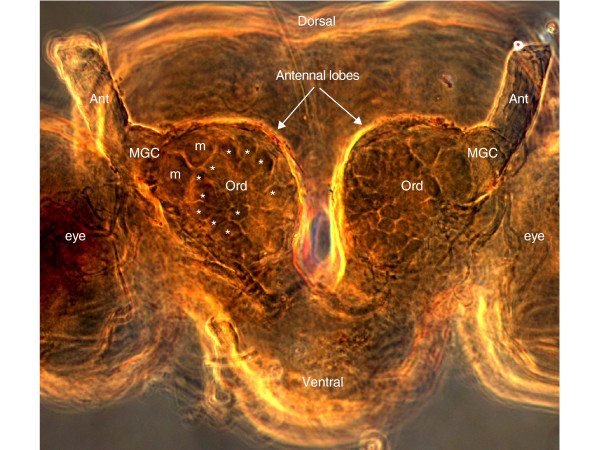
Frontal view of the face of a male Helicoverpa zea moth showing the two antennal lobes at the bases of the antennae. The preparation has been histologically cleared so that the many antennal lobe glomeruli are visible as spheroidal shapes. Asterisks denote 'ordinary' glomeruli that receive inputs from antennal neurons responding to general environmental odorants such as plant volatiles. The ordinary glomeruli reside in a large cluster in each antennal lobe (Ord). Larger glomeruli that receive inputs from pheromone component-tuned neurons on the antenna reside in their own cluster called the macroglomerular complex (MGC) and are labeled with an 'm'. Ant, the remaining bases of the antennae and antennal nerves; eye, optic lobe.
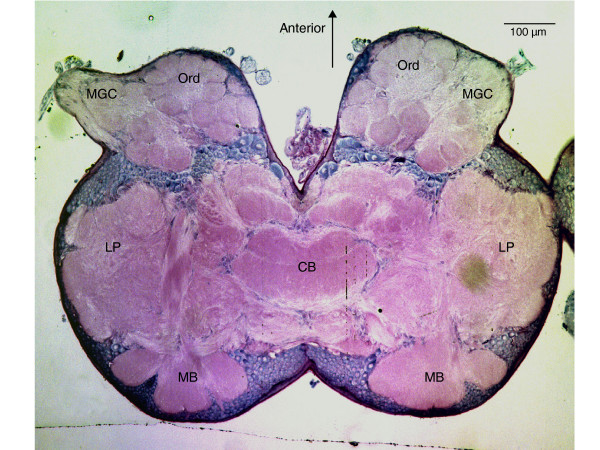
Top view of the head of a Helicoverpa zea male moth stained histologically to highlight the regions of the male moth brain involved with pheromone and other odorant signal processing and odor-quality discrimination. The anterior face of the moth is looking up toward the top of the figure. Sex pheromone information comes into the antennal lobe glomeruli of the macroglomerular complex (MGC) from the antenna. General odorant information comes from the antenna into the ordinary glomeruli (Ord) of the antennal lobe. Inhibitory GABA-ergic local interneurons form a network cross-linking all the antennal lobe glomeruli and help shape the relative levels of excitation emerging from each glomerulus via projection interneurons. The axons of these projection interneurons project in a single tract to the back of the brain to synapse first with neuropil in the mushroom body (MB) before continuing on to synapse with neurons in the lateral protocerebrum (LP). Axons of other projection neurons that also carry relative levels of excitation from antennal lobe glomeruli project in a second, different tract directly to the LP, bypassing the MB. The LP is where behavior-initiating descending interneurons synapse to send command signals to motor centers. Adapted from Lee et al. [11].
Comment on
-
Contrast enhancement of stimulus intermittency in a primary olfactory network and its behavioral significance.J Biol. 2009;8(2):21. doi: 10.1186/jbiol120. Epub 2009 Feb 20. J Biol. 2009. PMID: 19232128 Free PMC article.
References
-
- Murlis J. The structure of odor plumes. In: Payne TL, Kennedy CEJ, Birch MC, editor. Mechanisms in Insect Olfaction. Oxford: Clarendon Press; 1986. pp. 27–39.
-
- Baker TC, Vickers NJ. Pheromone-mediated flight in moths. In: Cardé RT, Minks AK, editor. Pheromone Research: New Directions. New York: Chapman and Hall; 1997. pp. 248–264.
Publication types
MeSH terms
Substances
LinkOut - more resources
Full Text Sources
