. 2009 May 8;284(19):12622-32.
doi: 10.1074/jbc.M900556200. Epub 2009 Feb 24.

The ubiquitin-interacting motif protein, S5a, is ubiquitinated by all types of ubiquitin ligases by a mechanism different from typical substrate recognition

Affiliations

The ubiquitin-interacting motif protein, S5a, is ubiquitinated by all types of ubiquitin ligases by a mechanism different from typical substrate recognition

Tomoaki Uchiki et al. J Biol Chem. .

Abstract

S5a/Rpn10 is a ubiquitin (Ub)-binding protein that is a subunit of the 26S proteasome but also exists free in the cytosol. It binds poly-Ub chains through its two Ub-interacting motifs (UIMs). We discovered that, unlike typical substrates of Ub ligases (E3s), S5a can be ubiquitinated by all E3s tested including multimeric and monomeric Ring finger E3s (MuRF1, Siah2, Parkin, APC, and SCF(betaTRCP1)), the U-box E3, CHIP, and HECT domain E3s (E6AP and Nedd4) when assayed with UbcH5 or related Ub-conjugating enzymes. However, the E2s, UbcH1 and UbcH13/Uev1a, which function by distinct mechanisms, do not support S5a ubiquitination. Thus, S5a can be used for assay of probably all E3s with UbcH5. Ubiquitination of S5a results from its binding to Ub chains on the E3 (after self-ubiquitination) or on the substrate, as a mutant lacking the UIM domain was not ubiquitinated. Furthermore, if the S5a UIM domains were fused to GST, the protein was rapidly ubiquitinated by MuRF1 and CHIP. In addition, polyubiquitination (but not monoubiquitination) of MuRF1 allowed S5a to bind to MuRF1 and accelerated S5a ubiquitination. This tendency of S5a to associate with the growing Ub chain can explain how S5a, unlike typical substrates, which are recognized by certain E3s through specific motifs, is ubiquitinated by all E3s tested and is rapidly degraded in vivo.


Figures

FIGURE 1.
FIGURE 1.
S5a can be ubiquitinated by various types of E3s with UbcH5. His10-S5a was incubated with various types of E3s for 60min as described under “Experimental Procedures.” A, ubiquitination by MuRF1 requires E1, E2, Ub, and ATP. S5a was probed by immunoblotting using an anti-His6 antibody. B, Siah2, MuRF1, CHIP, E6AP, and Nedd4 can all polyubiquitinate S5a. 35S-Labeled S5a (700cpm/pmol) was detected by autoradiography. C, ubiquitination of S5a by SCFβTRCP1 was assayed by immunoblotting using an anti-S5a antibody. D, ubiquitination of S5a by GST-MDM2 was assayed by immunoblotting with an anti-S5a antibody.
FIGURE 2.
FIGURE 2.
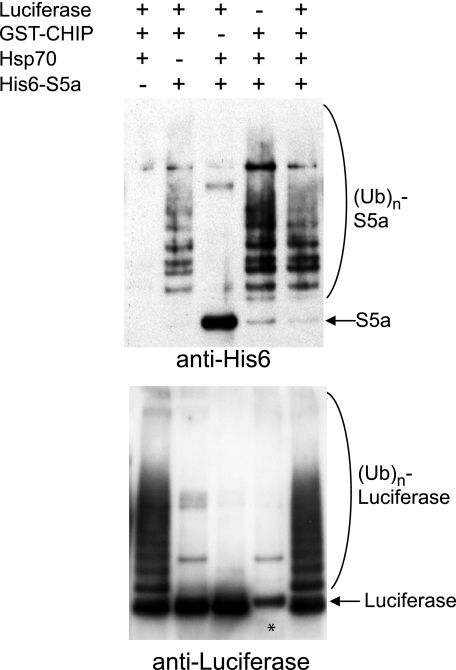
S5a ubiquitination by CHIP does not require Hsp70 unlike ubiquitination of a typical substrate, denatured luciferase. 200 nm His10-S5a or luciferase were ubiquitinated in the presence or absence of 200 nm Hsp70 for 60 min (before the ubiquitination reaction, 2 μm luciferase was denatured by preincubation with 2 μm Hsp70 at 43 °C for 10 min). S5a was ubiquitinated by CHIP even in the absence of Hsp70 or without heat-denaturation, whereas luciferase was ubiquitinated only in the presence of Hsp70. Ubiquitination of S5a and luciferase was assayed by immunoblotting with an anti-His6 or anti-luciferase antibody, respectively. The asterisk indicates that the anti-luciferase antibody cross-reacted with GST-MuRF1.
FIGURE 3.
FIGURE 3.
The rapid ubiquitination of S5a by MuRF1 or E6AP requires its UIM domains. His10-S5a and the mutants, which lack hydrophobic residues in either or both UIM domains (16), were incubated with MuRF1 (A) or E6AP (B) and UbcH5 for 60 min. S5a was probed by immunoblotting using an anti-His6 antibody. The asterisk shows His6-E1 present in the reaction.
FIGURE 4.
FIGURE 4.
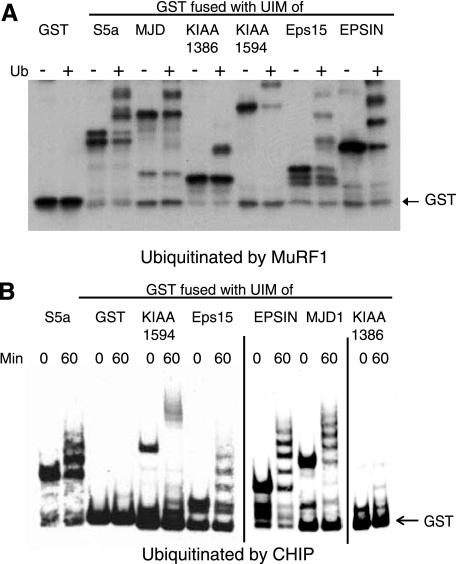
The attachments of a UIM domain from various UIM proteins to GST is sufficient to cause its ubiquitination by multiple E3s. GST or GST fused with UIM domains from S5a, Eps15, EPSIN, MJD1, KIAA1594, or KIAA1386 were subjected to ubiquitination by MuRF1 (A) or CHIP in the absence of molecular chaperones (B) with UbcH5 for 60 min. Ubiquitination of GST-UIMs was assayed by immunoblotting using an anti-GST antibody.
FIGURE 5.
FIGURE 5.
Self-ubiquitination of MuRF1 with UbcH5 accelerates ubiquitination of S5a but inhibits ubiquitination of troponin I. A, GST-MuRF1 was first self-ubiquitinated by incubation with UbcH5, ATP, E1, and E2 at 37 °C for 25 min, and then S5a was added. For comparison, MuRF1 with E1 and UbcH5 was incubated first without Ub, and then S5a and Ub were added to the reaction mixture. GST-MuRF1 (i) in the reaction was assayed using an anti-GST antibody and S5a (ii) with an anti His6 antibody. The asterisk shows His6-E1 present in the reaction. iii, unmodified S5a was quantified by densitometric analysis of the immunoblot image shown in Aii. B, a similar experiment was conducted with troponin I (TnI) in place of S5a, and GST-MuRF1 (i) or troponin I (ii) was probed by immunoblotting using an anti-GST or an anti-troponin I antibody respectively. iii, unmodified troponin I was quantified by densitometric analysis of the immunoblot image shown in Bii.
FIGURE 6.
FIGURE 6.
S5a binds to ubiquitinated MuRF1 but not unmodified MuRF1. A, GST-MuRF1 was immobilized on a glutathione resin and allowed to self-ubiquitinate for 30 min by incubation with UbcH5. The resulting Ubn-GST-MuRF1, GST-MuRF1 (unmodified), and GST on the glutathione resin were then incubated with 125I-labeled S5a (7500 cpm/pmol). i, S5a bound to the resin was measured using a gamma counter (the data represent averages of three replicates, and the error bar represents S.E.). ii, autoradiograph of the samples corresponding to Ai. iii, self-ubiquitination of the immobilized GST-MuRF1 corresponding to Ai is shown by immunoblotting with an anti-GST antibody. B, 125I-labeled S5a was incubated with E1, UbcH5, ATP, Ub, and GST-MuRF1 immobilized on glutathione resin. Aliquots were taken at different times, and radioactivity bound to the resin was analyzed by gamma counting (i) or autoradiography (ii). iii, self-ubiquitination of GST-MuRF1 in the same aliquots is shown by immunoblotting using an anti-GST antibody. As a control, the same procedure was performed with the reaction mixture lacking Ub.
FIGURE 7.
FIGURE 7.
Methylated Ub, although supporting monoubiquitination of MuRF1 and troponin I, does not support ubiquitination of S5a unless the E3, MuRF1, is first polyubiquitinated. A, His10-S5a and troponin I were ubiquitinated by GST-MuRF1 with methylated Ub (MeUb) or Ub for 60 min. Ubiquitination of His10-S5a was assayed by immunoblotting with anti-His6, troponin I (TnI) with anti-troponin I, and MuRF1 with anti-GST antibodies. B, to test if S5a can be conjugated to MeUb when MuRF1 is polyubiquitinated, GST-MuRF1 immobilized on the glutathione resin was first polyubiquitinated by incubation with E1, UbcH5, Ub, and ATP at 37 °C for 30 min. As a control, the immobilized GST-MuRF1 was preincubated similarly but without E1 and E2. The resin containing GST-MuRF1 was washed extensively and then incubated with S5a, E1, UbcH5, ATP, and MeUb at 37 °C for 60 min (lanes 4 and 8). No Ub was added to a set of reaction mixtures (lanes 2 and 6) to show that the washing after the first incubation was complete. In parallel, Ub was added to another set of reaction mixtures (lanes 3 and 7) to confirm that the GST-MuRF1 retained its activity after the first incubation. The asterisk shows His6-E1 present in the reaction.
FIGURE 8.
FIGURE 8.
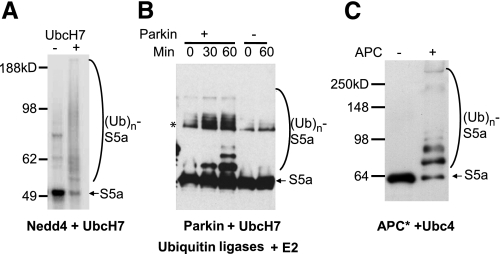
Other Class I E2s, UbcH7, and Ubc4 can support ubiquitination of S5a. S5a was ubiquitinated as described in Fig. 1 using UbcH7 or Ubc4 as the E2 for 60 min. A, ubiquitination by Nedd4 with UbcH7. 125I-Labeled S5a (7500 cpm/pmol) was detected by autoradiography. B, ubiquitination by Parkin with UbcH7. S5a was probed by immunoblotting using an anti-S5a antibody. C, ubiquitination by Xenopus APC with Ubc4. S5a was probed by immunoblotting using an anti-S5a antibody.
FIGURE 9.
FIGURE 9.
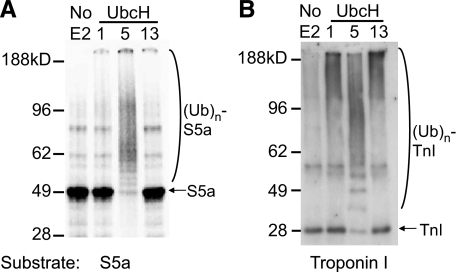
Unlike UbcH5, UbcH1 and UbcH13 cannot support ubiquitination of S5a by MuRF1, although they support ubiquitination of a typical MuRF1 substrate, troponin I. A, 125I-labeled S5a (7500 cpm/pmol) was incubated with MuRF1 and UbcH1, UbcH5a, or UbcH13/Uev1a for 120 min. S5a was detected by autoradiography. B, troponin I (TnI) was also ubiquitinated under the same conditions and probed by immunoblotting using an anti-troponin I antibody.
FIGURE 10.
FIGURE 10.
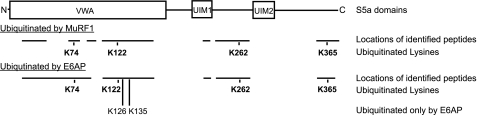
MuRF1 and E6AP attach ubiquitins to the same four lysines in S5a. S5a was ubiquitinated by MuRF1 or E6AP, and the proteins in the sample were resolved on SDS-PAGE and digested by trypsin. The tryptic peptides were analyzed by liquid chromatography-MS/MS using a LTQ-Orbitrap hybrid mass spectrometer, and the ubiquitination sites were identified by searching a data base using SEQUEAST. An increase in the mass of the Lys residues by 114.0429275 Da was considered as the ubiquitination signature. Twenty (with MuRF1) or 17 (by E6AP) Lys residues of a total 24 Lys residues in S5a were identified. Four Lys residues (Lys-74, -122, -262, and -365) were ubiquitinated by both E3s. Two additional Lys residues (Lys-126 and -135) were ubiquitinated by E6AP. The data represent two independent experiments for each E3, which yielded similar results.
FIGURE 11.
FIGURE 11.
The proposed mechanism of ubiquitination of S5a. S5a binds to growing Ub chain on the E3 and is ubiquitinated because of its proximity to the highly reactive Ub thioester. After multiple round of ubiquitination, S5a is supposedly released as our data (supplemental Fig. S2) showed that ubiquitination of S5a is a catalytic process.

References

    1. Glickman, M. H., and Ciechanover, A. (2002) Physiol. Rev. 82 373–428 - PubMed
    1. Goldberg, A. L. (2003) Nature 426 895–899 - PubMed
    1. Pickart, C. M. (2001) Annu. Rev. Biochem. 70 503–533 - PubMed
    1. Varshavsky, A. (1997) Genes Cells 2 13–28 - PubMed
    1. Nash, P., Tang, X., Orlicky, S., Chen, Q., Gertler, F. B., Mendenhall, M. D., Sicheri, F., Pawson, T., and Tyers, M. (2001) Nature 414 514–521 - PubMed

Publication types

MeSH terms