


Meta- and pooled analysis of GSTP1 polymorphism and lung cancer: a HuGE-GSEC review
- PMID: 19240225
- PMCID: PMC2727222
- DOI: 10.1093/aje/kwn417
Meta- and pooled analysis of GSTP1 polymorphism and lung cancer: a HuGE-GSEC review
Abstract
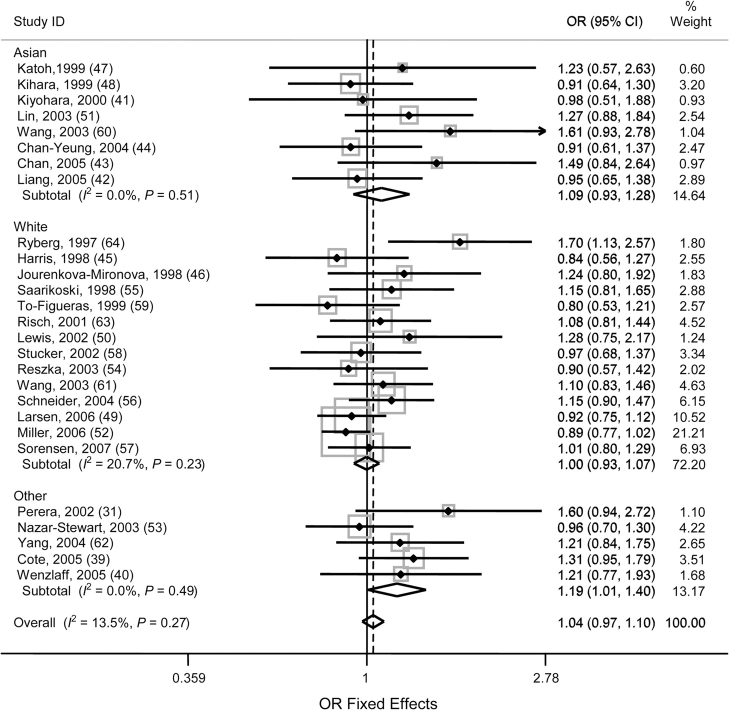
Lung cancer is the most common cancer worldwide. Polymorphisms in genes associated with carcinogen metabolism may modulate risk of disease. Glutathione S-transferase pi (GSTP1) detoxifies polycyclic aromatic hydrocarbons found in cigarette smoke and is the most highly expressed glutathione S-transferase in lung tissue. A polymorphism in the GSTP1 gene, an A-to-G transition in exon 5 (Ile105Val, 313A --> 313G), results in lower activity among individuals who carry the valine allele. The authors present a meta- and a pooled analysis of case-control studies that examined the association between this polymorphism in GSTP1 and lung cancer risk (27 studies, 8,322 cases and 8,844 controls and 15 studies, 4,282 cases and 5,032 controls, respectively). Overall, the meta-analysis found no significant association between lung cancer risk and the GSTP1 exon 5 polymorphism. In the pooled analysis, there was an overall association (odds ratio = 1.11, 95% confidence interval: 1.03, 1.21) between lung cancer and carriage of the GSTP1 Val/Val or Ile/Val genotype compared with those carrying the Ile/Ile genotype. Increased risk varied by histologic type in Asians. There appears to be evidence for interaction between amount of smoking, the GSTP1 exon 5 polymorphism, and risk of lung cancer in whites.
Figures
References
-
- Anttila S, Hirvonen A, Vainio H, et al. Immunohistochemical localization of glutathione S-transferases in human lung. Cancer Res. 1993;53(23):5643–5648. - PubMed
-
- Coles BF, Kadlubar FF. Detoxification of electrophilic compounds by glutathione S-transferase catalysis: determinants of individual response to chemical carcinogens and chemotherapeutic drugs? Biofactors. 2003;17(1–4):115–130. - PubMed
-
- Goto S, Iida T, Cho S, et al. Overexpression of glutathione S-transferase pi enhances the adduct formation of cisplatin with glutathione in human cancer cells. Free Radic Res. 1999;31(6):549–558. - PubMed
-
- Nakagawa K, Saijo N, Tsuchida S, et al. Glutathione-S-transferase pi as a determinant of drug resistance in transfectant cell lines. J Biol Chem. 1990;265(8):4296–4301. - PubMed
Publication types
MeSH terms
Substances
Grants and funding
LinkOut - more resources
Full Text Sources
Medical
Research Materials
Miscellaneous
