Total and unopposed estrogen exposure across stages of the transition to menopause
- PMID: 19240232
- PMCID: PMC2675575
- DOI: 10.1158/1055-9965.EPI-08-0996
Total and unopposed estrogen exposure across stages of the transition to menopause
Abstract
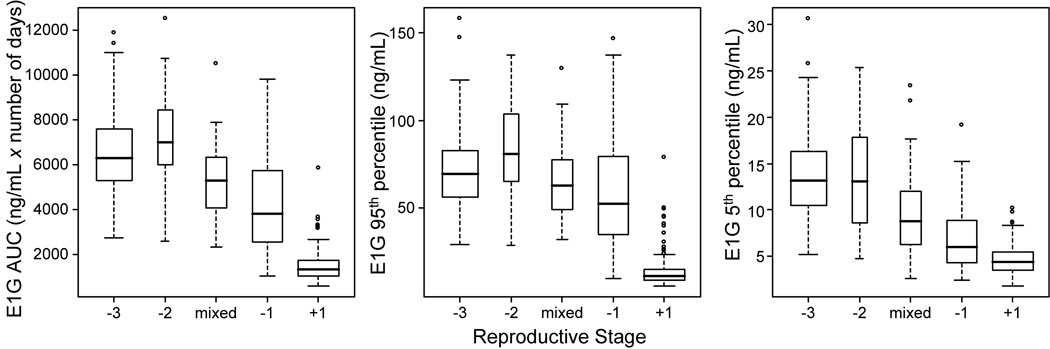
Detailed characterization of estrogen dynamics during the transition to menopause is an important step toward understanding its potential implications for reproductive cancers developing in the transition years. We conducted a 5-year prospective study of endogenous levels of total and unopposed estrogen. Participants (n=108; ages 25-58 years) collected daily urine specimens for 6 months in each of 5 consecutive years. Specimens were assayed for estrone-3-glucuronide (E1G) and pregnanediol-3-glucuronide. Linear mixed-effects models were used to estimate exposure to total and unopposed estrogen by age and reproductive stage. Reproductive stage was estimated using menstrual cycle length variance. E1G mean area under the curve and mean E1G 5th and 95th percentiles represented total estrogen exposure. An algorithm identifying days of above-baseline E1G that coincided with the days of baseline pregnanediol-3-glucuronide was used to identify days of unopposed estrogen. Mean E1G area under the curve increased with age in the pretransition and early transition and decreased in the late transition. Ninety-fifth percentile E1G levels did not decline until after menopause, whereas 5th percentile levels declined from the early transition to the postmenopause. The number of days of unopposed estrogen was significantly higher during the transition compared with the pretransition. Given the length of time women spend in the transition, they are exposed to more total and unopposed estrogen than has been previously appreciated. Coupled with epidemiologic evidence on lifetime exposure to estrogen, these results suggest that variation in the amount of time spent in the transition may be an important risk factor for reproductive cancers.
Figures


References
-
-
Surveillance, Epidemiology and End Results (SEER) Program (www.seer.cancer.gov), SEER*Stat Database: Incidence-SEER 17 Regs Limited-Use, Nov 2006 Sub (2000–2004), National Cancer Institute, DCCPS, Surveillance Research Program, Cancer Statistics Branch, released 2007, based on the November 2006 submission.
-
-
- Henderson BE, Ross RK, Pike MC, Casagrande JT. Endogenous hormones as a major factor in human cancer. Cancer Res. 1982;42:3232–3239. - PubMed
-
- Key TJ. Hormones and cancer in humans. Mutat Res. 1995;333:59–67. - PubMed
-
- Ursin G, Wilson M, Henderson BE, et al. Do urinary estrogen metabolites reflect the differences in breast cancer risk between Singapore Chinese and United States African-American and white women? Cancer Res. 2001;61:3326–3329. - PubMed
-
- Pike MC, Pearce CL, Peters R, Cozen W, Wan PC, Wu AH. Hormonal factors and the risk of invasive ovarian cancer: a population-based case-control study. Fertil Steril. 2004;82:186–195. - PubMed
Publication types
MeSH terms
Substances
Grants and funding
LinkOut - more resources
Full Text Sources
Medical