


Hospital anxiety and depression scale cutoff scores for cancer patients in acute care
- PMID: 19240713
- PMCID: PMC2661775
- DOI: 10.1038/sj.bjc.6604952
Hospital anxiety and depression scale cutoff scores for cancer patients in acute care
Abstract
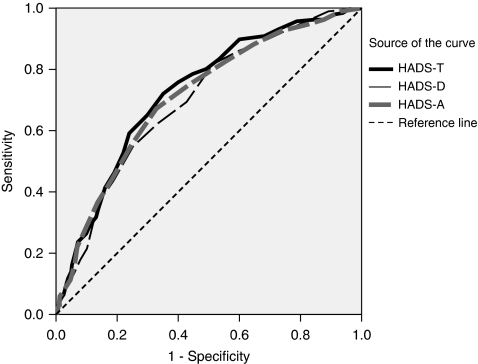
The aim of this study was to determine optimal cutoff scores for the Hospital Anxiety and Depression Scale (HADS) when used in evaluating cancer patients in acute care. A total of 689 cancer patients were assessed during their first days of in-patient treatment, using the structured clinical interview for DSM and the HADS. Statistical analysis was performed using ROC curves. A total of 222 patients (32%) had a mental disorder. The area under the curve was the best in the total scale of the HADS, namely 0.73. With a score of > or =13, it is possible to detect 76% of the cases with a specificity of .60, whereas 95% of the cases can be detected with a score of > or =6 (specificity 0.21). With scores of > or =16 and > or =22, recommended by the test authors for primary care, only 59 and 30% of the comorbid cancer patients are indicated. Lower HADS cutoff scores when preferable when evaluating cancer patients than are recommended for use in primary care. When using HADS in clinical practice and epidemiological studies, it is important to decide whether, for the task at hand, high detection rates of affected patients or low misclassification rates are more important.
Figures
References
-
- Adkins B, Titus-Howard T, Massey V, Washburn N, Molinaro J, Lang B, Bruning WL, Simmons S, Gerken P, Sommer V, LaNoue K, Rogers B, Wilson B (2005) Recognizing depression in cancer outpatients. Community Oncol 2: 528–533
-
- Arraras JI, Kuljanic-Vlasic K, Bjordal K, Yun YH, Efficace F, Holzner B, Mills J, Greimel E, Krauss O, Velikova G (2007) EORTC QLQ-INFO26: a questionnaire to assess information given to cancer patients – a preliminary analysis in eight countries. Psycho-Oncol 16: 249–254 - PubMed
-
- Atesci FC, Baltalarli B, Oguzhanoglu NK, Karadag F, Ozdel O, Karagoz N (2004) Psychiatric morbidity among cancer patients and awareness of illness. Support Care Cancer 12: 161–167 - PubMed
-
- Bjelland I, Dahl AA, Haug TT, Neckelmann D (2002) The validity of the hospital anxiety and depression scale: an updated literature review. J Psychosom Res 52: 69–77 - PubMed
-
- Boyes A, Newell S, Girgis A, McElduff P, Sanson-Fisher R (2006) Does routine assessment and real-time feedback improve cancer patients' psychosocial well-being? Eur J Cancer Care 15: 163–171 - PubMed
Publication types
MeSH terms
LinkOut - more resources
Full Text Sources
Other Literature Sources
Medical
