


Modeling "psychosis" in vitro by inducing disordered neuronal network activity in cortical brain slices
- PMID: 19241062
- PMCID: PMC2755104
- DOI: 10.1007/s00213-009-1484-9
Modeling "psychosis" in vitro by inducing disordered neuronal network activity in cortical brain slices
Abstract
Introduction: Dysregulation of neuronal networks has been suggested to underlie the cognitive and perceptual abnormalities observed schizophrenia.
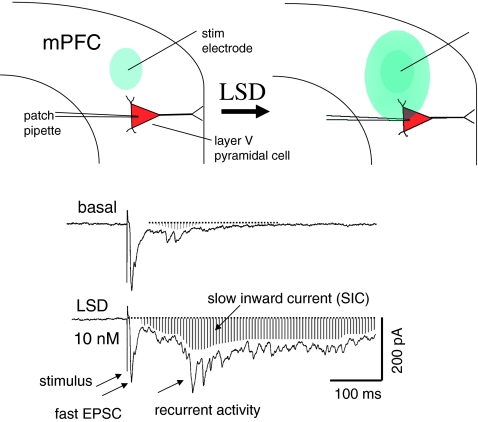
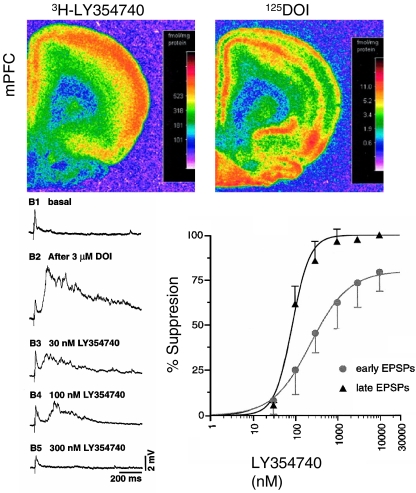
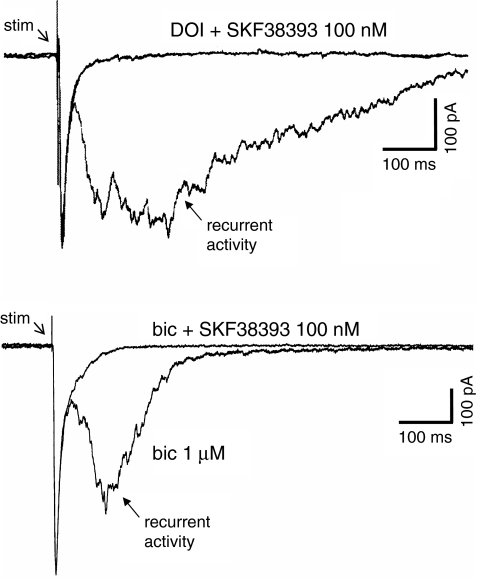
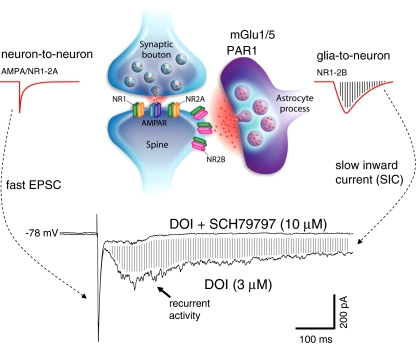
Discussions: An in vitro model of psychosis is proposed based on the two different approaches to cause aberrant network activity in layer V pyramidal cells of prefrontal brain slices: (1) psychedelic hallucinogens such as lysergic acid diethylamide and (2) minimal GABA(A) receptor antagonism, modeling the GABA interneuron deficit in schizophrenia. A test of this model would be to determine if drugs that normalize aberrant networks in brain slices have efficacy in the treatment of schizophrenia. Selective agonists of glutamate mGlu2/3 metabotropic receptors, which are highly effective in suppressing aberrant network activity in slices, are the most advanced toward reaching that clinical endpoint. In accord with the model, a recent phase II clinical trial shows that an mGlu2/3 receptor agonist is equivalent in efficacy to a standard antipsychotic drug for both negative and positive symptoms in schizophrenic patients, but without the usual side effects. D1/5 dopamine receptor agonists are also effective in normalizing aberrant network activity induced by both hallucinogens and minimal GABA(A) antagonism; clinical efficacy remains to be determined. A general model of network regulation is presented, involving astrocytes, GABA interneurons, and glutamatergic pyramidal cells, revealing a wide range of potential sites hitherto not considered as therapeutic targets.
Figures
References
-
- {'text': '', 'ref_index': 1, 'ids': [{'type': 'DOI', 'value': '10.1016/S0006-8993(00)02298-8', 'is_inner': False, 'url': 'https://doi.org/10.1016/s0006-8993(00)02298-8'}, {'type': 'PubMed', 'value': '10837822', 'is_inner': True, 'url': 'https://pubmed.ncbi.nlm.nih.gov/10837822/'}]}
- Abekawa T, Ohmori T, Ito K, Koyama T (2000) D1 dopamine receptor activation reduces extracellular glutamate and GABA concentrations in the medial prefrontal cortex. Brain Res 867:250–4 - PubMed
-
- {'text': '', 'ref_index': 1, 'ids': [{'type': 'DOI', 'value': '10.1177/1073858403252674', 'is_inner': False, 'url': 'https://doi.org/10.1177/1073858403252674'}, {'type': 'PubMed', 'value': '14580124', 'is_inner': True, 'url': 'https://pubmed.ncbi.nlm.nih.gov/14580124/'}]}
- Abi-Dargham A, Moore H (2003) Prefrontal DA transmission at D1 receptors and the pathology of schizophrenia. Neuroscientist 9:404–16 - PubMed
-
- {'text': '', 'ref_index': 1, 'ids': [{'type': 'DOI', 'value': '10.1016/S0028-3908(97)00051-8', 'is_inner': False, 'url': 'https://doi.org/10.1016/s0028-3908(97)00051-8'}, {'type': 'PubMed', 'value': '9225284', 'is_inner': True, 'url': 'https://pubmed.ncbi.nlm.nih.gov/9225284/'}]}
- Aghajanian GK, Marek GJ (1997) Serotonin induces excitatory postsynaptic potentials in apical dendrites of neocortical pyramidal cells. Neuropharmacology 36:589–599 - PubMed
-
- {'text': '', 'ref_index': 1, 'ids': [{'type': 'DOI', 'value': '10.1016/S0006-8993(99)01224-X', 'is_inner': False, 'url': 'https://doi.org/10.1016/s0006-8993(99)01224-x'}, {'type': 'PubMed', 'value': '10216183', 'is_inner': True, 'url': 'https://pubmed.ncbi.nlm.nih.gov/10216183/'}]}
- Aghajanian GK, Marek GJ (1999) Serotonin, via 5-HT2A receptors, increases EPSCs in layer V pyramidal cells of prefrontal cortex by an asynchronous mode of glutamate release. Brain Res 825:161–171 - PubMed
-
- {'text': '', 'ref_index': 1, 'ids': [{'type': 'DOI', 'value': '10.1016/S0165-0173(99)00046-6', 'is_inner': False, 'url': 'https://doi.org/10.1016/s0165-0173(99)00046-6'}, {'type': 'PubMed', 'value': '10719157', 'is_inner': True, 'url': 'https://pubmed.ncbi.nlm.nih.gov/10719157/'}]}
- Aghajanian GK, Marek GJ (2000) Serotonin model of schizophrenia: emerging role of glutamate mechanisms. Brain Res Rev 31:302–312 - PubMed
Publication types
MeSH terms
Substances
LinkOut - more resources
Full Text Sources
Other Literature Sources
Medical
