. 2009 Apr 2;458(7238):641-5.
doi: 10.1038/nature07746. Epub 2009 Feb 25.

Adaptation of HIV-1 to human leukocyte antigen class I

Affiliations

Adaptation of HIV-1 to human leukocyte antigen class I

Yuka Kawashima et al. Nature. .

Abstract

The rapid and extensive spread of the human immunodeficiency virus (HIV) epidemic provides a rare opportunity to witness host-pathogen co-evolution involving humans. A focal point is the interaction between genes encoding human leukocyte antigen (HLA) and those encoding HIV proteins. HLA molecules present fragments (epitopes) of HIV proteins on the surface of infected cells to enable immune recognition and killing by CD8(+) T cells; particular HLA molecules, such as HLA-B*57, HLA-B*27 and HLA-B*51, are more likely to mediate successful control of HIV infection. Mutation within these epitopes can allow viral escape from CD8(+) T-cell recognition. Here we analysed viral sequences and HLA alleles from >2,800 subjects, drawn from 9 distinct study cohorts spanning 5 continents. Initial analysis of the HLA-B*51-restricted epitope, TAFTIPSI (reverse transcriptase residues 128-135), showed a strong correlation between the frequency of the escape mutation I135X and HLA-B*51 prevalence in the 9 study cohorts (P = 0.0001). Extending these analyses to incorporate other well-defined CD8(+) T-cell epitopes, including those restricted by HLA-B*57 and HLA-B*27, showed that the frequency of these epitope variants (n = 14) was consistently correlated with the prevalence of the restricting HLA allele in the different cohorts (together, P < 0.0001), demonstrating strong evidence of HIV adaptation to HLA at a population level. This process of viral adaptation may dismantle the well-established HLA associations with control of HIV infection that are linked to the availability of key epitopes, and highlights the challenge for a vaccine to keep pace with the changing immunological landscape presented by HIV.


Figures
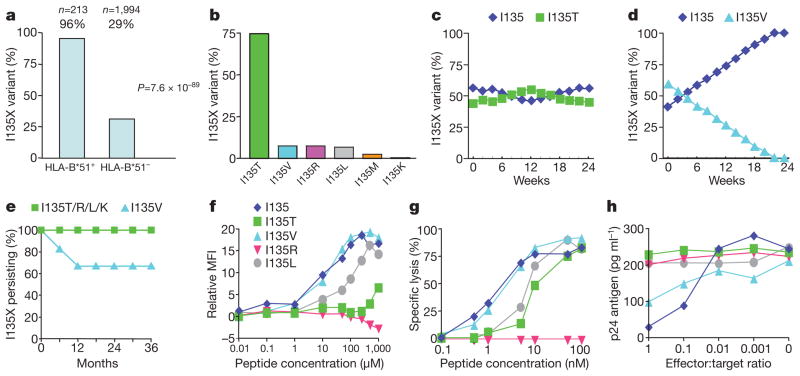
Figure 1
Figure 1. Selection and fitness cost of I135X escape variants and recognition by the HLA-B*51–TAFTIPSI (RT 128–135)-specific CD8+ T cells
a, Association between I135X and HLA-B*51 in all study cohorts. b, Ile 135 variation in HLA-B*51-positive subjects. c, d, In vitro competition assays between NL4-3 wild-type virus and I135X viral variants (I135T (c) and I135V (d)). I135R and I135L showed no fitness cost (not shown). e, Persistence of I135X mutants in 38 HLA-B*51-negative subjects followed from acute infection. f, TAFTIPSI variant binding to HLA-B*51 (see Methods). MFI, mean fluorescence intensity. g, h, Recognition of peptide-pulsed HLA-B*51-matched targets and viral variants by representative TAFTIPSI-specific CD8+ T-cell clones
Figure 2
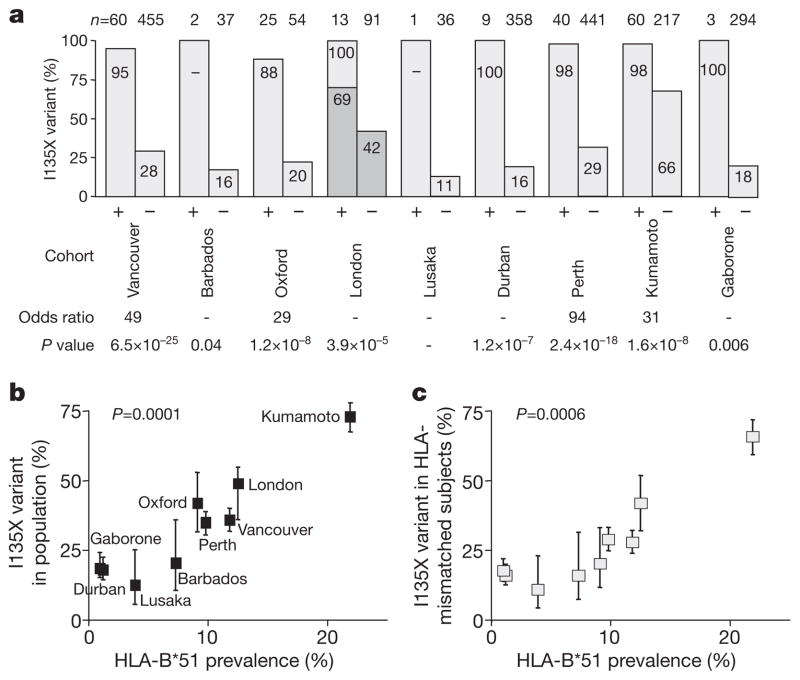
Figure 2. Correlation between frequency of HLA-B*51-associated escape mutations and HLA-B*51 prevalence in study cohorts
a, Frequency of I135X mutations within TAFTIPSI (RT 128–135) in HLA-B*51-positive (+) and -negative (−) subjects within nine study cohorts. In the acute cohort (London) 69% of HLA-B*51-positive subjects expressed I135X mutant at enrolment, 100% within 2 years of baseline (Supplementary Fig. 1). b, Correlation between frequency of I135X mutation and HLA-B*51 prevalence in the nine study populations. Logistic regression P = 0.0001 (Supplementary Table 1). c, Correlation between I135X frequency in HLA-B*51-negative subjects and HLA-B*51 prevalence in nine study populations. Error bars represent 95% confidence limits, obtained using a binomial error distribution.
Figure 3
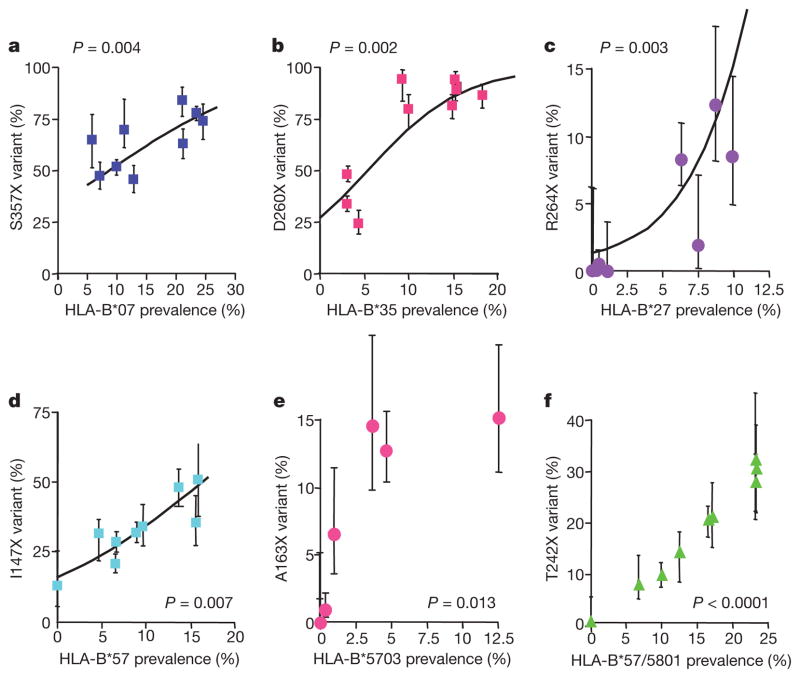
Figure 3. Correlation between frequency of HIV sequence variant and HLA prevalence for six additional well-characterized epitopes
P values calculated after logistic regression analysis as shown (calculations after linear regression analysis are shown in Supplementary Table 1). a, Frequency of the S357X mutation within the HLA-B*07-restricted epitope GPSHKARVL (Gag 355–363). b, Frequency of the D260X mutation within the HLA-B*35-restricted epitope PPIPVGDIY (Gag 254–262). c, Frequency of the R264X mutation within the HLA-B*27-restricted epitope KRWIILGLNK (Gag 263–272). d, Frequency of the I147X mutation within the HLA-B*57-restricted epitope ISPRTLNAW (Gag 147–155). e, Frequency of the A163X mutation associated with the HLA-B*5703-restricted epitope KAFSPEVIPMF (Gag 162–172). f, Frequency of the T242X mutation within the B*57/5801-restricted epitope TSTLQEQIAW (Gag 240–249). Error bars represent 95% confidence limits, obtained using a binomial error distribution.
Figure 4
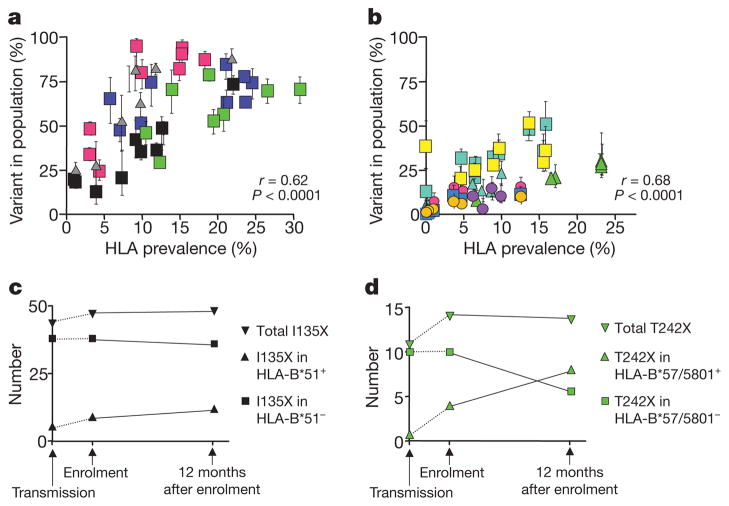
Figure 4. Correlation between HIV variant frequency and HLA prevalence for all epitopes studied
a, Correlation between HLA prevalence and the five stable, non-reverting variants (symbols in Figs 2 and 3, and Supplementary Fig. 3; grey triangles, I31V; green squares, D312X). b, Eight variants demonstrated to reduce viral fitness (see text, Fig. 3 and Supplementary Fig. 3; turquoise triangles, L268X; yellow squares. A146X; sky-blue squares, V168I; yellow circles, I247X). c, d, Data from acute London cohort. c, Number of HLA-B*51-positive and HLA-B*51-negative subjects carrying the non-reverting I135X variant. The percentage of I135X in HLA-B*51-negative subjects at enrolment (42%) assumed the percentage of I135X in all subjects at transmission (I135X frequency in HLA-B*51-positive subjects at enrolment was 69%, P = 0.07). d, The reverting HLA-B*57/5801-restricted T242X mutation. T242X frequency in HLA-B*57/5801-negative subjects at enrolment was 7%, versus 33% in HLA-B*57/5801-positive subjects (P = 0.01). Error bars represent 95% confidence limits, obtained using a binomial error distribution.

References

    1. Goulder PJR, Watkins DI. Impact of MHC class I diversity on immune control of immunodeficiency virus replication. Nature Rev Immunol. 2008;8:619–630. - PMC - PubMed
    1. Goulder PJR, et al. Evolution and transmission of stable CTL escape mutations in HIV infection. Nature. 2001;412:334–338. - PubMed
    1. Moore CB, et al. Evidence of HIV-1 adaptation to HLA-restricted immune responses at a population level. Science. 2002;296:1439–1443. - PubMed
    1. Draenert R, et al. Immune selection for altered antigen processing leads to cytotoxic T lymphocyte escape in chronic HIV-1 infection. J Exp Med. 2004;199:905–915. - PMC - PubMed
    1. Leslie AJ, et al. Transmission and accumulation of CTL escape variants drive negative associations between HIV polymorphisms and HLA. J Exp Med. 2005;201:891–902. - PMC - PubMed

Publication types

MeSH terms

Substances