Clinico-pathological discrepancies in the diagnosis of causes of maternal death in sub-Saharan Africa: retrospective analysis
- PMID: 19243215
- PMCID: PMC2646780
- DOI: 10.1371/journal.pmed.1000036
Clinico-pathological discrepancies in the diagnosis of causes of maternal death in sub-Saharan Africa: retrospective analysis
Abstract
Background: Maternal mortality is a major public-health problem in developing countries. Extreme differences in maternal mortality rates between developed and developing countries indicate that most of these deaths are preventable. Most information on the causes of maternal death in these areas is based on clinical records and verbal autopsies. Clinical diagnostic errors may play a significant role in this problem and might also have major implications for the evaluation of current estimations of causes of maternal death.
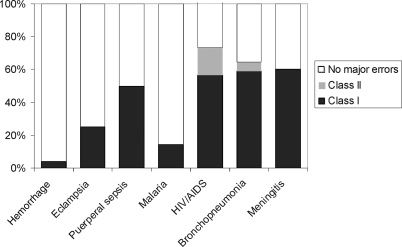
Methods and findings: A retrospective analysis of clinico-pathologic correlation was carried out, using necropsy as the gold standard for diagnosis. All maternal autopsies (n = 139) during the period from October 2002 to December 2004 at the Maputo Central Hospital, Mozambique were included and major diagnostic discrepancies were analyzed (i.e., those involving the cause of death). Major diagnostic errors were detected in 56 (40.3%) maternal deaths. A high rate of false negative diagnoses was observed for infectious diseases, which showed sensitivities under 50%: HIV/AIDS-related conditions (33.3%), pyogenic bronchopneumonia (35.3%), pyogenic meningitis (40.0%), and puerperal septicemia (50.0%). Eclampsia, was the main source of false positive diagnoses, showing a low predictive positive value (42.9%).
Conclusions: Clinico-pathological discrepancies may have a significant impact on maternal mortality in sub-Saharan Africa and question the validity of reports based on clinical data or verbal autopsies. Increasing clinical awareness of the impact of obstetric and nonobstetric infections with their inclusion in the differential diagnosis, together with a thorough evaluation of cases clinically thought to be eclampsia, could have a significant impact on the reduction of maternal mortality.
Conflict of interest statement
Figures
References
-
- Rutstein DD, Berenberg W, Chalmers TC, Child CG, III, Fishman AP, et al. Measuring the quality of medical care. A clinical method. N Engl J Med. 1976;294:582–588. - PubMed
-
- WHO. Maternal mortality in 2005: estimates developed by WHO, UNICEF UNFPA and the world bank. Geneva: WHO; 2004.
-
- AbouZahr C. Global burden of maternal death and disability. Br Med Bull. 2003;67:1–11. - PubMed
-
- Bartlett LA, Mawji S, Whitehead S, Crouse C, Dalil S, et al. Where giving birth is a forecast of death: maternal mortality in four districts of Afghanistan, 1999–2002. Lancet. 2005;365:864–870. - PubMed
-
- Geelhoed DW, Visser LE, Asare K, Schagen van Leeuwen JH, van RJ. Trends in maternal mortality: a 13-year hospital-based study in rural Ghana. Eur J Obstet Gynecol Reprod Biol. 2003;107:135–139. - PubMed