


Prevalence of refractive error among preschool children in an urban population: the Baltimore Pediatric Eye Disease Study
- PMID: 19243832
- PMCID: PMC2680482
- DOI: 10.1016/j.ophtha.2008.12.030
Prevalence of refractive error among preschool children in an urban population: the Baltimore Pediatric Eye Disease Study
Abstract
Purpose: To determine the age-specific prevalence of refractive errors in white and African-American preschool children.
Design: The Baltimore Pediatric Eye Disease Study is a population-based evaluation of the prevalence of ocular disorders in children aged 6 to 71 months in Baltimore, Maryland.
Participants: Among 4132 children identified, 3990 eligible children (97%) were enrolled and 2546 children (62%) were examined.
Methods: Cycloplegic autorefraction was attempted in all children with the use of a Nikon Retinomax K-Plus 2 (Nikon Corporation, Tokyo, Japan). If a reliable autorefraction could not be obtained after 3 attempts, cycloplegic streak retinoscopy was performed.
Main outcome measures: Mean spherical equivalent (SE) refractive error, astigmatism, and prevalence of higher refractive errors among African-American and white children.
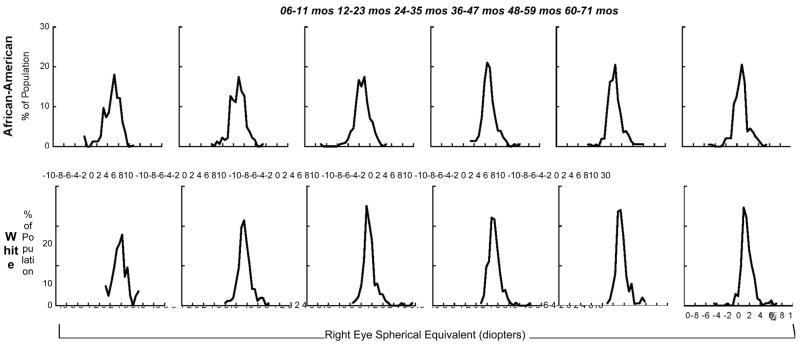
Results: The mean SE of right eyes was +1.49 diopters (D) (standard deviation [SD] = 1.23) in white children and +0.71 D (SD = 1.35) in African-American children (mean difference of 0.78 D; 95% confidence interval [CI], 0.67-0.89). Mean SE refractive error did not decline with age in either group. The prevalence of myopia of 1.00 D or more in the eye with the lesser refractive error was 0.7% in white children and 5.5% in African-American children (relative risk [RR], 8.01; 95% CI, 3.70-17.35). The prevalence of hyperopia of +3 D or more in the eye with the lesser refractive error was 8.9% in white children and 4.4% in African-American children (RR, 0.49; 95% CI, 0.35-0.68). The prevalence of emmetropia (<-1.00 D to <+1.00 D) was 35.6% in white children and 58.0% in African-American children (RR, 1.64; 95% CI, 1.49-1.80). On the basis of published prescribing guidelines, 5.1% of the children would have benefited from spectacle correction. However, only 1.3% had been prescribed correction.
Conclusions: Significant refractive errors are uncommon in this population of urban preschool children. There was no evidence for a myopic shift over this age range in this cross-sectional study. A small proportion of preschool children would likely benefit from refractive correction, but few have had this prescribed.
Conflict of interest statement
Figures
Comment in
-
Refractive error in preschool children.Ophthalmology. 2010 Jun;117(6):1278-9. doi: 10.1016/j.ophtha.2010.01.014. Ophthalmology. 2010. PMID: 20522341 No abstract available.
References
-
- Negrel AD, Maul E, Pokharel GP, Zhao J, Ellwein LB. Refractive error study in children: sampling and measurement methods for a multi-country survey. Am J Ophthalmol. 2000;129:421–6. - PubMed
-
- Zaho J, Pan X, Sui R, et al. Refractive error study in children: results from Shunyi District, China. Am J Ophthalmol. 2000;129:427–435. - PubMed
-
- Pokharel GP, Negrel AD, Munoz SR, Ellwein LB. Refractive error study in children: results from Mechi Zone, Nepal. Am J Ophthalmol. 2000;129:436–444. - PubMed
-
- Maul E, Barroso S, Munoz SR, et al. Refractive error study in children: results from La Florida, Chile. Am J Ophthalmol. 2000;129:445–454. - PubMed
-
- Murthy GVS, Gupta SK, Ellwein LB, et al. Refractive error in children in an urban population in New Delhi. Inves Ophthalmol Vis Sci. 2002;43:623–631. - PubMed
Publication types
MeSH terms
Substances
Grants and funding
LinkOut - more resources
Full Text Sources
Medical
