. 2009 May;329(2):718-28.
doi: 10.1124/jpet.108.149088. Epub 2009 Feb 24.

Studies of the biogenic amine transporters. 13. Identification of "agonist" and "antagonist" allosteric modulators of amphetamine-induced dopamine release

Affiliations

Studies of the biogenic amine transporters. 13. Identification of "agonist" and "antagonist" allosteric modulators of amphetamine-induced dopamine release

Richard B Rothman et al. J Pharmacol Exp Ther. 2009 May.

Abstract

Recent studies identified novel allosteric modulators of the dopamine (DA) transporter (DAT). N-(Diphenylmethyl)-2-phenyl-4-quinazolinamine (SoRI-9804), N-(2,2-diphenylethyl)-2-phenyl-4-quinazolinamine (SoRI-20040), and N-(3,3-diphenylpropyl)-2-phenyl-4-quinazolinamine (SoRI-20041) partially inhibited [(125)I]3beta-(4'-iodophenyl)tropan-2beta-carboxylic acid methyl ester (RTI-55) binding, slowed the dissociation rate of [(125)I]RTI-55 from the DAT, and partially inhibited [(3)H]dopamine uptake. In the present study, we report that SoRI-9804 and SoRI-20040, at doses that do not alter release, partially inhibited d-amphetamine-induced DAT-mediated release of [(3)H]1-methyl-4-phenylpyridinium (MPP(+))or[(3)H]dopamine from striatal synaptosomes ("DAT-mediated DA release") in a dose-dependent manner. SoRI-20041, which does not alter DAT-mediated DA release measured with [(3)H]DA, reversed the effect of SoRI-20040. SoRI-20040 and SoRI-9804 also partially inhibited DAT-mediated DA release induced by DA or (+/-)-3,4-methylenedioxyamphetamine, demonstrating that the observed partial inhibition is not specific for a particular DAT substrate. SoRI-9804 and SoRI-20040 did not attenuate D-amphetamine-induced release of [(3)H]5-hydroxytryptamine from serotonergic, or [(3)H]MPP(+) from noradrenergic, nerve terminals. Kinetic experiments demonstrated that SoRI-9804, in contrast to cocaine, slowed D-amphetamine-induced release of [(3)H]MPP(+) from dopaminergic nerve terminals without altering the apparent rate constants. The two major findings of this study are 1) the identification of both "agonist" (SoRI-9804 and SoRI-20040) and "antagonist" (SoRI-20041) allosteric modulators of D-amphetamine-induced DAT-mediated DA release and 2) [(3)H]DA uptake and d-amphetamine-induced DAT-mediated efflux can be separately modulated. Such agents may have therapeutic potential for the treatment of stimulant addiction, Parkinson's disease, and other psychiatric disorders.


Figures
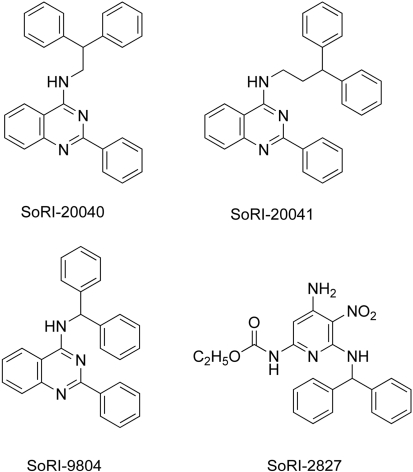
Fig. 1.
Fig. 1.
Compound structures.
Fig. 2.
Fig. 2.
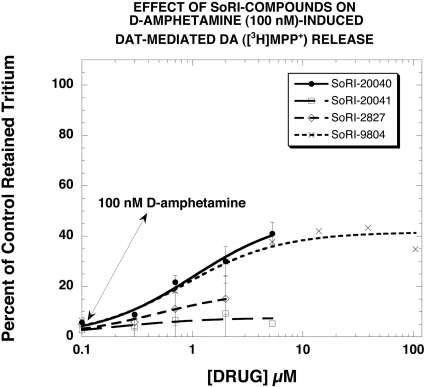
Effect of SoRI compounds on d-amphetamine (100 nM)-induced DAT-mediated DA ([3H]MPP+) release. Dose-response curves were generated in the absence and presence of 100 nM d-amphetamine. The effect of test drugs on d-amphetamine (100 nM)-induced release of [3H]MPP+ is graphed for doses that did not affect [3H]MPP+ release in the absence of d-amphetamine. Each value is the mean ± S.D. (n = 3).
Fig. 3.
Fig. 3.
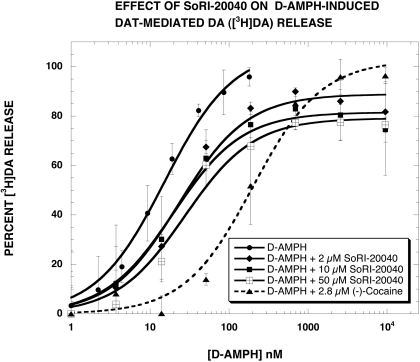
Effect of SoRI-20040 on d-amphetamine-induced DAT-mediated DA ([3H]DA) release. d-Amphetamine dose-response curves were generated in the absence and presence of the indicated concentrations of SoRI-20040 and cocaine. The dose-response curves were fit to the dose-response equation, and the results are reported in Table 1. Each value is the mean± S.D. (n = 3).
Fig. 4.
Fig. 4.
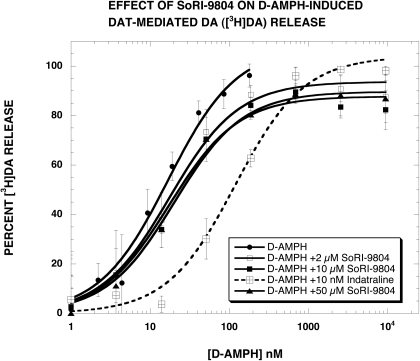
Effect of SoRI-9804 on d-amphetamine-induced DAT-mediated DA ([3H]DA) release. d-Amphetamine dose-response curves were generated in the absence and presence of the indicated concentrations of SoRI-9804 and indatraline. The dose-response curves were fit to the dose-response equation and the results are reported in Table 1. Each value is the mean ± S.D. (n = 3).
Fig. 5.
Fig. 5.
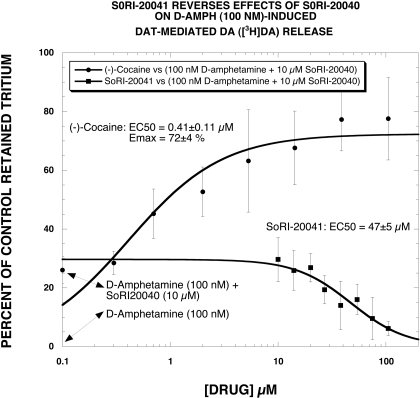
SoRI-20041 reverses the effect of SoRI-20040 on DAT-mediated DA ([3H]DA) release. SoRI-20041 and cocaine dose-response curves were generated in the presence of 100 nM d-amphetamine + SoRI-20040 (10 μM). SoRI-20041 then reduced the combined effect of SoRI-20040 + d-amphetamine back to 0% in a dose-dependent manner (EC50 = 47 ± 5 μM). In contrast, cocaine had the opposite effect, increasing the percentage of control in a dose-dependent manner (EC50 = 0.41 ± 0.11 μM). Each value is the mean ± S.D. (n = 3).
Fig. 6.
Fig. 6.
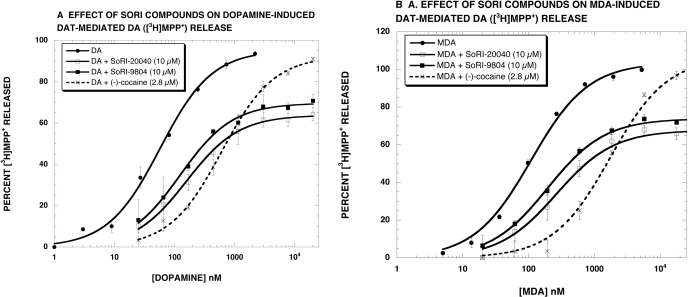
Effect of SoRI-20040 and SoRI-9804 on substrate-induced DAT-mediated DA ([3H]MPP+) release. Dopamine (A) and MDA (B) dose-response curves were generated in the absence and presence of SoRI-20040 (10 μM), SoRI-9804 (10 μM), and cocaine (2.8 μM). The dose-response curves were fit to the dose-response equation, and the results are reported in Table 2. Each value is the mean ± S.D. (n = 3).
Fig. 7.
Fig. 7.
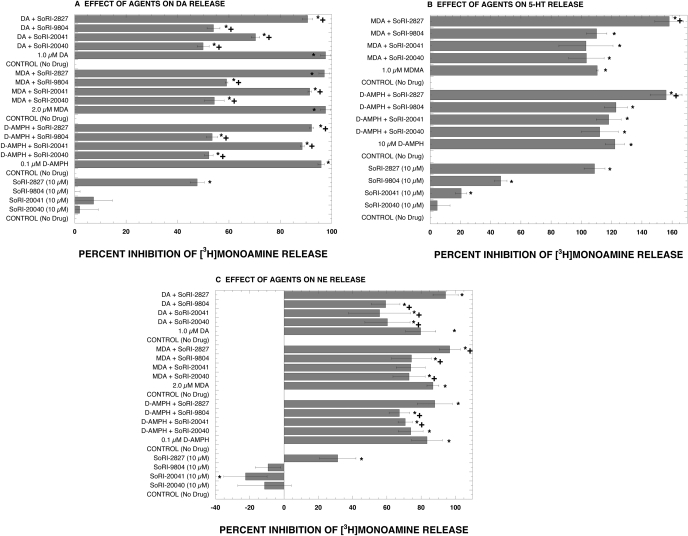
Effect of test drugs (10 μM) on substrate-induced release mediated by DAT (A), SERT (B), and NET (C). Release assays were conducted as described under Materials and Methods using [3H]MPP+ for DAT- and NET-mediated release and [3H]5-HT for SERT-mediated release. Each value is mean ± S.D. (n = 3 for DAT and SERT; n = 6 for NET). *, P < 0.05 compared with the no drug control. †, P < 0.05 compared with the substrate alone (ANOVA with post hoc Student-Newman-Keuls multiple comparison test).
Fig. 8.
Fig. 8.
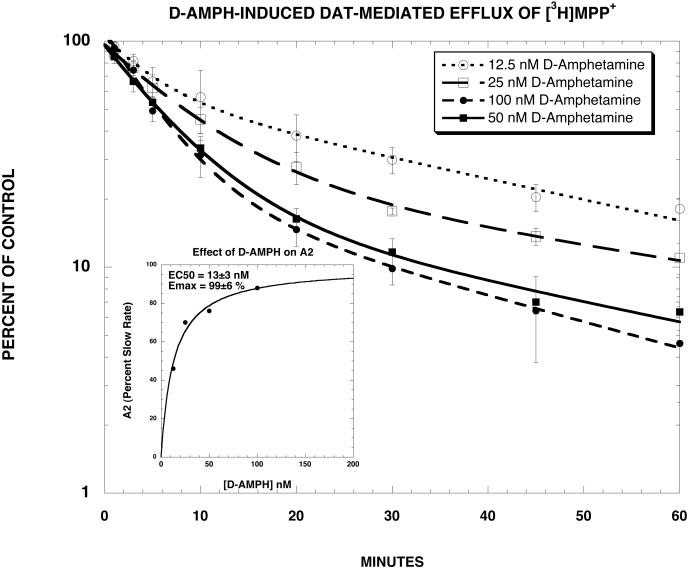
DAT-mediated [3H]MPP+ efflux experiments. As described under Materials and Methods, synaptosomes were preloaded with [3H]MPP+ for 60 min. Various concentrations of d-amphetamine were then added, and samples were filtered at various times up to 60 min later. Each value is the mean ± S.D. The data of three independent experiments were pooled and fit to one- and two-component dissociation experiments using MLAB-PC. In all cases, the two-component model fit significantly better than the one-component model (F-test, P < 0.002). The best-fit estimates of the kinetic parameters are reported in Table 3.
Fig. 9.
Fig. 9.
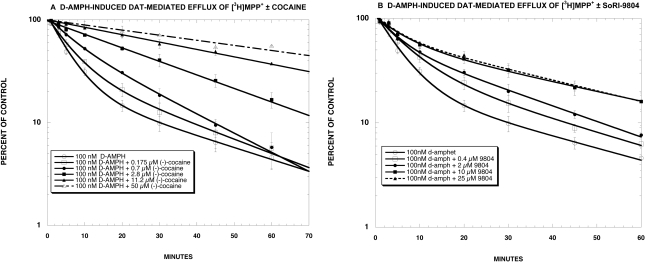
Effect of cocaine and SoRI-9804 on d-amphetamine induced DAT-mediated efflux of [3H]MPP+. As described under Materials and Methods, synaptosomes were preloaded with [3H]MPP+ for 60 min. d-Amphetamine (100 nM) was added in the absence and presence of various concentrations of cocaine (A) or SoRI-9804 (B), and samples were filtered at various times up to 60 min later. Each value is the mean ± S.D. The data of three independent experiments were pooled and fit to one- and two-component dissociation experiments using MLAB-PC. The best-fit estimates of the kinetic parameters are reported in Table 4 for cocaine and in Table 5 for SoRI-9804.
Fig. 10.
Fig. 10.
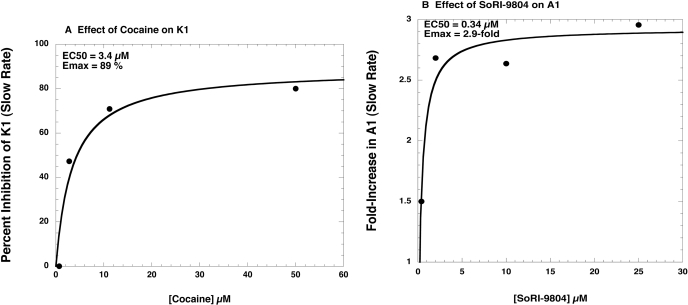
Effect of cocaine and SoRI-9804 on selected kinetic parameter values. A, effect of cocaine on the value of K1, as reported in Table 4. B, effect of SoRI-9804 on the value of A1, as reported in Table 5.

References

    1. Akunne HC, de Costa BR, Jacobson AE, Rice KC, and Rothman RB (1992) [3H]Cocaine labels a binding site associated with the serotonin transporter in guinea pig brain: allosteric modulation by paroxetine. Neurochem Res 17 1275-1283. - PubMed
    1. Andersson A and Marcusson J (1989) Inhibition and dissociation of [3H]-paroxetine binding to human platelets. Neuropsychobiology 22 135-140. - PubMed
    1. Chang AS and Chang SM (1999) Nongenomic steroidal modulation of high-affinity serotonin transport. Biochim Biophys Acta 1417 157-166. - PubMed
    1. Chen F, Larsen MB, Neubauer HA, Sánchez C, Plenge P, and Wiborg O (2005) Characterization of an allosteric citalopram-binding site at the serotonin transporter. J Neurochem 92 21-28. - PubMed
    1. Chen N and Reith ME (2000) Structure and function of the dopamine transporter. Eur J Pharmacol 405 329-339. - PubMed

Publication types