. 2009 Apr 24;284(17):11572-8.
doi: 10.1074/jbc.M805511200. Epub 2009 Feb 25.

Identification of a cardiolipin-specific phospholipase encoded by the gene CLD1 (YGR110W) in yeast

Affiliations

Identification of a cardiolipin-specific phospholipase encoded by the gene CLD1 (YGR110W) in yeast

Andreas Beranek et al. J Biol Chem. .

Abstract

The mitochondrial dimeric phospholipid cardiolipin is characterized by a high degree of unsaturation of its acyl chains, which is important for its functional interaction with mitochondrial enzymes. The unusual fatty acid composition of cardiolipin molecular species emerges from a de novo synthesized "premature" species by extensive acyl chain remodeling that involves as yet only partially identified acyltransferases and phospholipases. Recently, the yeast protein Taz1p was shown to function as a transacylase, which catalyzes the reacylation of monolysocardiolipin to mature cardiolipin. A defect in the orthologous human TAZ gene is associated with Barth syndrome, a severe genetic disorder, which may lead to cardiac failure and death in childhood. We now identified the protein encoded by reading frame YGR110W as a mitochondrial phospholipase, which deacylates de novo synthesized cardiolipin. Ygr110wp has a strong substrate preference for palmitic acid residues and functions upstream of Taz1p, to generate monolysocardiolipin for Taz1p-dependent reacylation with unsaturated fatty acids. We therefore rename the Ygr110wp as Cld1p (cardiolipin-specific deacylase 1).


Figures
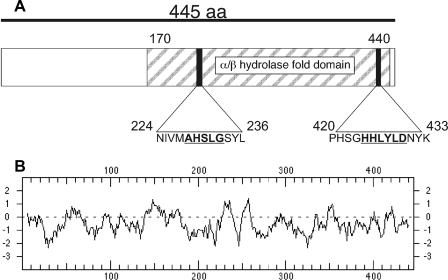
FIGURE 1.
FIGURE 1.
Sequence features of Ygr110wp. A, positions of conserved lipase and acyltransferase motifs are indicated by black boxes in the schematic illustration of Ygr110wp. The AXSXG lipase as well as the HXXXXD acyltransferase motifs are underlined. The striped box represents the α/β hydrolase fold domain. B, Kyte-Doolittle plot of the Ygr110wp primary amino acid sequence. No transmembrane regions were predicted by in silico analysis.
FIGURE 2.
FIGURE 2.
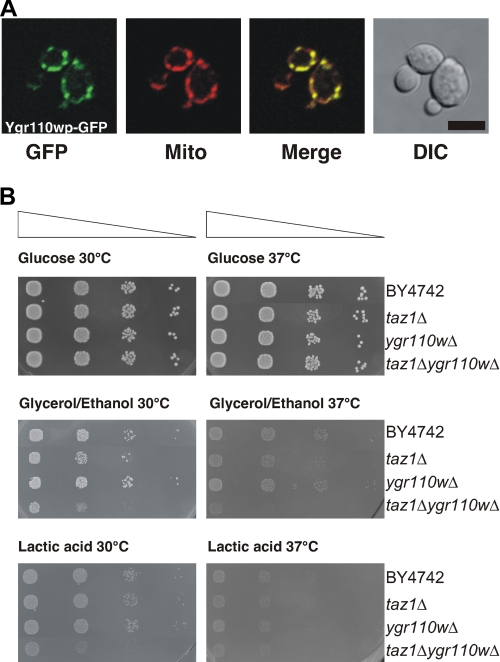
Subcellular localization of Ygr110wp and phenotypic analysis of mutant strains. A, subcellular localization of Ygr110wp. The expression of the C-terminal GFP fusion protein of Ygr110wp in BY4742 was induced by shifting the cells to synthetic medium lacking methionine for 3 h. Cells were incubated with MitoTracker® Red CM-H2XRos for 10 min, and images of red (MitoTracker) and green (GFP) fluorescence were collected by confocal microscopy. Mitochondrial localization of GFP fusion proteins was confirmed by merging of red and green fluorescence images. B, growth on fermentable and non-fermentable carbon sources. Serial dilutions of cells were prepared in microtiter plates (5 × 10⁵ to 5 × 10² cells per well) and spotted on YPD, YNBLac, and YNB containing glycerol/ethanol as carbon sources, using a prong plunger. Experiments were performed three times. The double mutant ygr110wΔtaz1Δ displays a severe growth defect on non-fermentable carbon sources.
FIGURE 3.
FIGURE 3.
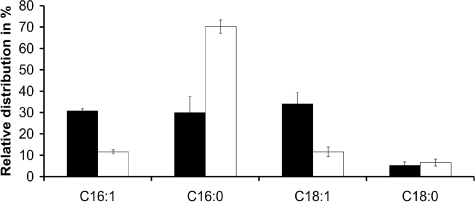
Cardiolipin acyl chain composition of wild-type and ygr110wΔ mutant strains. Mitochondria from wild-type BY4742 and ygr110wΔ mutant cells were isolated after 16 h of growth in YPD. Total lipids were extracted from mitochondria and separated by two-dimensional TLC as described under “Experimental Procedures.” Fatty acid (FA) profiles of CL were analyzed by GC-MS from ygr110wΔ (white bars) and wild-type (black bars). Data are expressed as relative percentage of total acyl chains in CL and represent means ± S.D. of at least three independent experiments. The ygr110wΔ mutant shows a 2.4-fold increased level of C16:0 acyl chains in CL compared with wild type.
FIGURE 4.
FIGURE 4.
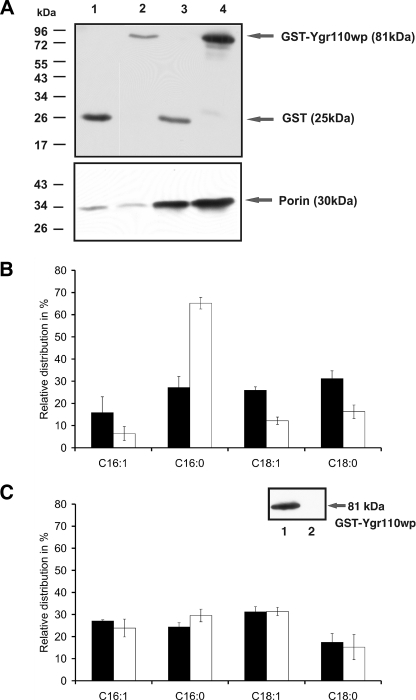
Expression of GST-Ygr110wp in the ygr110wΔ mutant and in wild-type cells. A, Western blot analysis. Mitochondria were isolated as described under “Experimental Procedures,” and Western blots were probed with antibodies against GST and porin. Lane 1, homogenate (6 μg) obtained from the mutant strain ygr110wΔ-expressing GST only; lane 2, homogenate (6 μg) obtained from ygr110wΔ overexpressing GST-Ygr110wp; lane 3, mitochondria (5 μg) prepared from ygr110wΔ expressing GST only; lane 4, mitochondria (5 μg) prepared from ygr110wΔ overexpressing GST-Ygr110wp. Numbers and bars on the left indicate the molecular mass markers. Experiments were performed as triplicates with at least two independent preparations of mitochondria. A strong band at 81 kDa was detected with anti-GST antibodies in mitochondria expressing the fusion protein. B, fatty acid profile of cardiolipin from mutant cells expressing GST or GST-Ygr110wp. Fatty acid methyl esters were isolated and quantified as described under “Experimental Procedures.” White bars, FA profile of CL isolated from ygr110wΔ expressing GST only; black bars, FA profile of CL from ygr110wΔ overexpressing GST-Ygr110wp. Data are expressed as percentage of total acyl chains in CL and represent means ± S.D. of at least three independent experiments. The fusion protein GST-Ygr110wp suppressed the accumulation of C16:0 acyl chains in CL of ygr110wΔ to wild-type level. C, fatty acid profile of CL from mitochondria isolated from wild-type cells expressing GST-Ygr110wp (lane 1) or GST (lane 2). White bars, FA profile of CL isolated from wild-type expressing GST only; black bars, FA profile of CL from wild-type overexpressing GST-Ygr110wp. Data are expressed as percentage of total acyl chains in CL and represent means ± S.D. of at least three independent experiments. Overexpression of GST-Ygr110wp did not change the fatty acid profile of cardiolipin in wild type.
FIGURE 5.
FIGURE 5.
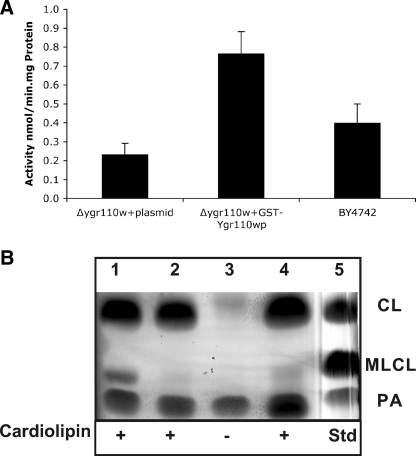
Phospholipase A activity of GST-Ygr110wp. Mitochondrial fractions were used for PLA activity assays as described under “Experimental Procedures.” A, the specific activity of GST-Ygr110wp toward sn2-arachidonoyl phosphatidylcholine was 0.767 nmol/min.mg of protein, which corresponds to a 3.3-fold induction over the control and is 2-fold higher compared with wild-type mitochondria. Data represent means ± S.D. of at least three independent experiments. B, CL-specific phospholipase A activity of GST-Ygr110wp. Lane 1, mitochondria from ygr110wΔ mutant cells harboring pGST-YGR110W. Lane 2, mitochondria from ygr110wΔ mutant cells harboring pYEX4T-1. Lane 3, mitochondria from ygr110wΔ mutant cells harboring pGST-YGR110W without exogenous CL. Lane 4, mitochondria from wild-type cells. Lane 5, lipid standards; CL, cardiolipin; MLCL, monolysocardiolipin; PA, phosphatidic acid. Experiments were performed three times with two independent mitochondrial preparations.
FIGURE 6.
FIGURE 6.
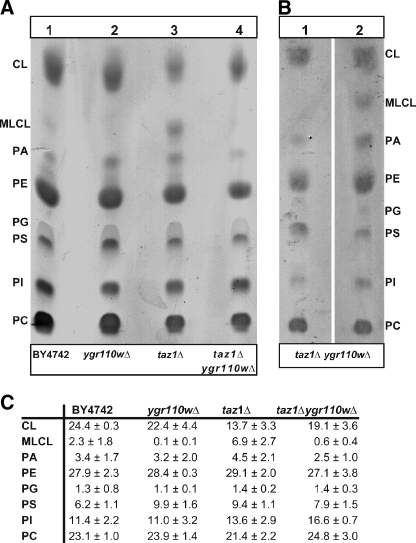
Determination of MLCL in BY4742 and ygr110wΔ, taz1Δ, and taz1Δygr110wΔ mutant cells. Lipid extracts of the mitochondrial fractions were subjected to one-dimensional TLC as described under “Experimental Procedures.” One representative experiment from triplicate determinations from at least two independent mitochondrial preparations is shown. A, accumulation of MLCL was observed in the mutant strain taz1Δ (lane 3). No MLCL was detectable in the mutant strains ygr110wΔ (lane 2) and taz1Δygr110wΔ (lane 4). Wild-type BY4742 (lane 1). B, overexpression of GST-Ygr110wp in the double mutant taz1Δygr110wΔ led to an accumulation of MLCL (lane 2). Double mutant taz1Δygr110wΔ cells expressing GST only (lane 1). C, lipid composition. Spots on TLC were quantified using ImageJ software (NIH). CL, cardiolipin; MLCL, monolysocardiolipin; PA, phosphatidic acid; PE, phosphatidylethanolamine; PG, phosphatidylglycerol; PS, phosphatidylserine; PI, phosphatidylinositol; PC, phosphatidylcholine. Data represent means ± S.D. of at least three independent experiments.

References

    1. Wriessnegger, T., Guebitz, G., Leitner, E., Ingolic, E., Cregg, J., de la Cruz, B. J., and Daum, G. (2007) Biochim. Biophys. Acta 1771, 455-461 - PubMed
    1. Zhang, M., Mileykovskaya, E., and Dowhan, W. (2005) J. Biol. Chem. 280, 29403-29408 - PMC - PubMed
    1. Pfeiffer, K., Gohil, V., Stuart, R. A., Hunte, C., Brandt, U., Greenberg, M. L., and Schägger, H. (2003) J. Biol. Chem. 278, 52873-52880 - PubMed
    1. Li, G., Chen, S., Thompson, M. N., and Greenberg, M. L. (2007) Biochim. Biophys. Acta 1771, 432-441 - PubMed
    1. Schlame, M., Rua, D., and Greenberg, M. L. (2000) Prog. Lipid Res. 39, 257-288 - PubMed

Publication types

MeSH terms