


HLA footprints on human immunodeficiency virus type 1 are associated with interclade polymorphisms and intraclade phylogenetic clustering
- PMID: 19244334
- PMCID: PMC2668443
- DOI: 10.1128/JVI.02017-08
HLA footprints on human immunodeficiency virus type 1 are associated with interclade polymorphisms and intraclade phylogenetic clustering
Erratum in
- J Virol. 2011 May;85(9):4635
Abstract
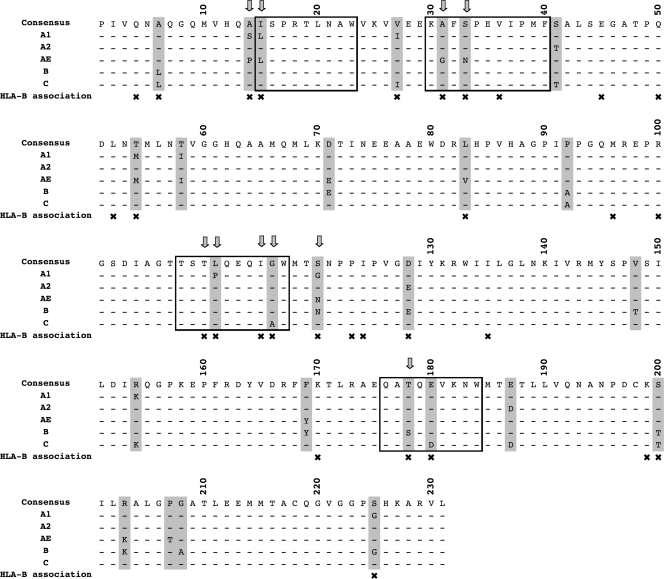
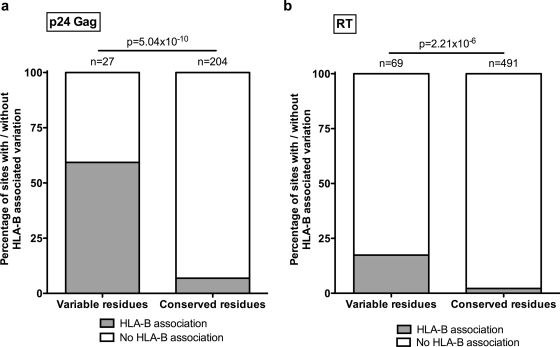
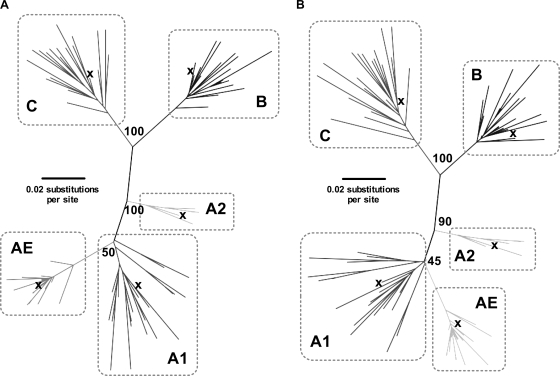
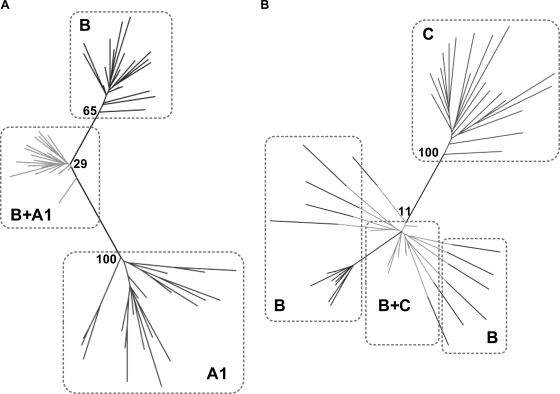
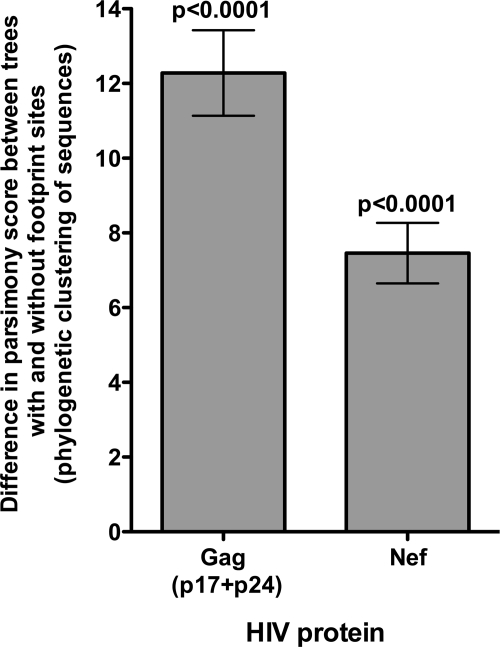
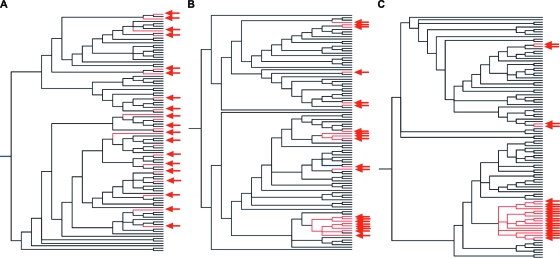
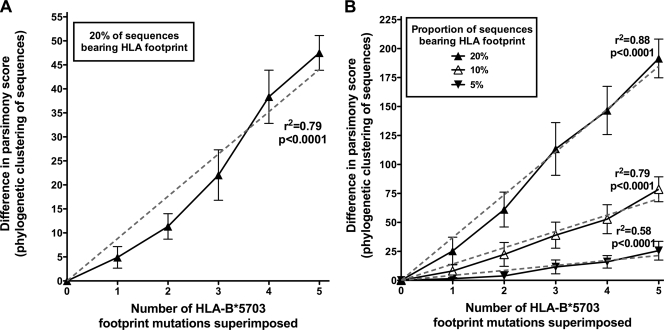
The selection of escape mutations has a major impact on immune control of infections with viruses such as human immunodeficiency virus (HIV). Viral evasion of CD8(+) T-cell responses leaves predictable combinations of escape mutations, termed HLA "footprints." The most clearly defined footprints are those associated with HLA alleles that are linked with successful control of HIV, such as HLA-B*57. Here we investigated the extent to which HLA footprint sites in HIV type 1 (HIV-1) are associated with viral evolution among and within clades. First, we examined the extent to which amino acid differences between HIV-1 clades share identity with sites of HLA-mediated selection pressure and observed a strong association, in particular with respect to sites of HLA-B selection (P < 10(-6)). Similarly, the sites of amino acid variability within a clade were found to overlap with sites of HLA-selected mutation. Second, we studied the impact of HLA selection on interclade phylogeny. Removing the sites of amino acid variability did not significantly affect clade-specific clustering, reflecting the central role of founder effects in establishing distinct clades. However, HLA footprints may underpin founder strains, and we show that amino acid substitutions between clades alter phylogeny, underlining a potentially substantial role for HLA in driving ongoing viral evolution. Finally, we investigated the impact of HLA selection on within-clade phylogeny and demonstrate that even a single HLA allele footprint can result in significant phylogenetic clustering of sequences. In conclusion, these data highlight the fact that HLA can be a strong selection force for both intra- and interclade HIV evolution at a population level.
Figures
References
-
- Allen, T. M., M. Altfeld, S. C. Geer, E. T. Kalife, C. Moore, M. O'Sullivan, K., I. Desouza, M. E. Feeney, R. L. Eldridge, E. L. Maier, D. E. Kaufmann, M. P. Lahaie, L. Reyor, G. Tanzi, M. N. Johnston, C. Brander, R. Draenert, J. K. Rockstroh, H. Jessen, E. S. Rosenberg, S. A. Mallal, and B. D. Walker. 2005. Selective escape from CD8+ T-cell responses represents a major driving force of human immunodeficiency virus type 1 (HIV-1) sequence diversity and reveals constraints on HIV-1 evolution. J. Virol. 7913239-13249. - PMC - PubMed
-
- Betts, M. R., B. Exley, D. A. Price, A. Bansal, Z. T. Camacho, V. Teaberry, S. M. West, D. R. Ambrozak, G. Tomaras, M. Roederer, J. M. Kilby, J. Tartaglia, R. Belshe, F. Gao, D. C. Douek, K. J. Weinhold, R. A. Koup, P. Goepfert, and G. Ferrari. 2005. Characterization of functional and phenotypic changes in anti-Gag vaccine-induced T cell responses and their role in protection after HIV-1 infection. Proc. Natl. Acad. Sci. USA 1024512-4517. - PMC - PubMed
-
- Bhattacharya, T., M. Daniels, D. Heckerman, B. Foley, N. Frahm, C. Kadie, J. Carlson, K. Yusim, B. McMahon, B. Gaschen, S. Mallal, J. I. Mullins, D. C. Nickle, J. Herbeck, C. Rousseau, G. H. Learn, T. Miura, C. Brander, B. Walker, and B. Korber. 2007. Founder effects in the assessment of HIV polymorphisms and HLA allele associations. Science 3151583-1586. - PubMed
-
- Brockman, M. A., A. Schneidewind, M. Lahaie, A. Schmidt, T. Miura, I. Desouza, F. Ryvkin, C. A. Derdeyn, S. Allen, E. Hunter, J. Mulenga, P. A. Goepfert, B. D. Walker, and T. M. Allen. 2007. Escape and compensation from early HLA-B57-mediated cytotoxic T-lymphocyte pressure on human immunodeficiency virus type 1 Gag alter capsid interactions with cyclophilin A. J. Virol. 8112608-12618. - PMC - PubMed
Publication types
MeSH terms
Substances
Grants and funding
LinkOut - more resources
Full Text Sources
Research Materials
