. 2009 Apr;15(4):515-23.
doi: 10.1261/rna.1273209. Epub 2009 Feb 25.

Differential 3' splice site recognition of SMN1 and SMN2 transcripts by U2AF and U2 snRNP

Affiliations

Differential 3' splice site recognition of SMN1 and SMN2 transcripts by U2AF and U2 snRNP

Mafalda Martins de Araújo et al. RNA. 2009 Apr.

Abstract

Spinal Muscular atrophy is a prevalent genetic disease caused by mutation of the SMN1 gene, which encodes the SMN protein involved in assembly of small nuclear ribonucleoprotein (snRNP) complexes. A paralog of the gene, SMN2, cannot provide adequate levels of functional SMN because exon 7 is skipped in a significant fraction of the mature transcripts. A C to T transition located at position 6 of exon 7 is critical for the difference in exon skipping between SMN1 and SMN2. Here we report that this nucleotide difference results in increased ultraviolet light-mediated crosslinking of the splicing factor U2AF(65) with the 3' splice site of SMN1 intron 6 in HeLa nuclear extract. U2 snRNP association, analyzed by native gel electrophoresis, is also more efficient on SMN1 than on SMN2, particularly under conditions of competition, suggesting more effective use of limiting factors. Two trans-acting factors implicated in SMN regulation, SF2/ASF and hnRNP A1, promote and repress, respectively, U2 snRNP recruitment to both RNAs. Interestingly, depending on the transcript and the regulatory factor, the effects on U2 binding not always correlate with changes in U2AF(65) crosslinking. Furthermore, blocking recognition of a Tra2-beta1-dependent splicing enhancer located in exon 7 inhibits U2 snRNP recruitment without affecting U2AF(65) crosslinking. Collectively, the results suggest that both U2AF binding and other steps of U2 snRNP recruitment can be control points in SMN splicing regulation.


Figures
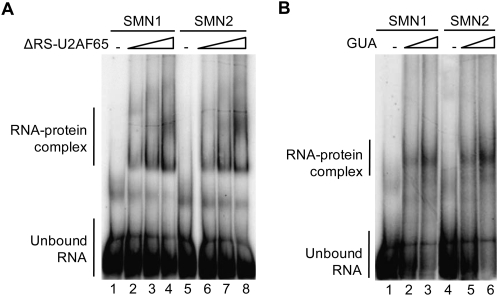
FIGURE 1.
FIGURE 1.
Intrinsic U2AF affinity is similar for SMN1 and SMN2. 32P-radioactively labeled SMN1 or SMN2 exon 7 pre-mRNAs containing the 3′ 68 nt of intron 6, exon 7 sequences, and 25 nt of intron 7, were incubated with increasing concentrations (30, 90, and 270 nM) of recombinant U2AF65 lacking the RS domain (ΔRS–U2AF65) (A) or endogenous U2AF partially purified from HeLa nuclear extract (GUA-guanidine eluate from oligo-dT cellulose columns used to prepare U2AF-depleted extracts) (B). Complexes were assembled on ice and RNA–protein complexes fractionated by electrophoresis on native polyacrylamide gels at 4°C. The positions of unbound–RNA and RNA–protein complexes are indicated.
FIGURE 2.
FIGURE 2.
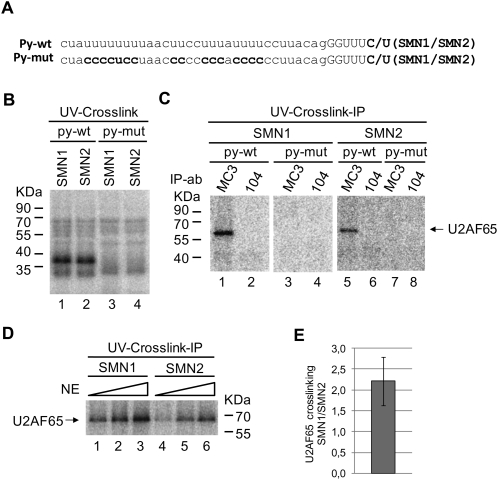
Higher levels of U2AF65 crosslinking to SMN1 intron 6 polypyrimidine-tract. (A) Sequences of the SMN intron 6 3′ splice site region and a mutant derivative (Py-mut) in which uridine residues at the polypyrimidine tract (Py-tract) were replaced by cytidines. Exon 7 position 6, different between SMN1 (C) and SMN2 (T) transcripts is also indicated. (B) Pattern of proteins from HeLa nuclear extracts crosslinked to SMN transcripts upon irradiation with UV light. 32P-uridine-labeled RNAs (SMN1 or SMN2, wild type or Py-mut, as indicated) containing the 3′ 68 nt of intron 6, exon 7 sequences, and 25 nt of intron 7 were incubated with nuclear extracts, and after UV irradiation and RNAse treatment, 10% of the crosslinked material was fractionated on a SDS-polyacrylamide gel and analyzed by PhosphorImager. (C) U2AF65 immunoprecipitation. 90% of the products of crosslinking obtained as in B were immunoprecipitated using the anti-U2AF65 antibody MC3, or a control monoclonal antibody (104). Immunoprecipitated materials were fractionated on SDS denaturing gels and analyzed by PhosporImager. The positions of molecular weight markers and U2AF65 are indicated. (D) UV-crosslinking and U2AF65 immunoprecipitation with increasing amounts of nuclear extracts (NE). Assays were carried out as in (C) using 1.3%, 4%, and 12% of nuclear extracts. (E) Ratio of U2AF65 crosslinking to SMN1 versus SMN2 transcripts, quantified by PhosphorImager analyses, corresponding to three independent experiments. Error bar represents standard deviation.
FIGURE 3.
FIGURE 3.
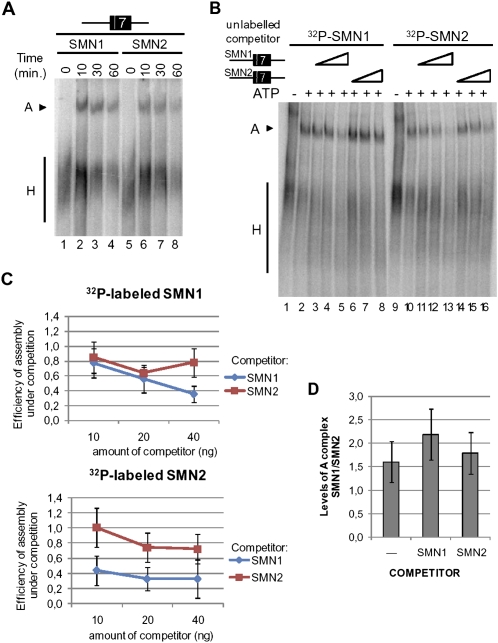
U2 snRNP recruitment to SMN1 and SMN2 RNAs. (A) Time-course of spliceosome assembly on SMN1 and SMN2 exon 7 pre-mRNAs. RNAs containing the 3′ 68 nt of intron 6, exon 7, and 25 nt of intron 7 were incubated with HeLa nuclear extracts under splicing conditions and after 30 min complexes were analyzed by electrophoresis on native polyacrylamide/agarose gels. The positions of A complex (U2 snRNP binding to intron 6 3′ splice site region) and H complex (hnRNP proteins bound to the same RNA) are indicated. (B) Spliceosome assembly under conditions of competition. Assays were set up as in A in the absence or presence of 10, 20, or 40 ng of the indicated unlabeled RNAs. (C) Quantification of the results of independent competition experiments carried out as in B. The efficiency of complex A formation (A/H ratios) on 32P-labeled SMN1 or SMN2 in the presence of competitor RNAs relative to assembly in the absence of competitor is represented for four independent experiments. (D) Relative levels of A complex formation on SMN1 versus SMN2. Ratios of A/H complex formation on SMN transcripts in the absence or presence of competitor RNAs are represented. Bars indicate standard deviations. P values for the null hypothesis that complex A assembly is identical on SMN1 and SMN2 are 0.03 (in the absence of competitor) and lower than 0.001 (in the presence of either competitor).
FIGURE 4.
FIGURE 4.
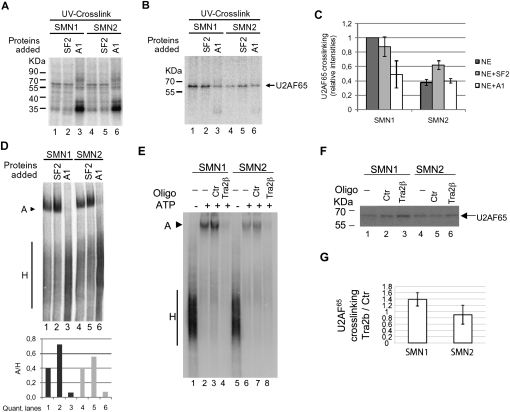
Differential effects of SF2/ASF and hnRNPA1 on U2AF65 crosslinking and spliceosome assembly to SMN transcripts. (A) Pattern of proteins crosslinked to SMN transcripts upon addition of recombinant purified SF2/ASF or hnRNP A1 (0.4 pmol/μL). (B) Crosslinking/immunoprecipitation of U2AF65 in assays as in A, carried out as in Figure 2C. (C) PhosphorImager quantification of signals corresponding to U2AF65 precipitates obtained in independent experiments as in B. (D) Spliceosomal complexes assembled on SMN transcripts in the absence or presence of recombinant SF2/ASF or hnRNP A1, as in B. Complexes assembled on SMN1 and SMN2 RNAs after incubation with nuclear extract and the indicated proteins for 30 min were resolved by electrophoresis on native polyacrylamide/agarose gels. Signals from A and H complexes were quantified by PhosphorImager analysis and the ratios represented at the bottom of the figure. (E) Spliceosomal complexes assembled on SMN transcripts in the presence of 125 nM of a 2′-O-methyl oligonucleotide complementary to the Tra2-β1 enhancer located in exon 7 positions 21–35 (5′-GAGCACCTTCCTTCT-3′) or a control (Ctr) oligonucleotide (5′-ATTAGTGGAATTGGC-3′), analyzed as in D. (F) Crosslinking/immunoprecipitation of U2AF65 in assays as in E, carried out as in Figure 2C. (G) Ratio between U2AF65 crosslinking in the presence of Tra2-β1 enhancer antisense and control oligos from PhosphorImager quantification of signals corresponding to U2AF65 precipitates obtained in three independent experiments as in F.

References

    1. Blanchette M., Chabot B. Modulation of exon skipping by high-affinity hnRNP A1-binding sites and by intron elements that repress splice site utilization. EMBO J. 1999;18:1939–1952. - PMC - PubMed
    1. Bonnal S., Martínez C., Förch P., Bachi A., Wilm M., Valcárcel J. RBM5/Luca-15/H37 regulates Fas alternative splice site pairing after exon definition. Mol. Cell. 2008;32:81–95. - PubMed
    1. Brzustowicz L.M., Lehner T., Castilla L.H., Penchaszadeh G.K., Wilhelmsen K.C., Daniels R., Davies K.E., Leppert M., Ziter F., Wood D., et al. Genetic mapping of chronic childhood-onset spinal muscular atrophy to chromosome 5q11.2–13.3. Nature. 1990;344:540–541. - PubMed
    1. Cartegni L., Krainer A.R. Disruption of an SF2/ASF-dependent exonic splicing enhancer in SMN2 causes spinal muscular atrophy in the absence of SMN1. Nat. Genet. 2002;30:377–384. - PubMed
    1. Cartegni L., Krainer A.R. Correction of disease-associated exon skipping by synthetic exon-specific activators. Nat. Struct. Biol. 2003;10:120–125. - PubMed

Publication types

LinkOut - more resources