. 2009;60(6):1569-77.
doi: 10.1093/jxb/erp022. Epub 2009 Feb 26.

NtCP56, a new cysteine protease in Nicotiana tabacum L., involved in pollen grain development

Affiliations

NtCP56, a new cysteine protease in Nicotiana tabacum L., involved in pollen grain development

Xiao-mei Zhang et al. J Exp Bot. 2009.

Abstract

Proteinases play a critical role in developmental homeostasis and in response to environ-mental stimuli. Our present research reports that a new cysteine protease, NtCP56, is involved in the development of pollen grains in Nicotiana tabacum L. The NtCP56 gene, which encodes a protein of 361 amino acid residues with a calculated molecular mass of 40 kDa, is strongly expressed in anthers. The recombinant NtCP56 showed a high activity towards casein. Kinetic analysis revealed a K(m) of 2.20 mg ml(-1) and V(max) of 11.07 microg ml(-1) min(-1). The recombinant NtCP56 retained more than 50% of its maximum enzymatic activity from 20 degrees C to 60 degrees C with an optimum Tm range of 30-50 degrees C. The enzyme had a maximum activity at approximately pH 6.5. Suppression of the NtCP56 gene in anti-sense transgenic tobaccos resulted in the sterility of pollen grains. Our data indicated that, as a cysteine protease, NtCP56 might play an important role in pollen development.


Figures

Fig. 1.
Fig. 1.
Nucleotide and deduced amino acid sequence of NtCP56. The signal peptide (M1-S20) of NtCP56 is shown in bold. The catalytic triad Cys, His, and Asn and also the Glu active site residue are circled. The GCNGG motif is double-underlined. ERFNIN motif (E53-N72) of NtCP56 is shown in a rectangular box and the KDEL (K358-L361) motif is single underlined. The arrow indicates the site of auto-hydrolysis. Numbers on the left and right margins represent nucleotide and deduced amino acid sequences, respectively.
Fig. 2.
Fig. 2.
Phylogenetic tree showing relationships between NtCP56 and other plant CPs. Bootstrap values from a sample of 500 replicates are shown on each branch using the following sequences NtCP (Nicotiana tabacum, GenBank accession no. AAW78660); SlCP (Solanum lycopersicum, GenBank accession no. ABV22590); GmCP (Glycine max, GenBank accession no. BAC77523); PvEP-C1 (Phaseolus vulgaris, GenBank accession no. CAA40073); VmCP (Vigna mungo, GenBank accession no. P12412); HaCP (Helianthus annuus, GenBank accession no. BAC75924); AtCP (Arabidopsis thaliana, GenBank accession no. NP_568722); HemCP (Hemerocallis hybrid cultivar, GenBank accession no. P43156); IhCP (Iris×hollandica, GenBank accession no. AAR92155); SaCP (Sandersonia aurantiaca, GenBank accession no. AAD28477); OsCP (Oryza sativa, GenBank accession no. AAD20453); TrCP (Trifolium repens, GenBank accession no. AAP32196); MtCP (Medicago truncatula, GenBank accession no. AAQ63885); LjCP (Lotus japonicus, GenBank accession no. BAF56430); DcCP (Daucus carota, GenBank accession no. BAD29956); AdCP (Actinidia deliciosa, GenBank accession no. ABQ10200); HaCP (Helianthus annuus, GenBank accession no. BAC75923); BoCP (Brassica oleracea, GenBank accession no. AAL60580); ZmCP (Zea mays, GenBank accession no. NP_001104879).
Fig. 3.
Fig. 3.
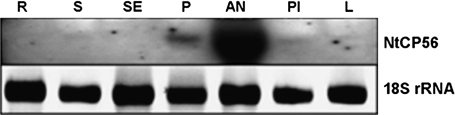
Northern hybridization showing NtCP56 expression in the tissue of Nicotiana tabacum L. NtCP56 mRNA abundance was analysed by using the 5’ end of NtCP56 cDNA as a probe. Each lane was loaded with 20 μg total RNA. R, root; S, stem; SE, sepal; P, petal; AN, anther; PI, pistil; L, leaf. To ensure equal sample abundance on gels 18S rRNA was used to monitor loading equivalence.
Fig. 4.
Fig. 4.
Purification of recombinant NtCP56 and processed protein. Protein samples were subjected to SDS-polyacrylamide gel electrophoresis under reducing conditions and stained with Coomassie Brilliant Blue R-250. Lane M, molecular mass markers with the sizes shown on the left in kDa. Lane 1, induced BL21 (DE3)+PET30a whole cell lysate. Lane 2, induced BL21 (DE3)+pET30a/NtCP56 whole cell lysate. Lane 3, 43 kDa purified recombinant NtCP56. Lane 4, 33 kDa processed mature recombinant NtCP56.
Fig. 5.
Fig. 5.
Effect of pH and Tm on the enzyme activity. (A) pH stability of processed recombinant NtCP56. (B) Thermal stability of processed recombinant NtCP56.
Fig. 6.
Fig. 6.
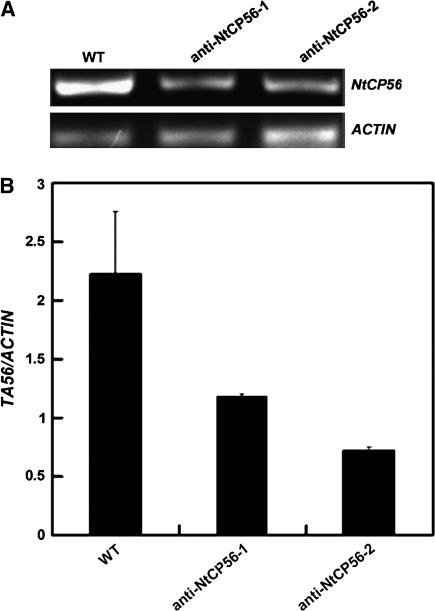
Relative expression level of NtCP56 mRNA in control, anti-NtCP56-1 and anti-NtCP56-2 tobaccos. (A) Results of the semi quantity RT-PCR by 1% agarose. (B) Quantification of the result of the semi quantity RT-PCR.
Fig. 7.
Fig. 7.
Lengthways section comparison of the anther development of the control and the anti-NtCP56 transgenic tobaccos. Six stages of anther development in the control and the corresponding stages of development in the anti-NtCP56 transformation were compared. Control sections are shown in (A), (C), (E), (G), (I), (K), (M), (O), (Q), (S), and (B), (D), (F), (H), (J), (L), (N), (P), (R), and (T) show corresponding anti-NtCP56 sections. (S) and (T) show the locules corner sections of control and anti-NtCP56 transgenic tobaccos in the last stage. Tds, tetrads; PG, pollen grains; Ms, microspore; Tp, tapetum; Ep, epidermis; En, endothecium.; ML, middle layer. (A, B) The MMC stage; (C, D) The TDS stage; (E, F, M, and N) The young microspore stage; (G, H, O, P) The single nuclear pollen stage; (I, J) The dinuclear pollen stage; (K, L, Q, R, S, T) The mature pollen stage. (Bars=50 μm).

References

    1. Akasofu H, Yamauchi D, Mitsuhashi W, Minamikawa T. Nucleotide sequence of cDNA for sulfhydryl-endopeptidase (SHEP) from cotyledons of germinating Vigna mungo seeds. Nucleic Acids Research. 1989;17:6733. - PMC - PubMed
    1. Albrecht C, Russinova E, Hecht V, Baaijens E, de Vries S. The Arabidopsis thaliana SOMATIC EMBRYOGENESIS RECEPTOR-LIKE KINASES1 and 2 control male sporogenesis. The Plant Cell. 2005;17:3337–3349. - PMC - PubMed
    1. Alonso JM, Granell A. A putative vacuolar processing protease is regulated by ethylene and also during fruit ripening in citrus fruit. Plant Physiology. 1995;109:541–547. - PMC - PubMed
    1. Beyene G, Foyer CH, Kunert KJ. Two new cysteine proteinases with specific expression patterns in mature and senescent tobacco (Nicotiana tabacum L.) leaves. Journal of Experimental Botany. 2006;57:1431–1443. - PubMed
    1. Colcombet J, Boisson-Dernier A, Ros-Palau R, Vera CE, Schroeder JI. Arabidopsis SOMATIC EMBRYOGENESIS RECEPTOR KINASES1 and 2 are essential for tapetum development and microspore maturation. The Plant Cell. 2005;17:3350–3361. - PMC - PubMed

Publication types

MeSH terms