


Smokers' responses toward cigarette pack warning labels in predicting quit intention, stage of change, and self-efficacy
- PMID: 19246625
- PMCID: PMC2666375
- DOI: 10.1093/ntr/ntn029
Smokers' responses toward cigarette pack warning labels in predicting quit intention, stage of change, and self-efficacy
Abstract
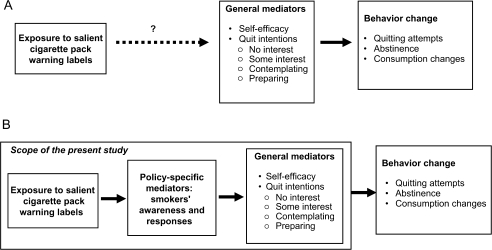
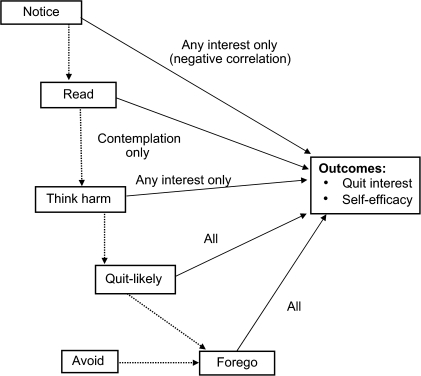
Introduction: This paper is concerned with the effects of cigarette pack warning labels on quitting intentions. We examined whether different responses among smokers toward cigarette pack warning labels could predict quit intentions and self-efficacy in quitting. Variables studied were "noticing warning labels during last month," "reading or looking closely at warning labels," "avoiding looking at labels during last month," "thinking about health risks of smoking because of the warning labels, "more likely to quit because of the warning labels," and "stopping from having a cigarette when about to smoke one because of the labels."
Methods: A total of 2,006 adult smokers in Malaysia were surveyed in face-to-face interviews using a standardized questionnaire. Of those, 1,919 male smokers were included in the analyses.
Results: The responses "more likely to quit because of the warning labels" and "stopped from having a cigarette when about to smoke one" significantly predicted all stages of change and self-efficacy, independent of the other measures. In addition, thinking about the health risks and reading the warnings more often added extra predictive capacity but only in the early stages of contemplating change.
Discussion: Less intense processing of the information may be important in initiating thoughts, but cognitions about quitting and foregoing cigarettes are the key mechanisms by which warnings stimulate quitting intentions and help smokers feel capable of succeeding. Malaysian smokers appear to respond to warnings in ways comparable with those from developed countries.
Figures
References
-
- Baron RM, Kenny DA. The moderator-mediator variable distinction in social psychological research: Conceptual, strategic, and statistical considerations. Journal of Personality and Social Psychology. 1986;51:1173–1182. - PubMed
-
- Borland R. Tobacco health warnings and smoking-related cognitions and behaviors. Addiction. 1997;92:1427–1435. - PubMed
-
- Clearinghouse for Tobacco Control. Tobacco control in Malaysia: A long winding road. Universiti Sains Malaysia, Pulau Pinang, Malaysia: National Poison Centre; 2005. (Internal document)
-
- Cote F, Godin G, Gagne C. Identification of factors promoting abstinence from smoking in a cohort of elementary school children. Preventive Medicine. 2004;39:695–703. - PubMed
Publication types
MeSH terms
Grants and funding
LinkOut - more resources
Full Text Sources
Medical
