. 2009 Feb;5(2):e1000395.
doi: 10.1371/journal.pgen.1000395. Epub 2009 Feb 27.

Chordin is a modifier of tbx1 for the craniofacial malformations of 22q11 deletion syndrome phenotypes in mouse

Affiliations

Chordin is a modifier of tbx1 for the craniofacial malformations of 22q11 deletion syndrome phenotypes in mouse

Murim Choi et al. PLoS Genet. 2009 Feb.

Abstract

Point mutations in TBX1 can recapitulate many of the structural defects of 22q11 deletion syndromes (22q11DS), usually associated with a chromosomal deletion at 22q1.2. 22q11DS often includes specific cardiac and pharyngeal organ anomalies, but the presence of characteristic craniofacial defects is highly variable. Even among family members with a single TBX1 point mutation but no cytological deletion, cleft palate and low-set ears may or may not be present. In theory, such differences could depend on an unidentified, second-site lesion that modifies the craniofacial consequences of TBX1 deficiency. We present evidence for such a locus in a mouse model. Null mutations of chordin have been reported to cause severe defects recapitulating 22q11DS, which we show are highly dependent on genetic background. In an inbred strain in which chordin(-/-) is fully penetrant, we found a closely linked, strong modifier--a mutation in a Tbx1 intron causing severe splicing defects. Without it, lack of chordin results in a low penetrance of mandibular hypoplasia but no cardiac or thoracic organ malformations. This hypomorphic Tbx1 allele per se results in defects resembling 22q11DS but with a low penetrance of hallmark craniofacial malformations, unless chordin is mutant. Thus, chordin is a modifier for the craniofacial anomalies of Tbx1 mutations, demonstrating the existence of a second-site modifier for a specific subset of the phenotypes associated with 22q11DS.


Conflict of interest statement

The authors have declared that no competing interests exist.

Figures
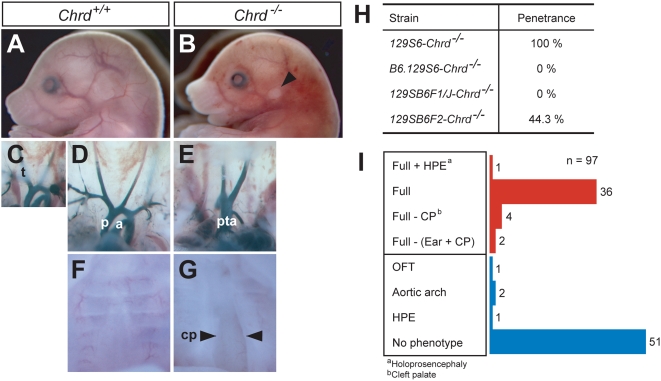
Figure 1
Figure 1. Phenotype of Chrd mutant embryos in 129S6 inbred and hybrid backgrounds.
(A–G) Comparison of organ structures in wildtype and Chrd mutant embryos at embryonic day (E) 15.5. Ears of Chrd−/− embryos are abnormally located and fail to form auricle structures (A, B). Athymia, persistent truncus arteriosus (PTA; failure of outflow tract septation) and abnormal aortic arch artery structure are observed in the mutant (C–E). Cleft palate (CP) is also a feature of the mutant embryos (F, G). (H) Penetrance of Chrd null mutation in various genetic backgrounds; it shows complete penetrance in the 129S6 strain and partial penetrance in the F2 hybrid (129SB6F2) strain. (I) Phenotypic pattern of 129SB6F2-Chrd−/− embryos. The majority of embryos showed either a ‘Full phenotype’ (as defined in the main text) or no phenotype. Several embryos (11/97) showed variable DGS-like phenotypes. Despite this variability, the embryos can be classified into two groups: those that retain DGS-like phenotypes (in red), and those devoid of DGS-like phenotypes (in blue). a, aorta; cp, cleft palate; HPE, holoprosencephaly; p, pulmonary trunk; pta, persistent truncus arteriosus; t, thymus.
Figure 2
Figure 2. Characterization of a linked modifier of Chrd in the 129S6 strain.
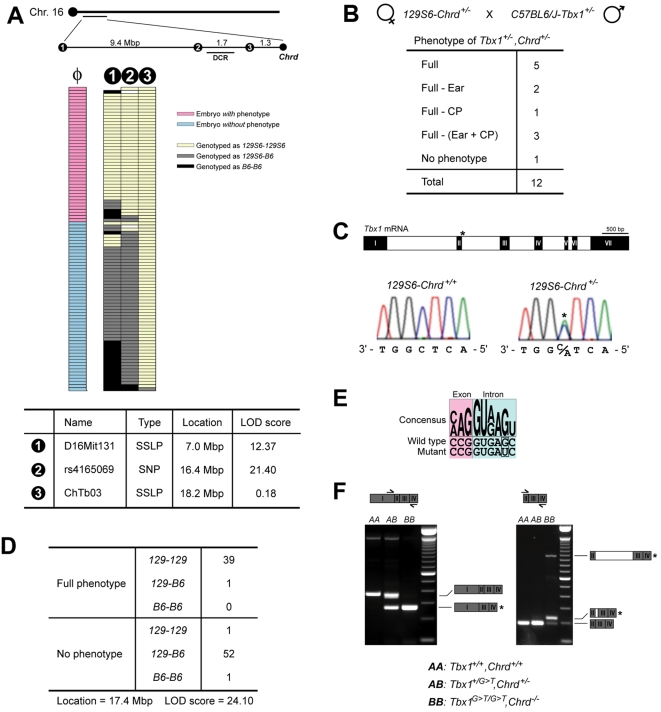
(A) Schematic diagram of mouse chromosome 16, showing three genetic markers used and genotyping results of F2 hybrid DNAs using these markers. Information on the markers is shown in the table at the bottom of the panel. The second marker rs4165069 shows the strongest co-segregation with the trait. The novel SSLP marker ‘ChTb03’ produces a 271 bp long PCR fragment from 129S6, and 262 bp from B6 (Figure S4). (B) Cross between 129S6-Chrd+/− and B6-Tbx1+/− mice produced Chrd+/−,Tbx1+/− embryos with highly penetrant 22q11DS phenotypes, supporting the existence of modifier linked to Chrd and suggesting the possibility of a mutation in Tbx1 itself. (C) Sequencing of theTbx1 locus of 129S6-Chrd+/+ and 129S6-Chrd+/− strains, revealing a specific point mutation (Tbx1G>T) located in the second intron of the 129S6-Chrd+/− allele (asterisk). (D) Genotyping results of F2 hybrid DNAs using theTbx1G>T mutation as a SNP marker, showing that it is more strongly linked to the phenotype than rs4165069. (E) Tbx1G>T is located at an exon-intron boundary. Consensus, wild-type, and mutant sequences encompassing the mutation are displayed. (F) RT-PCR analysis demonstrates that Tbx1G>T disrupts normal splicing of Tbx1 in 129S6 mice carrying the Chrd null allele. As a result of the point mutation, both exon skipping (left) and intron retention (right) occur in the generation of Tbx1 mRNA, but very little normal message is produced. Diagrams of mRNA with asterisks (*) denote mutant splicing variants that would invariably produce truncated Tbx1 protein.
Figure 3
Figure 3. Phenotypes of Chrd+/+,Tbx1G>T/G>T and Chrd−/−,Tbx1+/+ mutant embryos.
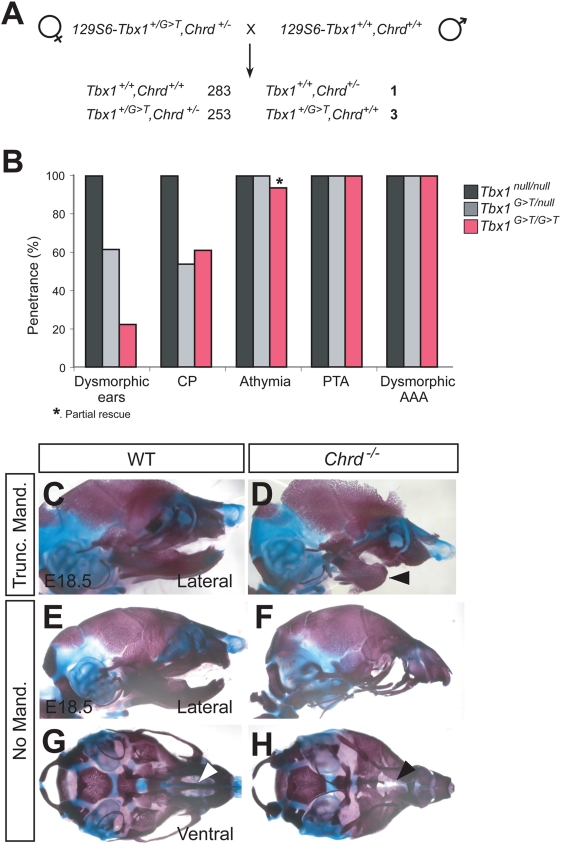
(A) Crossing scheme to generate recombinant animals. 129S6-Chrd+/− females were mated with 129S6 wild-type studs and offspring were screened for recombination of markers. (B) Penetrance of five phenotypes associated with DGS from each different Tbx1 mutant class, displaying dosage-dependent rescue of craniofacial phenotypes. (C–H) Variable mandible defects in Chrd−/− mutant at late gestation stages. (C, D) Mild mandible outgrowth defect in B6-Chrd−/− mutant embryo (arrowhead). (E–H) Total absence of mandibular elements accompanying incomplete midline structure (arrowhead) is displayed in lateral (E, F) and ventral view (G, H) of 129S6-Chrd−/− mutant embryo. (I–L) Developmental defects of Chrd null, Tbx1 hypomorphic, and compound mutations. (I) Organs that are defective in various classes of mutant embryos. (J) Chrd null mice display a truncated mandible phenotype at low penetrance. (K) Tbx1 hypomorphic embryos develop very mild craniofacial defects (note partially dysmorphic ear) compared to Tbx1 null embryos.
Figure 4
Figure 4. Reduced expression of Tbx1 in 129S6- and B6-Chrd−/− embryos.
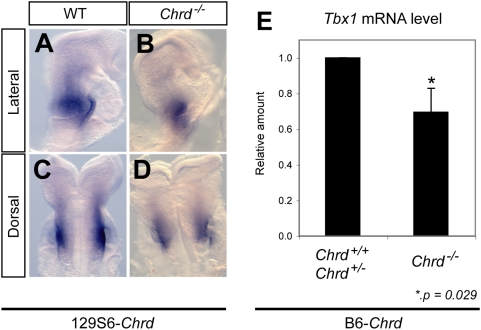
In situ hybridization at 5-somite stage of Tbx1 in 129S6-Chrd+/+ (A,C) and 129S6-Chrd−/− embryos (B,D), displaying reduced expression in pharyngeal area of homozygotes with a DGS-like phenotype. (E) Quantitative PCR of Tbx1 mRNA in embryos of the genotypes B6-Chrd +/+ and B6-Chrd +/− (n = 8) versus B6-Chrd−/− (n = 4), demonstrating a modest but significant (p = 0.029) reduction of Tbx1 expression despite the absence of a DGS-like phenotype in B6-Chrd−/− mutants.
Figure 5
Figure 5. Developmental defects of Chrd, Tbx1, and compound mutants.
Organs that are defective in the various classes of Chrd and/or Tbx1 mutant embryos studied here. Degree of penetrance of phenotypes reminiscent of 22q11DS is shown by variable intensity of red shading, as defined to the upper right of the figure. (A) Normal morphology (indicated by green shading) of organs sensitive to loss of Chrd and/or Tbx1 and their location in wildtype embryos: mx, maxilla; mn, mandible; e, ear; t, thymus; h, heart; CP, cleft palate; ME, malformed ear; AT, athymia; PTA, persistent truncus arteriosus. (B) Chrd null mice display a markedly truncated mandible phenotype at low penetrance (blue shading), while other structures are unaffected. (C) Tbx1G>T/G>T embryos sometimes develop mild craniofacial defects (note partially dysmorphic ear) compared to Tbx1−/− null embryos, while AT and PTA are fully penetrant. We did not quantitatively score for the presence of previously reported possible subtle mandibular dysmorphology associated with loss of Tbx1 (yellow, NA: not addressed, [3]), quite distinct from the Chrd truncation phenotype. (D) In the Chrd−/−;Tbx1G>T/G>T double mutant embryos, all indicated organs develop abnormally with complete penetrance, with an overall phenotype identical with (E) Tbx1−/− null embryos. Rarely, these defects are superimposed on mandibular truncations (blue), as seen at similarly low penetrance in Chrd−/− mutants.

References

    1. Paylor R, Lindsay E. Mouse models of 22q11 deletion syndrome. Biol Psychiatry. 2006;59:1172–1179. - PubMed
    1. Lindsay EA, Vitelli F, Su H, Morishima M, Huynh T, et al. Tbx1 haploinsufficieny in the DiGeorge syndrome region causes aortic arch defects in mice. Nature. 2001;410:97–101. - PubMed
    1. Jerome LA, Papaioannou VE. DiGeorge syndrome phenotype in mice mutant for the T-box gene, Tbx1. Nat Genet. 2001;27:286–291. - PubMed
    1. Merscher S, Funke B, Epstein JA, Heyer J, Puech A, et al. TBX1 is responsible for cardiovascular defects in velo-cardio-facial/DiGeorge syndrome. Cell. 2001;104:619–629. - PubMed
    1. Zweier C, Sticht H, Aydin-Yaylagul I, Campbell CE, Rauch A. Human TBX1 missense mutations cause gain of function resulting in the same phenotype as 22q11.2 deletions. Am J Hum Genet. 2007;80:510–517. - PMC - PubMed

Publication types

MeSH terms