. 2009;4(2):e4640.
doi: 10.1371/journal.pone.0004640. Epub 2009 Feb 27.

Temporally-controlled site-specific recombination in zebrafish

Affiliations

Temporally-controlled site-specific recombination in zebrafish

Stefan Hans et al. PLoS One. 2009.

Abstract

Conventional use of the site-specific recombinase Cre is a powerful technology in mouse, but almost absent in other vertebrate model organisms. In zebrafish, Cre-mediated recombination efficiency was previously very low. Here we show that using transposon-mediated transgenesis, Cre is in fact highly efficient in this organism. Furthermore, temporal control of recombination can be achieved by using the ligand-inducible CreER(T2). Site-specific recombination only occurs upon administration of the drug tamoxifen (TAM) or its active metabolite, 4-hydroxy-tamoxifen (4-OHT). Cre-mediated recombination is detectable already 4 or 2 hours after administration of TAM or 4-OHT, demonstrating fast recombination kinetics. In addition, low doses of TAM allow mosaic labeling of single cells. Combined, our results show that conditional Cre/lox will be a valuable tool for both, embryonic and adult zebrafish studies. Furthermore, single copy insertion transgenesis of Cre/lox constructs suggest a strategy suitable also for other organisms.


Conflict of interest statement

Competing Interests: The authors have declared that no competing interests exist.

Figures

Figure 1
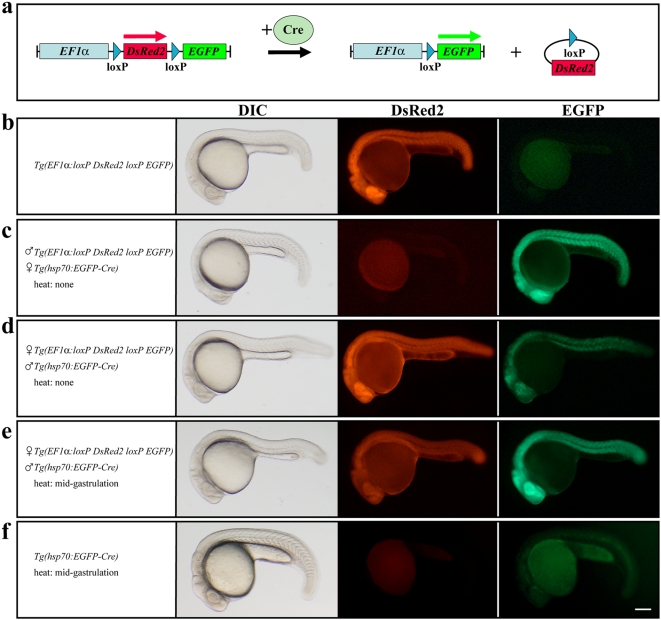
Figure 1. Cre-mediated recombination in the red-to-green reporter line.
(a) Scheme of the recombination event. In the absence of Cre the EF1α promoter drives the expression of DsRed2 but changes to EGFP after successful Cre-mediated recombination. (b) Embryos of the red-to-green reporter line show strong DsRed2 and no EGFP fluorescence. (c) Maternal contribution of the Tg(hsp70:EGFP-Cre) allele results in complete loss of DsRed2 and ubiquitous EGFP expression in double transgenic embryos. (d) Paternal contribution of the Tg(hsp70:EGFP-Cre) allele leads to strong DsRed2 and mosaic EGFP expression in double transgenic embryos. (e) Paternal contribution of the Tg(hsp70:EGFP-Cre) allele and brief heat induction at mid-gastrulation stages results in reduced DsRed2 and strong ubiquitous EGFP expression in double transgenic embryos. (f) Embryos of the Tg(hsp70:EGFP-Cre) line show only weak EGFP fluorescence after brief heat induction at mid-gastrulation stages. b–f Lateral views of live 24 hpf embryos bearing different transgenes. Scale bar, 125 µm.
Figure 2
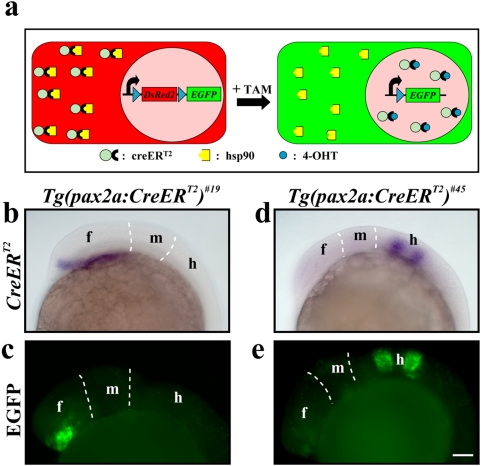
Figure 2. Ligand-dependent Cre-mediated recombination.
(a) Scheme of the ligand-dependent recombination event in cells of the red-to-green reporter line. The chimeric CreERT2 recombinase is retained in the cytoplasm in the absence of the ligand. After administration of TAM which is converted to the active ligand 4-OHT, CreERT2 translocates to the nucleus, where it catalyzes the recombination event. (b) Expression of CreERT2 in the diencephalon of the Tg(pax2a:CreERT2)#19 line at early segmentation stages revealed by in situ hybridization. (c) EGFP expression in the diencephalon of double transgenic embryos at 24 hpf bearing the red-to-green reporter and the Tg(pax2a:CreERT2)#19 alleles after TAM treatment at mid-gastrulation stages. (d) Expression of CreERT2 in rhombomere 3 and 5 of the Tg(pax2a:CreERT2)#45 line at early segmentation stages revealed by in situ hybridization. (e) EGFP expression in rhombomere 3 and 5 of double transgenic embryos at 24 hpf bearing the red-to-green reporter and the Tg(pax2a:CreERT2)#45 alleles after TAM treatment at mid-gastrulation stages. Abbreviations: f, forebrain; h, hindbrain; m, midbrain. Scale bar, 50 µm.
Figure 3
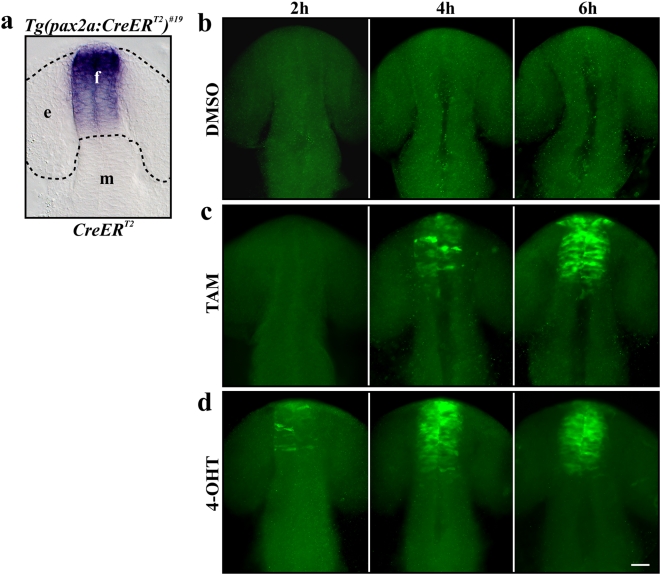
Figure 3. Kinetics of ligand-dependent Cre-mediated recombination.
(a) Expression of CreERT2 in the Tg(pax2a:CreERT2)#19 line at the 12-somite stage revealed by in situ hybridization. (b) Control embryos treated with DMSO never show any EGFP. (c) Immunofluorescence staining with antibodies to EGFP is detectable 4 hours after application of TAM and expanded further after 6 hours. (d) Onset of EGFP expression by immunofluorescence staining is detected after 2 hours and expanded further after 4 and 6 hours after application of 4-OHT. a–d Dorsal views of double transgenic embryos at 12-, 16-, 20 and 24-somite stage (15, 17, 19 and 21 hpf). Abbreviations: f, forebrain; e, eye anlage; h, hours; m, midbrain. Scale bar, 30 µm.
Figure 4
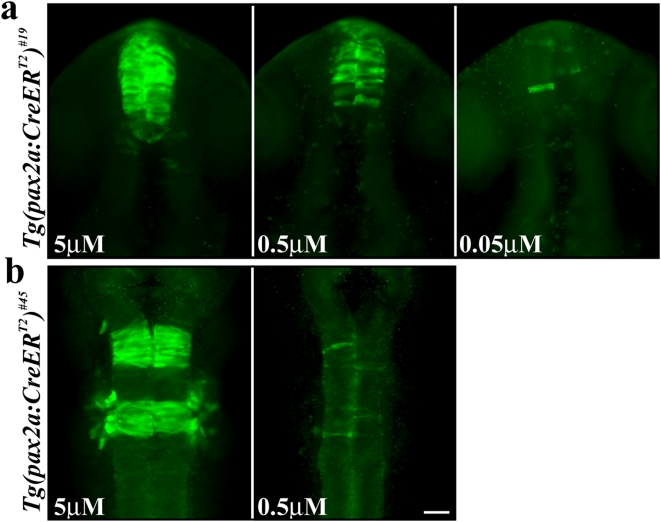
Figure 4. Dose-dependent recombination in the Tg(pax2a:CreERT2)#19 and Tg(pax2a:CreERT2)#45 lines by TAM.
(a) Double transgenic embryos bearing the red-to-green reporter and the Tg(pax2a:CreERT2)#19 alleles show strong EGFP expression in the diencephalon after application of 5 µM TAM at mid-gastrulation stages. Application of 0.5 µM TAM or 0.05 µM TAM at the same stage, results in reduced EGFP expression or single EGFP-positive cells, respectively. (b) Double transgenic embryos bearing the red-to-green reporter and the Tg(pax2a:CreERT2)#45 alleles show strong EGFP expression in rhombomere 3 and 5 after application of 5 µM TAM at mid-gastrulation stages. Application of 0.5 µM TAM at the same stage, results in single EGFP-positive cells. a, b Dorsal views of double transgenic embryos at 24 hpf. Scale bar, 30 µm.

References

    1. Lieschke GJ, Currie PD. Animal models of human disease: zebrafish swim into view. Nat Rev Genet. 2007;8:353–367. - PubMed
    1. Haffter P, Granato M, Brand M, Mullins MC, Hammerschmidt M, et al. The identification of genes with unique and essential functions in the development of the zebrafish, Danio rerio. Development. 1996;123:1–36. - PubMed
    1. Driever W, Solnica-Krezel L, Schier AF, Neuhauss SC, Malicki J, et al. A genetic screen for mutations affecting embryogenesis in zebrafish. Development. 1996;123:37–46. - PubMed
    1. Nasevicius A, Ekker SC. Effective targeted gene ‘knockdown’ in zebrafish. Nat Genet. 2000;26:216–20. - PubMed
    1. Wienholds E, van Eeden F, Kosters M, Mudde J, Plasterk RH, et al. Efficient target-selected mutagenesis in zebrafish. Genome Res. 2003;13:2700–7. - PMC - PubMed

Publication types

LinkOut - more resources