


Angiotensin-receptor blockers as therapy for mild-to-moderate hypertension-associated non-alcoholic steatohepatitis
- PMID: 19248193
- PMCID: PMC2653406
- DOI: 10.3748/wjg.15.942
Angiotensin-receptor blockers as therapy for mild-to-moderate hypertension-associated non-alcoholic steatohepatitis
Abstract
Aim: To evaluate insulin resistance, cytolysis and non-alcoholic steatohepatitis (NASH) score (NAS) using the Kleiner and Brunt criteria in 54 patients with NASH and mild-to-moderate hypertension, treated with telmisartan vs valsartan for 20 mo.
Methods: All patients met the NCEP-ATP III criteria for metabolic syndrome. Histology confirmed steatohepatitis, defined as a NAS greater than five up to 3 wk prior inclusion, using the current criteria. Patients with viral hepatitis, chronic alcohol intake, drug abuse or other significant immune or metabolic hepatic pathology were excluded. Subjects were randomly assigned either to the valsartan (V) group (standard dose 80 mg o.d., n = 26), or to the telmisartan (T) group (standard dose 20 mg o.d., n = 28). Treatment had to be taken daily at the same hour with no concomitant medication or alcohol consumption allowed. Neither the patient nor the medical staff was aware of treatment group allocation. Paired liver biopsies obtained at inclusion (visit 1) and end of treatment (EOT) were assessed by a single blinded pathologist, not aware of patient or treatment group. Blood pressure, BMI, ALT, AST, HOMA-IR, plasma triglycerides (TG) and total cholesterol (TC) were evaluated at inclusion and every 4 mo until EOT (visit 6).
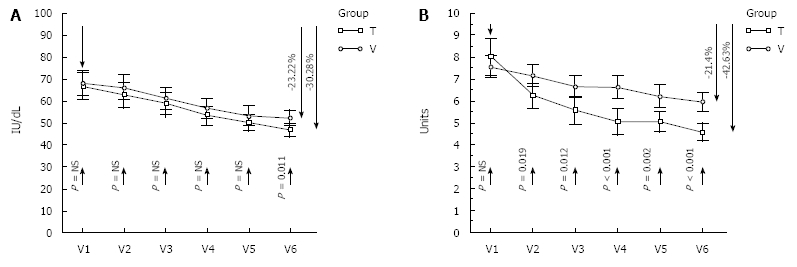
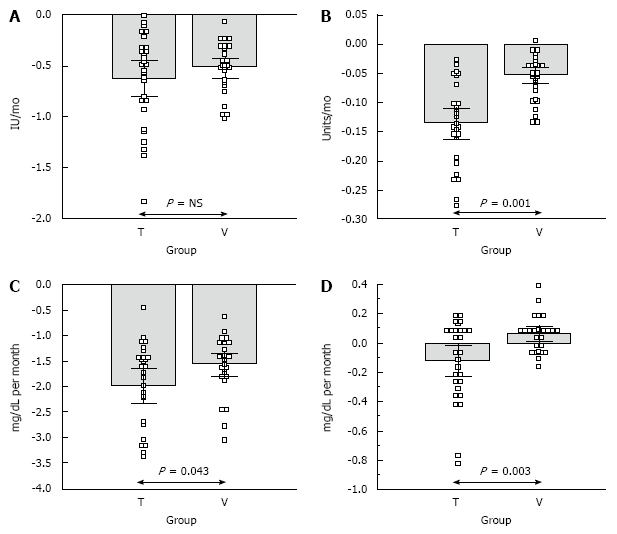
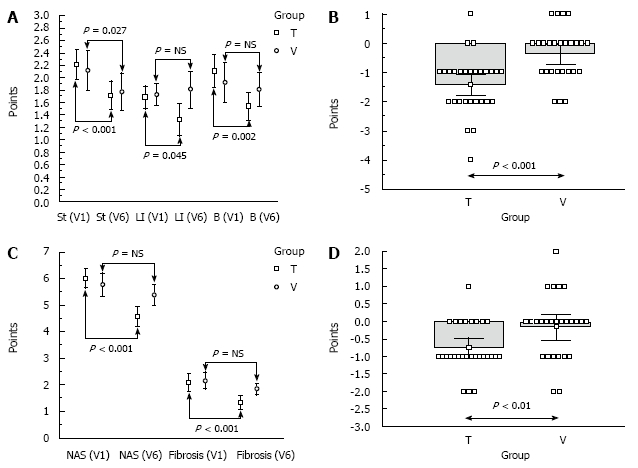
Results: At EOT we noticed a significant decrease in ALT levels vs inclusion in all patients and this decrease did not differ significantly in group T vs group V. HOMA-IR significantly decreased at EOT vs inclusion in all patients but in group T, the mean HOMA-IR decrease per month was higher than in group V. NAS significantly diminished at EOT in all patients with a higher decrease in group T vs group V.
Conclusion: Angiotensin receptor blockers seem to be efficient in hypertension-associated NASH. Telmisartan showed a higher efficacy regarding insulin resistance and histology, perhaps because of its specific PPAR-gamma ligand effect.
Figures
References
-
- Angulo P. GI epidemiology: nonalcoholic fatty liver disease. Aliment Pharmacol Ther. 2007;25:883–889. - PubMed
-
- Sherman M. Hepatocellular carcinoma: epidemiology, risk factors, and screening. Semin Liver Dis. 2005;25:143–154. - PubMed
-
- Bugianesi E, Leone N, Vanni E, Marchesini G, Brunello F, Carucci P, Musso A, De Paolis P, Capussotti L, Salizzoni M, et al. Expanding the natural history of nonalcoholic steatohepatitis: from cryptogenic cirrhosis to hepatocellular carcinoma. Gastroenterology. 2002;123:134–140. - PubMed
-
- Caldwell SH, Oelsner DH, Iezzoni JC, Hespenheide EE, Battle EH, Driscoll CJ. Cryptogenic cirrhosis: clinical characterization and risk factors for underlying disease. Hepatology. 1999;29:664–669. - PubMed
-
- Powell EE, Jonsson JR, Clouston AD. Steatosis: co-factor in other liver diseases. Hepatology. 2005;42:5–13. - PubMed
Publication types
MeSH terms
Substances
LinkOut - more resources
Full Text Sources
Other Literature Sources
Medical
Miscellaneous
