


Neural mechanisms of grief regulation
- PMID: 19249748
- PMCID: PMC2782609
- DOI: 10.1016/j.biopsych.2009.01.019
Neural mechanisms of grief regulation
Abstract
Background: The death of an attachment figure triggers intrusive thoughts of the deceased, sadness, and yearning for reunion. Recovery requires reduction of symptoms. We hypothesized that symptoms might correlate with a capacity to regulate attention toward reminders of the deceased, and activity in, and functional connectivity between, prefrontal regulatory regions and the amygdala.
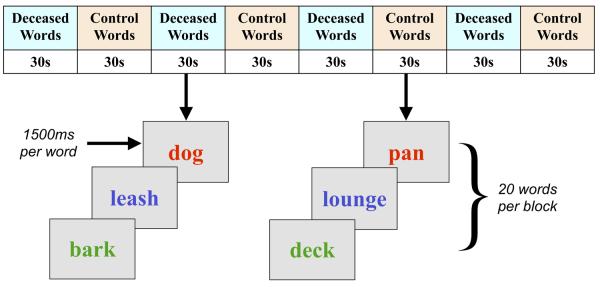
Methods: Twenty recently bereaved subjects rated intrusive thoughts of the deceased versus a capacity to avoid thoughts (grief style). Reaction time was measured while subjects completed an Emotional Stroop (ES) task contrasting deceased-related with control words during functional magnetic resonance imaging (fMRI). Subjects subsequently visualized the death of the deceased and rated induced emotions.
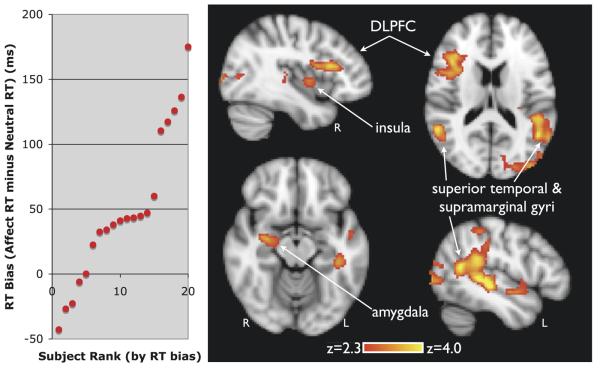
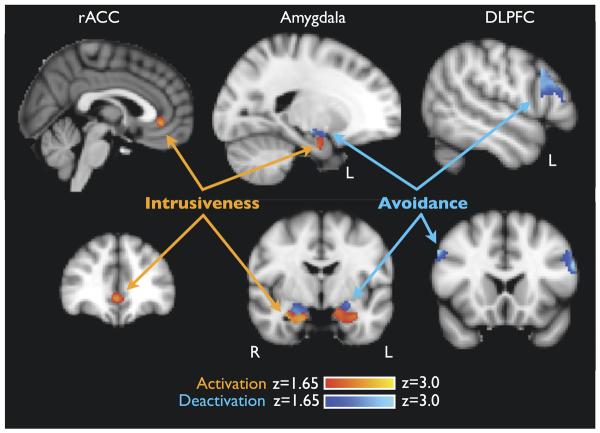
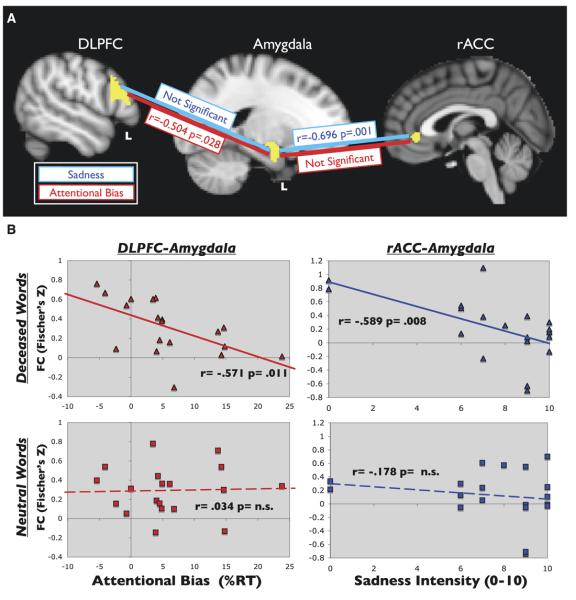
Results: Subjects demonstrated attentional bias toward deceased-related words. Bias magnitude correlated with amygdala, insula, dorsolateral prefrontal cortex (DLPFC) activity. Amygdala activity predicted induced sadness intensity. A double dissociation between grief style and both prefrontal and amygdala subregion activity was found. Intrusiveness correlated with activation of ventral amygdala and rostral anterior cingulate (rACC); avoidance correlated with deactivation of dorsal amygdala and DLPFC. A double dissociation between regulatory region and task-dependent functional connectivity (FC) was found. High DLPFC-amygdala FC correlated with reduced attentional bias, while low rACC-amygdala FC predicted sadness intensity.
Conclusions: Results are consistent with a model in which activity in and functional connectivity between the amygdala and prefrontal regulatory regions indexes differences in mourners' regulation of attention and sadness during pangs of grief, and may be used to distinguish between clinically relevant differences in grief style.
Figures
References
-
- Rosenblatt P, Walsh R, Jackson D. Grief and Mourning in Cross-Cultural Perspective. Human Relations Area File Press; New Haven, CT: 1976.
-
- Kagawa-Singer M. The cultural context of death rituals and mourning practices. Oncol Nurs Forum. 1998;25:1752–1756. - PubMed
-
- Archer J. Grief from an evolutionary perspective. In: Stroeb M, Hansson R, Stroeb W, Schut H, editors. Handbook of Bereavement Research: Consequences, Coping, and Care. American Psychological Association; Washington, DC: 2001.
-
- Maciejewski PK, Zhang B, Block SD, Prigerson HG. An empirical examination of the stage theory of grief. JAMA. 2007;297:716–723. - PubMed
-
- Lichtenthal W, Cruess D, Prigerson H. A case for establishing complicated grief as a distinct mental disorder in DSM-V. Clin Psychol Rev. 2004;24:637–662. - PubMed
Publication types
MeSH terms
Substances
Grants and funding
LinkOut - more resources
Full Text Sources
