


Yoga therapy decreases dyspnea-related distress and improves functional performance in people with chronic obstructive pulmonary disease: a pilot study
- PMID: 19249998
- PMCID: PMC3051406
- DOI: 10.1089/acm.2008.0389
Yoga therapy decreases dyspnea-related distress and improves functional performance in people with chronic obstructive pulmonary disease: a pilot study
Abstract
Background: There has been limited study of yoga training as a complementary exercise strategy to manage the symptom of dyspnea in patients with chronic obstructive pulmonary disease (COPD).
Purpose: The primary purpose of this pilot study was to evaluate a yoga program for its safety, feasibility, and efficacy for decreasing dyspnea intensity (DI) and dyspnea-related distress (DD) in older adults with COPD.
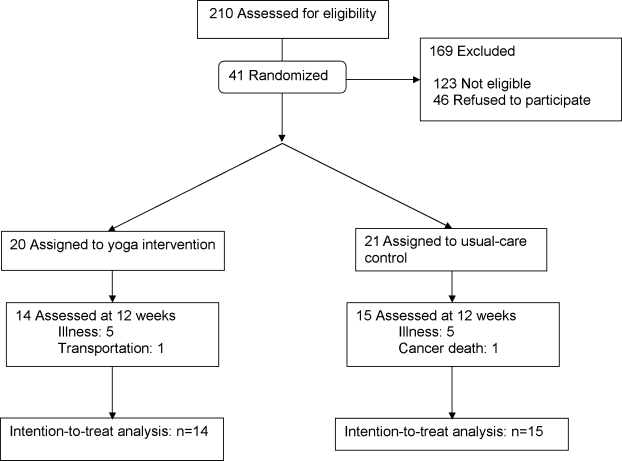
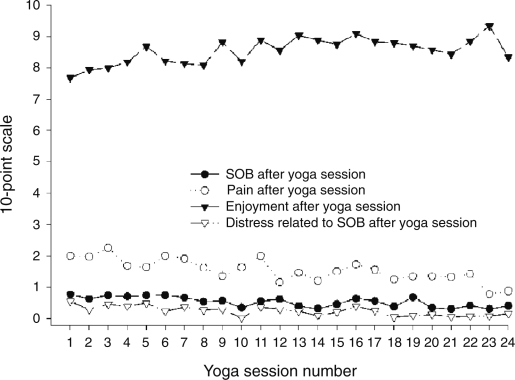
Methods: Clinically stable patients with COPD (n = 29; age 69.9 +/- 9.5; forced expiratory volume in 1 second (FEV(1)) 47.7 +/- 15.6% predicted; female = 21) were randomized to a 12-week yoga program specifically designed for people with COPD or usual-care control (UC). The twice-weekly yoga program included asanas (yoga postures) and visama vritti pranayama (timed breathing). Safety measure outcomes included heart rate, oxygen saturation, dyspnea, and pain. Feasibility was measured by patient-reported enjoyment, difficulty, and adherence to yoga sessions. At baseline and at 12 weeks, DI and DD were measured during incremental cycle ergometry and a 6-minute walk (6MW) test. Secondary efficacy outcomes included physical performance, psychologic well-being, and health-related quality of life (HRQoL).
Results: Yoga training was safe and feasible for patients with COPD. While yoga training had only small effects on DI after the 6MW test (effect size [ES], 0.20; p = 0.60), there were greater reductions in DD in the yoga group compared to UC (ES, 0.67; p = 0.08). Yoga training also improved 6MW distance (+71.7 +/- 21.8 feet versus -27.6 +/- 36.2 feet; ES = 0.78, p = 0.04) and self-reported functional performance (ES = 0.79, p = 0.04) compared to UC. There were small positive changes in muscle strength and HRQoL.
Conclusions: Elderly patients with COPD participated safely in a 12-week yoga program especially designed for patients with this chronic illness. After the program, the subjects tolerated more activity with less DD and improved their functional performance. These findings need to be confirmed in a larger, more sufficiently powered efficacy study.
Figures
References
-
- American Thoracic Society. Dyspnea: Mechanisms, assessment, and management: A consensus statement. Am J Respir Crit Care Med. 1999;159:321–340. - PubMed
-
- Lorenz K. Lynn J. Morton S. Dy S. End-of-Life Care and Outcomes: Summary, Evidence Report/Technology Assessment: Number 110. Rockville, MD: AHRQ Publication Number 05-E004–1, Agency for Healthcare Research and Quality; 2004. [Dec 8;2008 ].
-
- Solano JP. Gomes B. Higginson IJ. A comparison of symptom prevalence in far advanced cancer, AIDS, heart disease, chronic obstructive pulmonary disease and renal disease. J Pain Symp Manage. 2006;31:58–69. - PubMed
-
- Nici L. Donner C. Wouters E, et al. American Thoracic Society/European Respiratory Society Statement on Pulmonary Rehabilitation. Am J Respir Crit Care Med. 2006;173:1390–1413. - PubMed
-
- Troosters T. Casaburi R. Gosselink R. Decramer M. Pulmonary rehabilitation in chronic obstructive pulmonary disease. Am J Respir Crit Care Med. 2005;172:19–38. - PubMed
Publication types
MeSH terms
Grants and funding
LinkOut - more resources
Full Text Sources
Medical
