


Do minority or white patients respond to brief alcohol intervention in trauma centers? A randomized trial
- PMID: 19250705
- PMCID: PMC2745201
- DOI: 10.1016/j.annemergmed.2009.01.033
Do minority or white patients respond to brief alcohol intervention in trauma centers? A randomized trial
Abstract
Study objective: The current study evaluates whether the effectiveness of brief alcohol intervention in reducing 6- and 12-month risk of injuries in a large Level I urban trauma center varies according to trauma patients' ethnicity.
Methods: Eligible white, Hispanic, and black trauma patients aged 18 years or older were randomized to brief alcohol intervention or treatment as usual. The intervention was a "non-confrontational, patient-centered conversation" focused on patients' drinking pattern, with the purpose of encouraging them to change risky drinking. Study outcomes were patient-reported 6- and 12-month incidence of all-type injuries, alcohol-related injuries, and serious injuries (ie, injuries requiring emergency department visit or hospital admission).
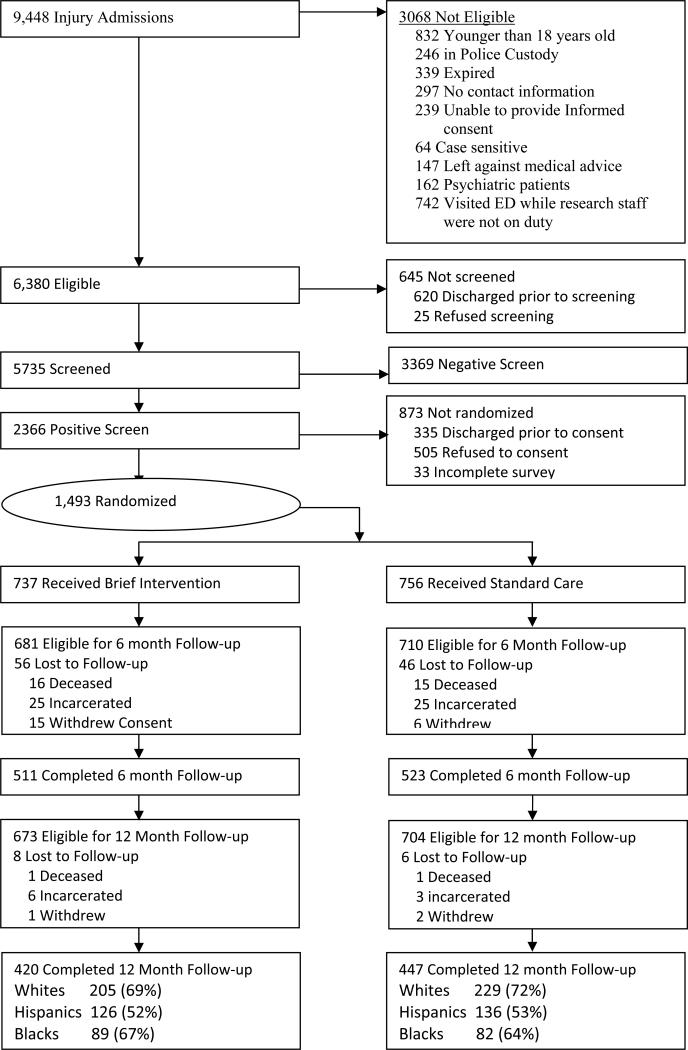
Results: A total of 1,493 trauma patients (668 whites, 537 Hispanics, 288 blacks) participated in this study. After 1 year of follow-up, we were not able to detect any important association between brief intervention and the risk of all-type injuries, alcohol-related injuries, or serious injuries among study participants. In addition, the association between brief intervention and the outcomes of interest was not modified by patients' ethnicity.
Conclusion: Our study, congruent with some recent publications, implies that there are some patient- and provider-related impediments that could restrict the effectiveness of brief intervention programs in trauma centers, regardless of patient ethnicity. Unless those impediments are identified and eliminated, assuming that brief intervention will be an effective strategy for controlling future alcohol-related injuries among trauma patients and should be provided under any circumstances might not be reasonable.
References
-
- Miller WR, Rollnick S. Motivational Interviewing: Preparing People to Change. Guilford Press; NY: 2002.
-
- Project MATCH Research Group Matching alcoholism treatments to client heterogeneity: Project MATCH post treatment outcomes. Journal of Studies on Alcohol. 1997;58:7–29. - PubMed
-
- Fleming MF, Barry KL, Manwell LB, et al. Brief physician advice for problem alcohol drinkers - A randomized controlled trial in community-based primary care practices. Jama-Journal of the American Medical Association. 1997 Apr;277(13):1039–1045. - PubMed
-
- Israel Y, Hollander O, Sanchez-Craig M, et al. Screening for problem drinking and counseling by the primary care physician-nurse team. Alcoholism,Clinical and Experimental Research. 1996;20:1443–1450. - PubMed
-
- Bien TH, Miller WR, Tonigan JS. Brief interventions for alcohol problems: A review. Addiction. 1993;88:315–335. - PubMed
Publication types
MeSH terms
Grants and funding
LinkOut - more resources
Full Text Sources
Medical
