. 2009 Mar 17;106(11):4465-70.
doi: 10.1073/pnas.0813339106. Epub 2009 Feb 27.

Schwann cells expressing dismutase active mutant SOD1 unexpectedly slow disease progression in ALS mice

Affiliations

Schwann cells expressing dismutase active mutant SOD1 unexpectedly slow disease progression in ALS mice

Christian S Lobsiger et al. Proc Natl Acad Sci U S A. .

Abstract

Neurodegeneration in an inherited form of ALS is non-cell-autonomous, with ALS-causing mutant SOD1 damage developed within multiple cell types. Selective inactivation within motor neurons of an ubiquitously expressed mutant SOD1 gene has demonstrated that mutant damage within motor neurons is a determinant of disease initiation, whereas mutant synthesis within neighboring astrocytes or microglia accelerates disease progression. We now report the surprising finding that diminished synthesis (by 70%) within Schwann cells of a fully dismutase active ALS-linked mutant (SOD1(G37R)) significantly accelerates disease progression, accompanied by reduction of insulin-like growth factor 1 (IGF-1) in nerves. Coupled with shorter disease duration in mouse models caused by dismutase inactive versus dismutase active SOD1 mutants, our findings implicate an oxidative cascade during disease progression that is triggered within axon ensheathing Schwann cells and that can be ameliorated by elevated dismutase activity. Thus, therapeutic down-regulation of dismutase active mutant SOD1 in familial forms of ALS should be targeted away from Schwann cells.


Conflict of interest statement

The authors declare no conflict of interest.

Figures

Fig. 1.
Fig. 1.
Targeted P0-cre-mediated gene excision in LoxSOD1G37R ALS mice was used to specifically reduce Schwann cell-expressed mutant SOD1. (A–D) β-galactosidase (β-Gal) activity in Schwann cells (A and B, arrows) of longitudinal sciatic nerve sections, as well as in terminal Schwann cells (C, arrows; visualized with S100 immunostaining) at the neuromuscular junction (arrowheads) of gastrocnemius muscles but not in (D) spinal cord glia or neurons of (A–D) adult ROSA26/P0-Cre reporter mice, visualized with X-Gal (A–D) and counterstained with eosin (A, B, and D). [Scale bars: 100 μm (A and D); 30 μm (B and C).] (E and F) qPCR showing a 70% reduction of human SOD1G37R transgene (E) and mRNA (F) levels (P < 0.01; Student's t test) in sciatic nerves of LoxSOD1G37R/P0-cre (Cre+) mice relative to LoxSOD1G37R (Cre) littermates, without significant spinal cord SOD1G37R transgene reduction (E) (n = 3 mice per group; presymptomatic, 4 months old; error bars, SEM).
Fig. 2.
Fig. 2.
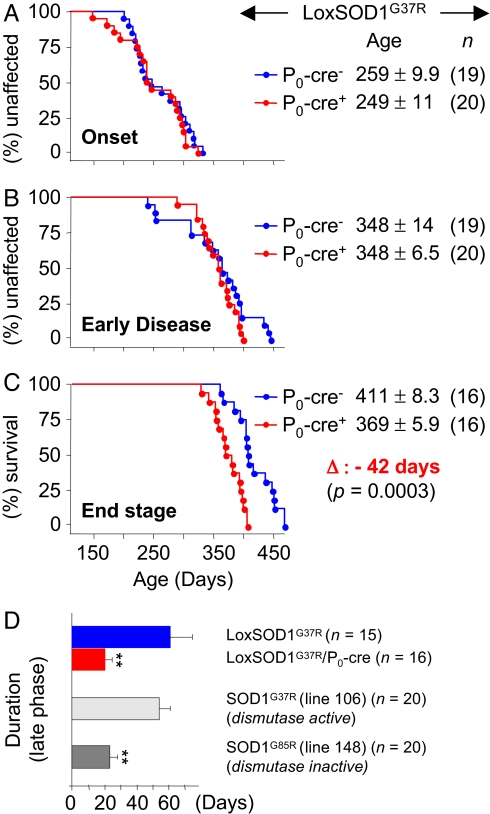
Selective mutant SOD1 gene excision from Schwann cells accelerates disease progression in ALS mice. (A–C) Plots of ages (in days) at which disease onset (A), early disease (B), and end stage (C) are reached in LoxSOD1G37R ALS mice with (blue) and without (red) mutant SOD1 in Schwann cells. (D) Correlation between dismutase activity of Schwann cell-localized SOD1 mutants with slow disease progression in ALS mice: removal of dismutase active mutant SOD1G37R from Schwann cells leads to a 3-fold faster late phase (from early disease to end stage) in LoxSOD1G37R/P0-cre mice than in LoxSOD1G37R mice (P < 0.01; Student's t test). This difference correlates well with a faster late phase in dismutase inactive mutant SOD1G85R mice (line 148; end stage at 12.5 months) as compared to a slow late phase in dismutase active mutant SOD1G37R mice (line 106; end stage at 13.5 months) (P < 0.001; Student's t test) (see Discussion).
Fig. 3.
Fig. 3.
Assessment of axonal degeneration in lumbar motor roots of ALS mice with or without Cre-mediated mutant SOD1 excision in Schwann cells. Numbers and distributions of axonal diameters in L5 motor roots of LoxSOD1G37R and LoxSOD1G37R/P0-cre mice at onset (8.5 months) (A), early disease (B), and end stage (C). No axonal degeneration was seen in nontransgenic or single transgenic P0-cre control mice at ages matched to onset (8.5 months) or end stage (13.5 months) (A and C) (n = 4 mice per group; error, SEM).
Fig. 4.
Fig. 4.
The inherent regenerative capacity of motor neurons after crush injury is not influenced by Schwann cell-expressed mutant SOD1. The speed of nerve regeneration (measured by the toe spread) after unilateral crush injury was assessed at 2 time points [at 4 months (A), presymptomatic, and at 8.5 months (B), onset] before the appearance of overall symptoms (at 11.5 months). No significant differences were detected between LoxSOD1G37R/P0-cre and LoxSOD1G37R ALS mice (n = 5 mice per group; only males used), indicating that removal of mutant SOD1G37R from Schwann cells did not influence the sciatic nerve's inherent regenerative capacity (similar results were obtained with females; Fig. S4A).
Fig. 5.
Fig. 5.
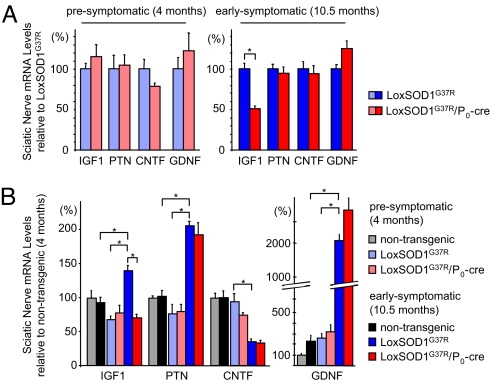
More aggressive disease progression in ALS mice with reduced Schwann cell-expressed mutant SOD1 is accompanied by reduced IGF-1. (A) By using RT-qPCR analysis, whole sciatic nerve mRNA expression levels of IGF-1, PTN, CNTF, and GDNF are compared between LoxSOD1G37R/P0-cre and LoxSOD1G37R ALS mice at presymptomatic and early symptomatic disease stages. At an early symptomatic time point (10.5 months), removal of dismutase active mutant SOD1G37R from Schwann cells leads to a 50% reduction (P < 0.05; Student's t test) selectively of IGF-1 in LoxSOD1G37R/P0-cre ALS-mice. (B) Comparison of mRNA levels from presymptomatic and early symptomatic ages in LoxSOD1G37R ALS mice: disease-associated inductions are found for IGF-1 (2.0-fold), PTN (2.7-fold), and GDNF (8.6-fold), whereas CNTF is reduced (2.3-fold) (P < 0.05; Student's t test). There is no disease-associated IGF-1 induction after removal of mutant SOD1 from Schwann cells. Absolute inductions of IGF-1 and PTN in early symptomatic LoxSOD1G37R ALS mice as compared with age-matched (nontransgenic) control mice are 1.5-fold and 2.0-fold, respectively (P < 0.05; Student's t test) (n = 3 mice per group; error bars, SEM).

References

    1. Boillee S, Vande Velde C, Cleveland DW. ALS: A disease of motor neurons and their nonneuronal neighbors. Neuron. 2006;52:39–59. - PubMed
    1. McNamara JO, Fridovich I. Human genetics. Did radicals strike Lou Gehrig? Nature. 1993;362:20–21. - PubMed
    1. Rothstein JD, Martin LJ, Kuncl RW. Decreased glutamate transport by the brain and spinal cord in amyotrophic lateral sclerosis. N Engl J Med. 1992;326:1464–1468. - PubMed
    1. Liu J, et al. Toxicity of familial ALS-linked SOD1 mutants from selective recruitment to spinal mitochondria. Neuron. 2004;43:5–17. - PubMed
    1. Urushitani M, et al. Chromogranin-mediated secretion of mutant superoxide dismutase proteins linked to amyotrophic lateral sclerosis. Nat Neurosci. 2006;9:108–118. - PubMed

Publication types

MeSH terms