


Review
doi: 10.1038/nrmicro2107.
Epub 2009 Mar 2.
The role of predictive modelling in rationally re-engineering biological systems
Affiliations
- PMID: 19252506
- PMCID: PMC2734281
- DOI: 10.1038/nrmicro2107
Item in Clipboard
Review
The role of predictive modelling in rationally re-engineering biological systems
Nat Rev Microbiol.
2009 Apr.
Abstract
Technologies to synthesize and transplant a complete genome into a cell have opened limitless potential to redesign organisms for complex, specialized tasks. However, large-scale re-engineering of a biological circuit will require systems-level optimization that will come from a deep understanding of operational relationships among all the constituent parts of a cell. The integrated framework necessary for conducting such complex bioengineering requires the convergence of systems and synthetic biology. Here, we review the status of these rapidly developing interdisciplinary fields of biology and provide a perspective on plausible venues for their merger.
Figures
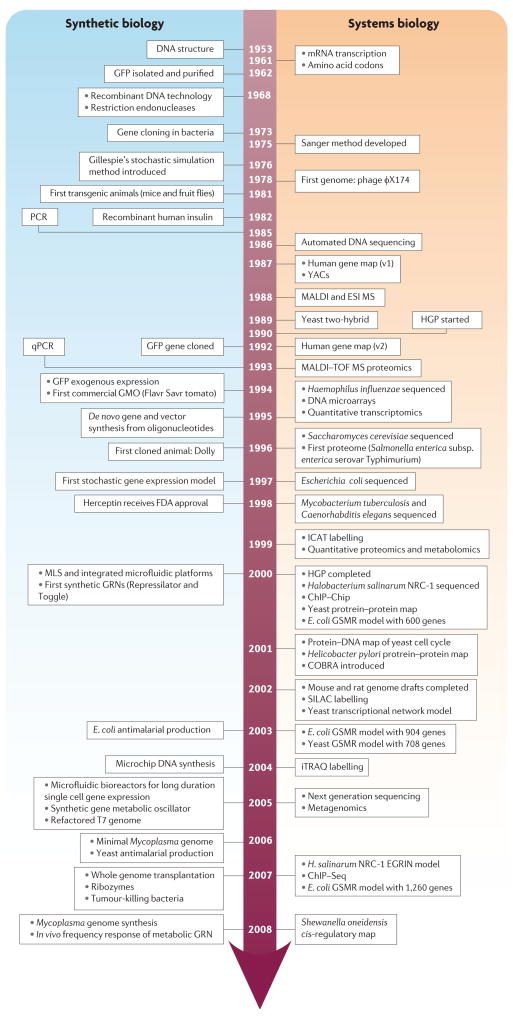
Key milestones within the fields of systems biology and synthetic biology are highlighted. For brevity and clarity, we have only included key advances in molecular systems biology and have not included important events related to other macroscale systems biology efforts; for example, human physiological systems and ecological systems. Although it is difficult to differentiate the specific impact some events have had on either of the two fields, we have attempted to do so for consistency. Particularly noteworthy are the events in which complete organism sequences were made available to the public and paired with gene regulatory and metabolic reconstruction models. Next generation sequencing refers to pyrosequencing on beads, polony sequencing and sequencing by synthesis. Pivotal technologies that produced new paradigms for systems and synthetic research are also important; for example, the use of mass spectrometry (MS) for proteomic analysis gave rise to quantitative proteomics and eventually metabolomics, multilayer soft lithography and microfluidic devices, and next-generation sequencing technologies enabled deep metagenomics studies. ChIP–chip, chromatin immunoprecipitation with microarray hybridization; ChIP–Seq, chromatin immunoprecipitation with sequencing; COBRA, constraints-based reconstruction and analysis; EGRIN, environment and gene regulatory influence network; ESI, electrospray ionization; FDA, Food and Drug Administration; GFP, green fluorescent protein; GRN, gene regulatory network; GMO, genetically modified organism; GSMR, genome-scale metabolic reconstruction; HGP, Human Genome Project; ICAT, isotopic coded affinity tag; iTRAQ, isobaric tags for relative and absolute quantitation; MALDI, matrix-assisted laser desorption ionization; MLS, multi-layer soft lithography; qPCR, quantitative PCR; SILAC, stable isotope labelling with amino acid in cell culture; TOF, time of flight; YAC, yeast artificial chromosome.
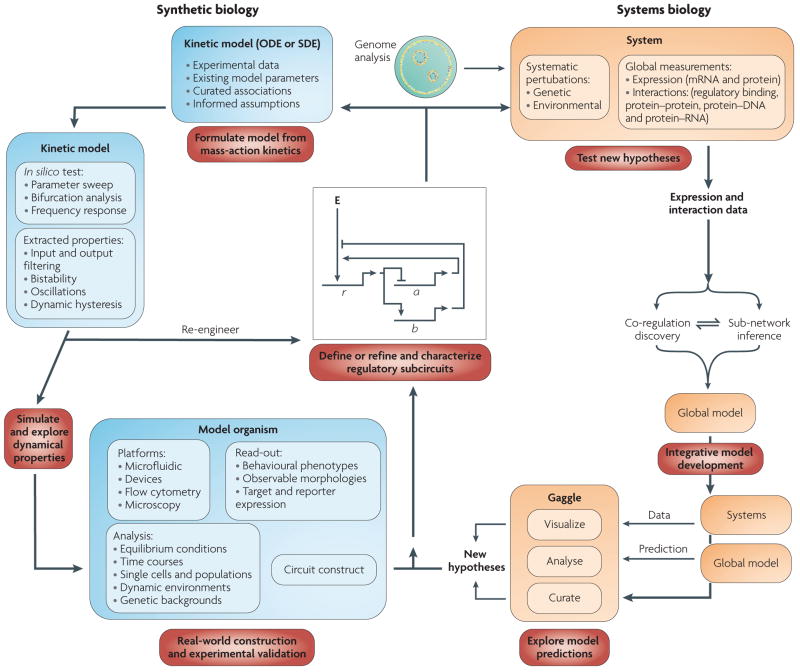
The systems biology cycle begins with a specific hypothesis that is tested by systematic perturbations through targeted environmental and genetic changes. Molecular changes are measured globally at multiple levels (for example, transcription, translation and physical interactions) using high-throughput technologies. This produces large and diverse data sets that drive the development of algorithms to process raw signal and integrate all available information to infer predictive models of how the inputs (environmental and genetic perturbations) were converted to outputs (for example, phenotypes, transcriptional changes and interactions). Owing to the complexity of these models, their exploration requires a framework that enables the integration and interoperation of diverse databases and applications for visualizing and analysing the data used to construct the models. The exploration of systems models enables a biologist to design experiments to test model predictions using classical genetics, biochemistry and molecular biology approaches. This helps define subcircuits and feeds the next iterations of the systems and synthetic biology cycles. In the synthetic biology cycle, the hypothesis begins as a specific network topology, regulatory subcircuit or set of molecular interactions. The system is mathematically formulated as systems of ordinary differential equations (ODEs), stochastic differential equations (SDEs) or a stochastic reaction network to produce a quantitative and kinetic representative model that is fit for computational simulation and testing. Key parameters of the system (synthesis and degradation rates, binding cooperativities and association or dissociation constants) are derived based on estimates from other models of well known systems. The system is analysed by focusing on exploring the parameter space and testing the kinetic properties of the system (for example, through frequency response analysis) to locate the regimes of desired dynamic behaviour and define their limits. Simulations elucidate revisions in the topology of the system to produce the desired output or enhance unexpected, but desirable, dynamic characteristics. Once these characteristics are well defined computationally, they are verified experimentally through system construction and implementation. Experimental exploration of the parameter space is performed using flow cytometry and microfluidics-based assays, which provide high-throughput measurements at population and single cell scales simultaneously. Finally, the experimental implementation incorporates revisions, leading to another iteration of computational modelling to validate the dynamics of the system. New challenges to construct hybrid models that link detailed ODE or SDE models of subcircuits to the statistically learned systems models will emerge. We suggest that such a tandem ‘top-down’ and ‘bottom-up’ approach will be essential to precisely manipulate a biological circuit and accurately predict its system-level outcomes. E represents an effector (either global regulatory influences or environmental factors), r represents a regulator gene, a represents gene A and b represents gene B.
References
-
- Yeh BJ, Lim WA. Synthetic biology: lessons from the history of synthetic organic chemistry. Nature Chem Biol. 2007;3:521–525. - PubMed
-
- Williams DC, Frank RMV, Muth WL, Burnett JP. Cytoplasmic inclusion bodies in Escherichia coli producing biosynthetic human insulin proteins. Science. 1982;215:687–689. - PubMed
-
- Bonneau R, et al. A predictive model for transcriptional control of physiology in a free living cell. Cell. 2007;131:1354–1365. - PubMed
-
- Sprinzak D, Elowitz MB. Reconstruction of genetic circuits. Nature. 2005;438:443–448. - PubMed
Publication types
MeSH terms
Grants and funding
LinkOut - more resources
Full Text Sources
