


Canine immune-mediated polyarthritis: clinical and laboratory findings in 83 cases in western Canada (1991-2001)
- PMID: 19252711
- PMCID: PMC2583415
Canine immune-mediated polyarthritis: clinical and laboratory findings in 83 cases in western Canada (1991-2001)
Abstract
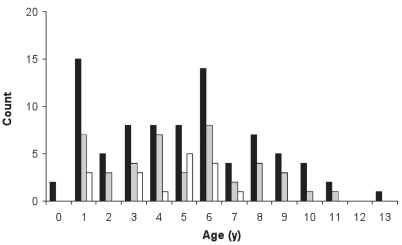
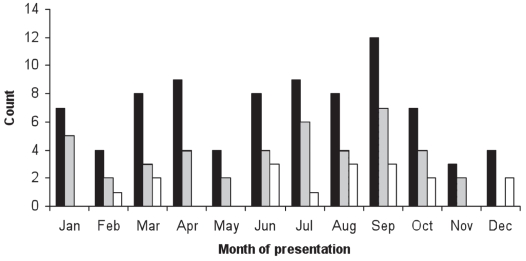
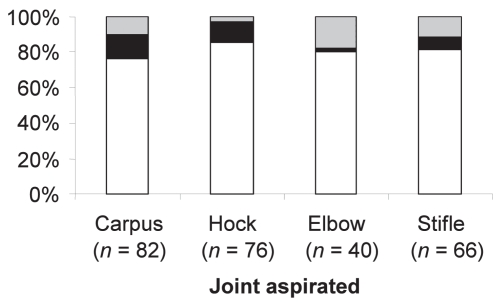
A hospital-based, case-control study was used to describe clinical and laboratory findings in 83 dogs diagnosed with noninfectious, nonerosive, immune-mediated polyarthritis (IMPA) in western Canada. Case medical records were reviewed. Cases were analyzed as total IMPA cases and as subgroups [breed, systemic lupus erythematosus (SLE), reactive, and idiopathic] and compared with the general canine hospital population. Dogs with IMPA differed in age (P = 0.004) and weight (P = 0.01) from other hospital admissions. Idiopathic IMPA cases were older (4-10 y; P < 0.05), compared with the general canine hospital population, and their common laboratory abnormalities included the following: leukocytosis, nonregenerative anemia, increased alkaline phosphatase, and hypoalbuminemia. The SLE cases were seen more often in summer and fall (P = 0.04), raising concern of an undiagnosed etiologic agent. The hock joint appeared to be the most reliable for diagnosis of IMPA, and arthrocentesis of both hock joints may aid in case identification.
Polyarthrite canine à médiation immunitaire : observations cliniques et résultats de laboratoire dans 83 cas répertoriés dans l’ouest du Canada (1991–2001). Une étude a été réalisée à partir des dossiers d’un hôpital dans le but de décrire les observations cliniques et les résultats de laboratoires chez 83 chiens ayant reçu un diagnostic de polyarthrite à médiation immunitaire (PAMI), non infectieuse et non érosive, dans l’ouest du Canada. Les cas ont été analysés dans leur ensemble et en sous-groupes [race, lupus érythémateux systémique (LES), réactifs et idiopathiques] et comparés à la population canine générale de l’hôpital. Les chiens atteints de PAMI différaient en âge (P = 0,004) et en poids (P = 0,01) des autres admissions à l’hôpital. Les cas idiopathiques de PAMI étaient plus âgés (4–10 a; P < 0,05) comparés à la population canine générale de l’hôpital et les anomalies de laboratoire comprenait : leucocytose, anémie non régénérative, phosphatase alcaline augmentée et hypoalbuminémie. Les cas de LES étaient plus nombreux en été qu’en automne (P = 0,04), soulevant la possibilité d’un agent étiologique indéterminé. L’articulation du jarret semblait être la plus fiable pour le diagnostic de la PAMI et l’arthrocentèse des 2 articulations pourrait aider pour l’identification des cas.
(Traduit par Docteur André Blouin)
Figures
References
-
- Magne M. Swollen joints and lameness. In: Ettinger JE, Feldman EC, editors. Textbook of Veterinary Internal Medicine. 5. Philadelphia: WB Saunders; 2000. pp. 77–80.
-
- Rondeau MP, Walton RM, Bissett S, et al. Suppurative, nonseptic polyarthropathy in dogs. J Vet Int Med. 2005;19:654–662. - PubMed
-
- Taylor SM. Disorders of the joints. In: Nelson RW, Couto CG, editors. Small Animal Internal Medicine. 2. Philadelphia: Mosby; 1998. pp. 1076–1088.
-
- Bennett D. Treatment of the immune-based inflammatory arthropathies of the dog and cat. In: Bonagura JD, editor. Kirk’s Current Veterinary Therapy XII Small Animal Practice. Philadelphia: WB Saunders; 1995. pp. 1188–1196.
-
- Bennett D. Immune-based non-erosive inflammatory joint disease of the dog. 3. Canine idiopathic polyarthritis. J Small Anim Pract. 1987;28:909–928.
MeSH terms
LinkOut - more resources
Full Text Sources
Medical