Case Reports
. 2009 Feb 15;149A(4):669-80.
doi: 10.1002/ajmg.a.32705.

Molecular (SNP) analyses of overlapping hemizygous deletions of 10q25.3 to 10qter in four patients: evidence for HMX2 and HMX3 as candidate genes in hearing and vestibular function

Affiliations
Case Reports

Molecular (SNP) analyses of overlapping hemizygous deletions of 10q25.3 to 10qter in four patients: evidence for HMX2 and HMX3 as candidate genes in hearing and vestibular function

Nathaniel D Miller et al. Am J Med Genet A. .

Abstract

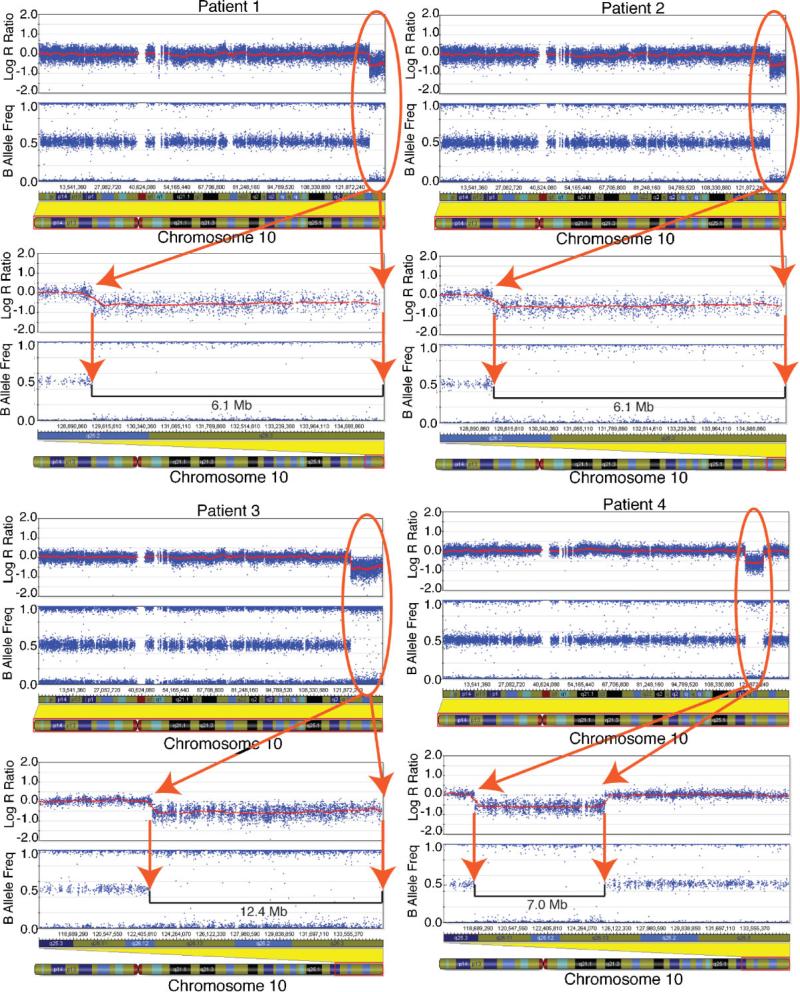
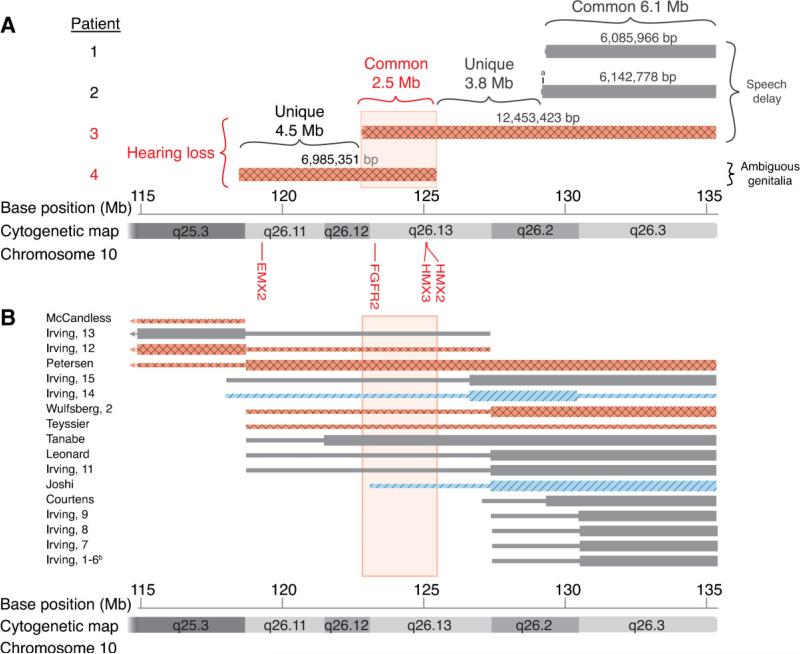
We report on the analyses of four unrelated patients with de novo, overlapping, hemizygous deletions of the long arm of chromosome 10. These include two small terminal deletions (10q26.2 to 10qter), a larger terminal deletion (10q26.12 to 10qter), and an interstitial deletion (10q25.3q26.13). Single nucleotide polymorphism (SNP) studies (Illumina 550 K) established that these deletions resulted in the hemizygous loss of approximately 6.1, approximately 6.1, approximately 12.5, and approximately 7.0 Mb respectively. Additionally, these data establish that Patients 1, 2, and 3 share common, distal, hemizygous deleted regions of 6.09 Mb containing 37 RefSeq genes. Patients 3 and 4 share a 2.52 Mb deleted region corresponding to the proximal deleted region of Patient 3 and the distal deleted region of Patient 4. This common, hemizygous region contains 20 RefSeq genes including two H6 family homeobox genes (HMX2 and HMX3). Based on previous reports that Hmx2/Hmx3 knockout mice have vestibular anomalies, we propose that hemizygous deletions of HMX2 and HMX3 are responsible for the inner ear malformations observed from CT images, vestibular dysfunction, and congenital sensorineural hearing loss found in Patients 3 and 4.


Figures
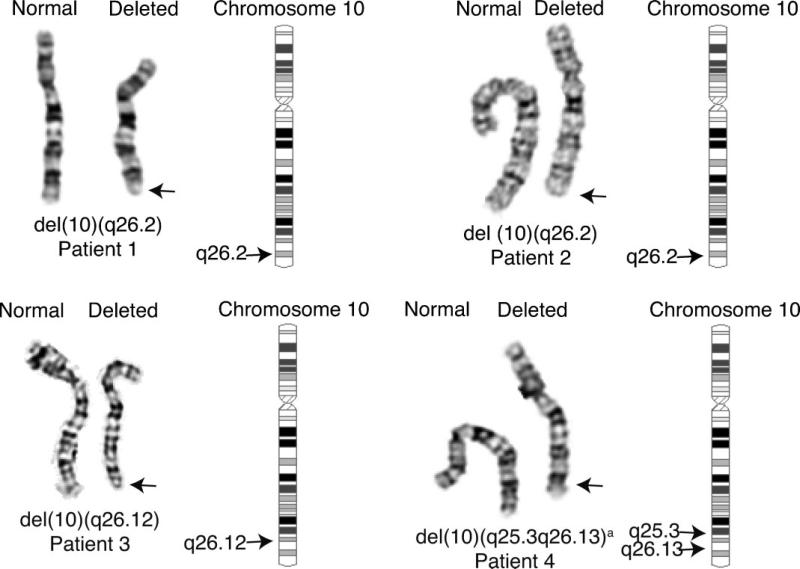
FIG. 1
FIG. 1
Karyograms of the 10q deletions. Partial karyograms showing normal and deleted chromosomes of three patients (1, 2, and 3) with terminal deletions and Patient 4 with an overlapping interstitial deletion of the long arm of chromosome 10. aThe karyogram for Patient 4 indicated a possible karyotype of del(10)(q25.2q26.11 or q26.11q26.13); analysis with SNP microarrays refined the karyotype to del(10)(q25.3q26.13).
FIG. 2
FIG. 2
10q Deletions in BeadStudio. Analysis of genotype and copy number data for four 10q deletion patients based on SNP genotyping. Results are shown for Patients 1−4 using BeadStudio software (Illumina). For each patient, results are shown for log R ratio (a measure of chromosomal copy number; y-axis) versus genomic position on chromosome 10. A horizontal smoothing line indicates that the copy number for each is at euploid levels across most of the chromosome but is present in one copy in the deletion region (oval). The B allele frequency panel indicates the presence of BB genotype calls (B allele frequency of 1.0), AB calls (frequency of 0.5), and AA calls (frequency of 0.0); in the deletion region (oval) only homozygous calls are evident. An ideogram illustrates chromosome 10, and the lower panels for each patient provide a detailed view of each deletion region. [Color figure can be viewed in the online issue, which is available at www.interscience.wiley.com.]
FIG. 3
FIG. 3
Overview of 10q deletion patients and hearing loss. Deletions of 10q for each patient are plotted. Thick bars indicate the minimum deletion. Thin bars indicate the maximum deletion. Diagonal lines (in two of the cases) indicate conductive hearing loss; diamond patterns (in six of the cases) indicate sensorineural hearing loss; and solid gray (in the remaining cases) indicates no hearing loss. A: Positions of the four deletions presented in this paper. B: Patients from the literature that have a pure 10q deletion and report on status of hearing loss. The row labels refer to the first author of the relevant publication and the patient number therein. aThe deletion in Patient 2 is 57 kb larger than in Patient 1. bIrving, Patients 1−6 are familial patients and thus depicted together [Teyssier et al., 1992; Petersen et al., 1998; Leonard et al., 1999; Tanabe et al., 1999]. [Color figure can be viewed in the online issue, which is available at www.interscience.wiley.com.]
FIG. 4
FIG. 4
CT imaging of inner ear abnormalities, Patients 3 and 4. CT images showing the inner ear abnormalities in Patients 3 and 4. A: Axial CT of Patient 3 at the level of the inner ear bilaterally. Right: Abnormally enlarged cystic vestibule (asterisk) and mildly prominent vestibular aqueduct (white arrow) are shown. Left: Abnormally large 1 cm cyst replacing the vestibule (asterisk), and small, narrowed IAC (black arrow) are shown. B: Axial CT of Patient 4 at the level of the right inner ear. The ratio of the transverse dimension of membranous vestibule (white arrow) to the inner diameter of the lateral SCC (black arrow) is increased. Bracket ({) indicates slightly dysplastic cochlea. C: Axial CT of Patient 4 at the level of the left inner ear. The ratio of the transverse dimension of membranous vestibule to the inner diameter of the lateral SCC is slightly increased (arrows same as in panel B). Bracket ({) indicates slightly dysplastic cochlea. Abbreviations: L, patient's left; R, patient's right.

References

    1. Brown D. CHARGE syndrome “behaviors”: Challenges or adaptations? Am J Med Genet Part A. 2005;133A:268–272. - PubMed
    1. Chen CP, Chern SR, Wang TH, Hsueh DW, Lee CC, Town DD, Wang W, Ko TM. Prenatal diagnosis and molecular cytogenetic analysis of partial monosomy 10q (10q25.3 → qter) and partial trisomy 18q (18q23 → qter) in a fetus associated with cystic hygroma and ambiguous genitalia. Prenat Diagn. 2005;25:492–496. - PubMed
    1. Conrad D, Andrews T, Carter N, Hurles M, Pritchard J. A high-resolution survey of deletion polymorphism in the human genome. Nat Genet. 2006;38:75–81. - PubMed
    1. Courtens W, Wuyts W, Rooms L, Pera SB, Wauters J. A subterminal deletion of the long arm of chromosome 10: A clinical report and review. Am J Med Genet Part A. 2006;140A:402–409. - PubMed
    1. Davidson HC, Harnsberger HR, Lemmerling MM, Mancuso AA, White DK, Tong KA, Dahlen RT, Shelton C. MR evaluation of vestibulocochlear anomalies associated with large endolymphatic duct and sac. Am J Neuroradiol. 1999;20:1435–1441. - PMC - PubMed

Publication types