Functional claudication distance: a reliable and valid measurement to assess functional limitation in patients with intermittent claudication
- PMID: 19254382
- PMCID: PMC2667172
- DOI: 10.1186/1471-2261-9-9
Functional claudication distance: a reliable and valid measurement to assess functional limitation in patients with intermittent claudication
Abstract
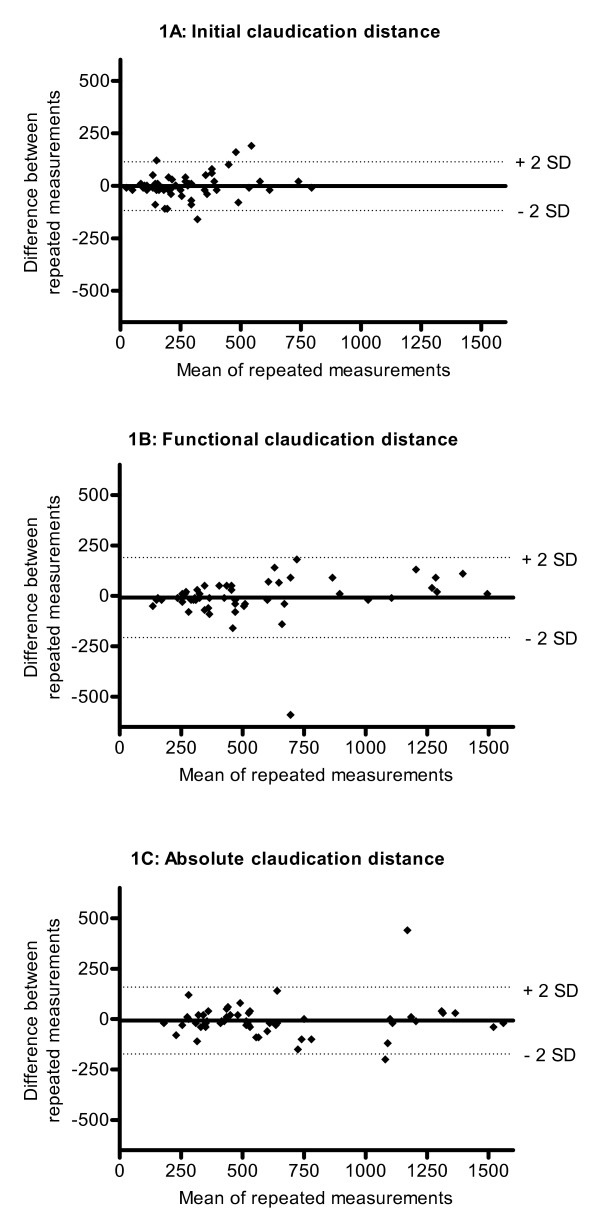
Background: Disease severity and functional impairment in patients with intermittent claudication is usually quantified by the measurement of pain-free walking distance (intermittent claudication distance, ICD) and maximal walking distance (absolute claudication distance, ACD). However, the distance at which a patient would prefer to stop because of claudication pain seems a definition that is more correspondent with the actual daily life walking distance. We conducted a study in which the distance a patient prefers to stop was defined as the functional claudication distance (FCD), and estimated the reliability and validity of this measurement.
Methods: In this clinical validity study we included patients with intermittent claudication, following a supervised exercise therapy program. The first study part consisted of two standardised treadmill tests. During each test ICD, FCD and ACD were determined. Primary endpoint was the reliability as represented by the calculated intra-class correlation coefficients. In the second study part patients performed a standardised treadmill test and filled out the Rand-36 questionnaire. Spearman's rho was calculated to assess validity.
Results: The intra-class correlation coefficients of ICD, FCD and ACD were 0.940, 0.959, and 0.975 respectively. FCD correlated significantly with five out of nine domains, namely physical function (rho = 0.571), physical role (rho = 0.532), vitality (rho = 0.416), pain (rho = 0.416) and health change (rho = 0.414).
Conclusion: FCD is a reliable and valid measurement for determining functional capacity in trained patients with intermittent claudication. Furthermore it seems that FCD better reflects the actual functional impairment. In future studies, FCD could be used alongside ICD and ACD.
Figures
Similar articles
-
Minimally Important Difference of the Absolute and Functional Claudication Distance in Patients with Intermittent Claudication.Eur J Vasc Endovasc Surg. 2016 Mar;51(3):404-9. doi: 10.1016/j.ejvs.2015.11.008. Epub 2015 Dec 20. Eur J Vasc Endovasc Surg. 2016. PMID: 26715076 Clinical Trial.
-
The walking impairment questionnaire: an effective tool to assess the effect of treatment in patients with intermittent claudication.J Vasc Surg. 2009 Jul;50(1):89-94. doi: 10.1016/j.jvs.2008.12.073. J Vasc Surg. 2009. PMID: 19563956
-
Rapid foot and calf compression increases walking distance in patients with intermittent claudication: results of a randomized study.J Vasc Surg. 2005 May;41(5):794-801. doi: 10.1016/j.jvs.2005.01.045. J Vasc Surg. 2005. PMID: 15886663 Clinical Trial.
-
Editor's choice--The effect of supervision on walking distance in patients with intermittent claudication: a meta-analysis.Eur J Vasc Endovasc Surg. 2014 Aug;48(2):169-84. doi: 10.1016/j.ejvs.2014.04.019. Epub 2014 Jun 10. Eur J Vasc Endovasc Surg. 2014. PMID: 24928167 Review.
-
A systematic review of exercise testing in patients with intermittent claudication: A focus on test standardisation and reporting quality in randomised controlled trials of exercise interventions.PLoS One. 2021 May 3;16(5):e0249277. doi: 10.1371/journal.pone.0249277. eCollection 2021. PLoS One. 2021. PMID: 33939704 Free PMC article.
Cited by
-
Evaluating the implementation of personalised outcomes forecasts to optimise supervised exercise therapy in patients with intermittent claudication in the Netherlands: a multimethods study.BMJ Open Qual. 2024 Feb 20;13(1):e002594. doi: 10.1136/bmjoq-2023-002594. BMJ Open Qual. 2024. PMID: 38378615 Free PMC article.
-
WalkingPad protocol: a randomized clinical trial of behavioral and motivational intervention added to smartphone-enabled supervised home-based exercise in patients with peripheral arterial disease and intermittent claudication.Trials. 2022 Apr 18;23(1):326. doi: 10.1186/s13063-022-06279-9. Trials. 2022. PMID: 35436974 Free PMC article.
-
Asia-Pacific Consensus Statement on the Management of Peripheral Artery Disease: A Report from the Asian Pacific Society of Atherosclerosis and Vascular Disease Asia-Pacific Peripheral Artery Disease Consensus Statement Project Committee.J Atheroscler Thromb. 2020 Aug 1;27(8):809-907. doi: 10.5551/jat.53660. Epub 2020 Jul 4. J Atheroscler Thromb. 2020. PMID: 32624554 Free PMC article.
-
Protocol for a prospective, longitudinal cohort study on the effect of arterial disease level on the outcomes of supervised exercise in intermittent claudication: the ELECT Registry.BMJ Open. 2019 Feb 19;9(2):e025419. doi: 10.1136/bmjopen-2018-025419. BMJ Open. 2019. PMID: 30782932 Free PMC article.
-
Burden of peripheral arterial disease in Europe and the United States: a patient survey.Health Qual Life Outcomes. 2013 Oct 22;11:175. doi: 10.1186/1477-7525-11-175. Health Qual Life Outcomes. 2013. PMID: 24148832 Free PMC article.
References
-
- Jongert MWA, Hendriks HJM, Van Hoek J, Klaasboer-Kogelman K, Robeer GG, Simens B, Voort S van der, Smit B. KNGF-richtlijn Claudicatio Intermittens. Nederlands Tijdschrift voor Fysiotherapie. 2003. pp. 3–58.
-
- Gardner AW, Katzel LI, Sorkin JD, Bradham DD, Hochberg MC, Flinn WR, Goldberg AP. Exercise rehabilitation improves functional outcomes and peripheral circulation in patients with intermittent claudication: a randomized controlled trial. J Am Geriatr Soc. 2001;49:755–762. doi: 10.1046/j.1532-5415.2001.49152.x. - DOI - PubMed
MeSH terms
LinkOut - more resources
Full Text Sources
