


Hypercoagulability as a prognostic factor for survival in patients with metastatic renal cell carcinoma
- PMID: 19254383
- PMCID: PMC2654863
- DOI: 10.1186/1756-9966-28-30
Hypercoagulability as a prognostic factor for survival in patients with metastatic renal cell carcinoma
Abstract
Background: In experimental systems, interference with coagulation can affect tumor biology. We suggested that abnormal coagulation could be a negative predictor for response to immunotherapy and survival among patients with metastatic renal cell carcinoma (MRCC).
Methods: To address this issue, retrospective analysis of 289 previously untreated MRCC patients entering on institutional review board-approved clinical trials was conducted between 2003 and 2006. In addition, two groups of MRCC patients with (n = 28) or without (n = 28) hypercoagulability were compared in a case-control study. Baseline and treatment characteristics were well balanced.
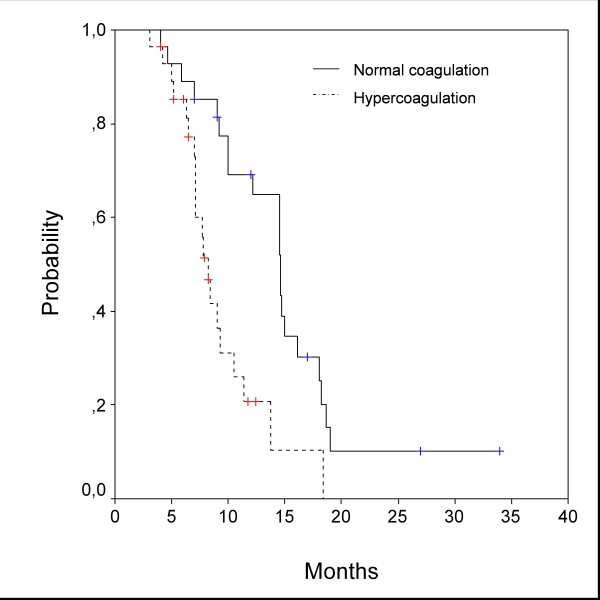
Results: Hypercoagulability was present at treatment start in 40% of patients. Median baseline fibrinogen was 6.2 mg/dl. Serious disorders were found in 68% of patients. Abnormal coagulation was strongly associated with a number of metastatic sites (2 and more metastatic sites vs. 0-1 (P = .001). Patients with high extent of hypercoagulability had significantly higher number of metastatic sites (P = .02). On univariate analysis, patients with hypercoagulability had significantly shorter overall survival than patients with normal coagulation; median survivals of 8.9 and 16.3, respectively (P = .001).Short survival and low response rate also were significantly associated with hypercoagulability in a case-control study. Median survival was 8.2 months and 14.6 months, respectively (P = .0011). Disease control rate (overall response + stable disease) was significantly higher in patients with normal coagulation: 71.4 versus 42.9% (P = .003).
Conclusion: Hypercoagulability disorders were found to be prognostic factor for response rate to systemic therapy and survival in patients with MRCC.
Figures
References
-
- Davydov MI, Aksel EM. Cancer statistics of Russia and CIS states in 2005. Journal of NN Blokhin Russian Cancer Research Center. 2007;18(2):52–90.
-
- DeVita VT, Jr, Hellman S, Rosenberg SA. Cancer: principles and practice of oncology. 7. Philadelphia, Pa: Lippincott Williams & Wilkins; 2004.
-
- Escudier B, Eisen T, Stadler WM, Szczylik C, Oudard S, Siebels M, Negrier S, Chevreau C, Solska E, Desai AA, Rolland F, Demkow T, Hutson TE, Gore M, Freeman S, Schwartz B, Shan M, Simantov R, Bukowski RM, TARGET Study Group Sorafenib in advanced clear-cell renal-cell carcinoma. N Engl J Med. 2007;356:125–34. doi: 10.1056/NEJMoa060655. - DOI - PubMed
Publication types
MeSH terms
LinkOut - more resources
Full Text Sources
Other Literature Sources
Medical
