


Effects of single-task versus dual-task training on balance performance in older adults: a double-blind, randomized controlled trial
- PMID: 19254600
- PMCID: PMC2768031
- DOI: 10.1016/j.apmr.2008.09.559
Effects of single-task versus dual-task training on balance performance in older adults: a double-blind, randomized controlled trial
Abstract
Objective: To compare the effect of 3 different approaches to balance training on dual-task balance performance in older adults with balance impairment.
Design: A double-blind, randomized controlled trial.
Setting: University research laboratory.
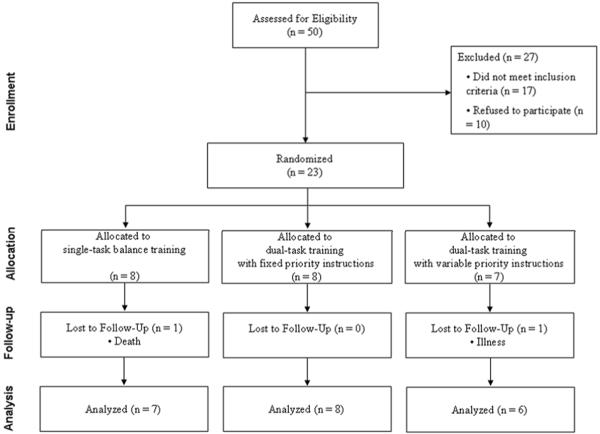
Participants: Older adults (N=23) with balance impairment (mean age, 74.8y). They scored 52 or less on the Berg Balance Scale (BBS) and/or walked with a self-selected gait speed of 1.1m/s or less.
Interventions: Participants were randomly assigned to 1 of 3 interventions: single-task training, dual-task training with fixed-priority instructions, and dual-task training with variable-priority instructions. Participants received 45-minute individualized training sessions, 3 times a week for 4 weeks.
Main outcome measures: Gait speed under single-task and dual-task conditions was obtained at baseline, the second week, the end of training, and the twelfth week after the end of training. Other measures, including the BBS and the Activities-specific Balance Confidence (ABC) Scale, were collected at baseline and after training.
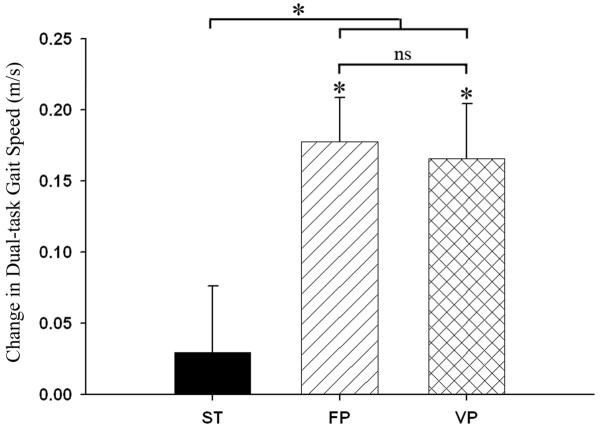
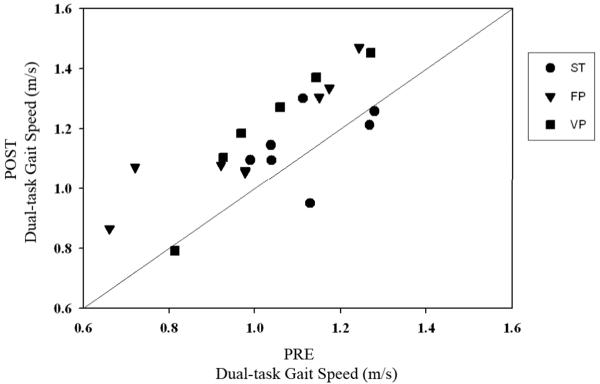
Results: Participants in all groups improved on the BBS (P<.001; effect size [ES]=.72), and walked significantly faster after training (P=.02; ES=.27). When a cognitive task was added, however, only participants who received dual-task training with fixed-priority instructions and dual-task training with variable-priority instructions exhibited significant improvements in gait speed (P<.001, ES=.57; and P<.001, ES=.46, respectively). In addition, only the dual-task training with variable-priority instructions group demonstrated a dual-task training effect at the second week of training and maintained the training effect at the 12-week follow-up. Only the single-task training group showed a significant increase on the ABC after training (P<.001; ES=.61).
Conclusions: Dual-task training is effective in improving gait speed under dual-task conditions in elderly participants with balance impairment. Training balance under single-task conditions may not generalize to balance control during dual-task contexts. Explicit instruction regarding attentional focus is an important factor contributing to the rate of learning and the retention of the dual-task training effect.
Figures
References
-
- Beauchet O, Annweiler C, Allali G, Berrut G, Dubost V. Dual task-related changes in gait performance in older adults: a new way of predicting recurrent falls? J Am Geriatr Soc. 2008;56:181–2. - PubMed
-
- Lundin-Olsson L, Nyberg L, Gustafson Y. “Stops walking when talking” as a predictor of falls in elderly people. Lancet. 1997;349:617. - PubMed
-
- Faulkner KA, Redfern MS, Cauley JA, et al. Multitasking: association between poorer performance and a history of recurrent falls. J Am Geriatr Soc. 2007;55:570–6. - PubMed
-
- Pettersson AF, Olsson E, Wahlund LO. Effect of divided attention on gait in subjects with and without cognitive impairment. J Geriatr Psychiatry Neurol. 2007;20:58–62. - PubMed
Publication types
MeSH terms
Grants and funding
LinkOut - more resources
Full Text Sources
Medical
