


Incidence rates of surgically treated idiopathic carpal tunnel syndrome in blue- and white-collar workers and housewives in Tuscany, Italy
- PMID: 19254910
- PMCID: PMC2664992
- DOI: 10.1136/oem.2008.040212
Incidence rates of surgically treated idiopathic carpal tunnel syndrome in blue- and white-collar workers and housewives in Tuscany, Italy
Abstract
Objectives: Rates of surgically treated carpal tunnel syndrome (CTS) among blue- and white-collar workers and housewives in the general population were compared.
Methods: Surgically treated cases of idiopathic CTS were investigated among 25-59-year-old residents of Tuscany, Italy, during 1997-2000, based on obligatory discharge records from all Italian public/private hospitals, archived according to residence on Tuscany's regional database. Population data were extracted from the 2001 census.
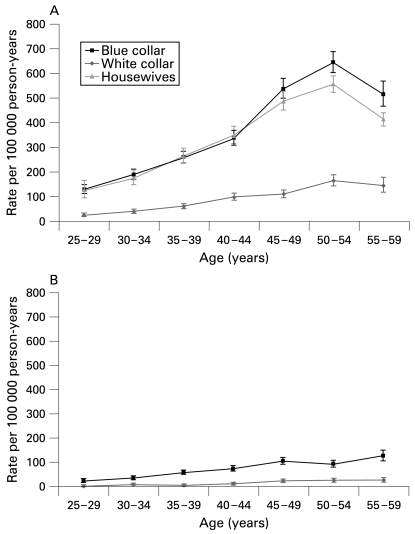
Results: After excluding repeat admissions, 8801 eligible cases were identified. Age-standardised rates (per 100 000 person-years) of surgical CTS were: "blue-collar women", 367.8; "white-collar women", 88.1; "housewives", 334.5; "blue-collar men", 73.5; and "white-collar men", 15.3. Compared with reference categories (same-sex white-collar workers): female blue-collar workers experienced a 4.2-fold higher standardised rate; housewives, a 3.8-fold excess; and male blue-collar workers, a 4.8-fold excess (all p<0.001). Male and female blue-collar workers showed approximately three to sevenfold higher age-specific rates compared to their white-collar counterparts (all p<0.001). Housewives' rates were similar to those of blue-collar female workers up to 40-44 years of age, after which they were significantly lower (p<0.002). At all ages, housewives' rates were much higher (p<0.001) than those of white-collar women.
Conclusions: Surgically treated CTS was three to seven times more common (depending on age/gender) in blue-collar than in white-collar workers, which is difficult to explain by differences in body weight or other individual factors. Thus, occupational risk factors seem relevant throughout working life. The high rates for full-time housewives suggest that domestic chores should be investigated as a possible risk factor for CTS.
Conflict of interest statement
Figures


References
-
- Bernard BP. Hand/wrist musculoskeletal disorders (carpal tunnel syndrome, tendinitis, hand-arm vibration syndrome): evidence for work-relatedness. Bernard B P, ed. Musculoskeletal disorders (MSDs) and workplace factors: a critical review of epidemiologic evidence for work-related musculoskeletal disorders of the neck, upper extremity, and low back Publication No. 97-141.Cincinnati, OH: US Department of Health and Human Services (NIOSH), 1997. Available from http://www.cdc.gov/niosh/docs/97-141/ergotxt5a.html (accessed 9 March 2009)
-
- Katz JN, Simmons BP. Clinical practice. Carpal tunnel syndrome. N Engl J Med 2002;346:1807–12 - PubMed
-
- Fulton-Kehoe D, Franklin G, Weaver M, et al. Years of productivity lost among injured workers in Washington State: modelling disability burden in worker’s compensation. Am J Ind Med 2000;37:656–62 - PubMed
-
- Abbas MA, Afifi AA, Zhang ZW, et al. Meta-analysis of published studies of work-related carpal tunnel syndrome. Int J Occup Environ Health 1998;4:160–7 - PubMed
Publication types
MeSH terms
LinkOut - more resources
Full Text Sources
Medical
Research Materials
