


Serum surfactant protein-A is a strong predictor of early mortality in idiopathic pulmonary fibrosis
- PMID: 19255294
- PMCID: PMC2716710
- DOI: 10.1378/chest.08-2209
Serum surfactant protein-A is a strong predictor of early mortality in idiopathic pulmonary fibrosis
Abstract
Background: Serum surfactant protein (SP) A and SP-D had prognostic value for mortality in patients with idiopathic pulmonary fibrosis (IPF) in prior studies before the reclassification of the idiopathic interstitial pneumonias. We hypothesized that baseline serum SP-A and SP-D concentrations would be independently associated with mortality among patients with biopsy-proven IPF and would improve a prediction model for mortality.
Methods: We evaluated the association between serum SP-A and SP-D concentrations and mortality in 82 patients with surgical lung biopsy-proven IPF. Regression models with clinical predictors alone and clinical and biomarker predictors were used to predict mortality at 1 year.
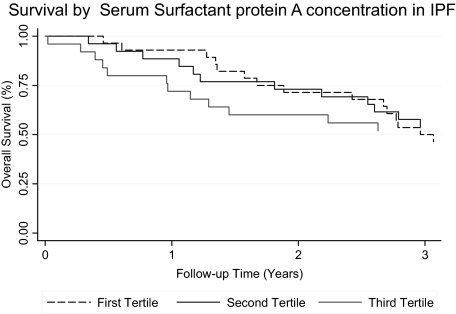
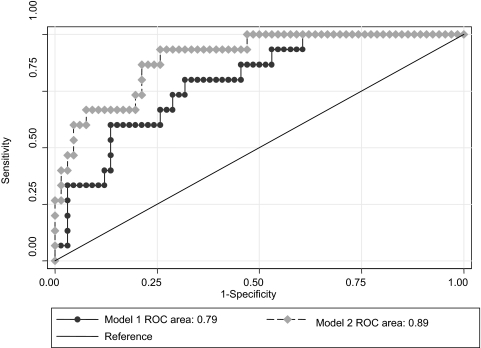
Results: After controlling for known clinical predictors of mortality, we found that each increase of 49 ng/mL (1 SD) in baseline SP-A level was associated with a 3.3-fold increased risk of mortality (adjusted hazard ratio, 3.27; 95% confidence interval, 1.49 to 7.17; adjusted p = 0.003) in the first year after presentation. We did not observe a statistically significant association between serum SP-D and mortality (adjusted hazard ratio, 2.04; p = 0.053). Regression models demonstrated a significant improvement in the 1-year mortality prediction model when serum SP-A and SP-D (area under the receiving operator curve [AROC], 0.89) were added to the clinical predictors alone (AROC, 0.79; p = 0.03).
Conclusions: Increased serum SP-A level is a strong and independent predictor of early mortality among patients with IPF. A prediction model containing SP-A and SP-D was substantially superior to a model with clinical predictors alone.
Conflict of interest statement
The authors have reported to the ACCP that no significant conflicts of interest exist with any companies/organizations whose products or services may be discussed in this article.
Figures
References
-
- King TE, Jr, Schwarz MI, Brown K, et al. Idiopathic pulmonary fibrosis: relationship between histopathologic features and mortality. Am J Respir Crit Care Med. 2001;164:1025–1032. - PubMed
-
- Bjoraker JA, Ryu JH, Edwin MK, et al. Prognostic significance of histopathologic subsets in idiopathic pulmonary fibrosis. Am J Respir Crit Care Med. 1998;157:199–203. - PubMed
-
- Flaherty KR, Mumford JA, Murray S, et al. Prognostic implications of physiologic and radiographic changes in idiopathic interstitial pneumonia. Am J Respir Crit Care Med. 2003;168:543–548. - PubMed
-
- American Thoracic Society, European Respiratory Society. International multidisciplinary consensus classification of the idiopathic interstitial pneumonias. Am J Respir Crit Care Med. 2002;165:277–304. - PubMed
-
- Raghu G, Brown KK, Bradford WZ, et al. A placebo-controlled trial of interferon γ-1b in patients with idiopathic pulmonary fibrosis. N Engl J Med. 2004;350:125–133. - PubMed
Publication types
MeSH terms
Substances
Grants and funding
LinkOut - more resources
Full Text Sources
Other Literature Sources
