Common and distinct amygdala-function perturbations in depressed vs anxious adolescents
- PMID: 19255377
- PMCID: PMC2891508
- DOI: 10.1001/archgenpsychiatry.2008.545
Common and distinct amygdala-function perturbations in depressed vs anxious adolescents
Abstract
Context: Few studies directly compare amygdala function in depressive and anxiety disorders. Data from longitudinal research emphasize the need for such studies in adolescents.
Objective: To compare amygdala response to varying attention and emotion conditions among adolescents with major depressive disorder (MDD) or anxiety disorders, relative to adolescents with no psychopathology.
Design: Case-control study.
Setting: Government clinical research institute.
Participants: Eighty-seven adolescents matched on age, sex, intelligence, and social class: 26 with MDD (14 with and 12 without anxiety disorders), 16 with anxiety disorders but no depression, and 45 without psychopathology.
Main outcome measures: Blood oxygen level-dependent signal in the amygdala, measured by means of event-related functional magnetic resonance imaging. During imaging, participants viewed facial expressions (neutral, fearful, angry, and happy) while attention was constrained (afraid, hostility, and nose-width ratings) or unconstrained (passive viewing).
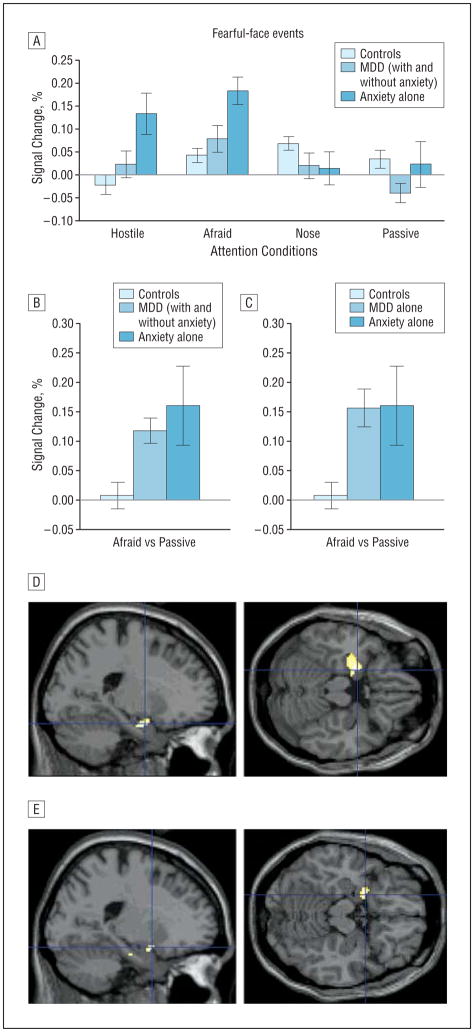
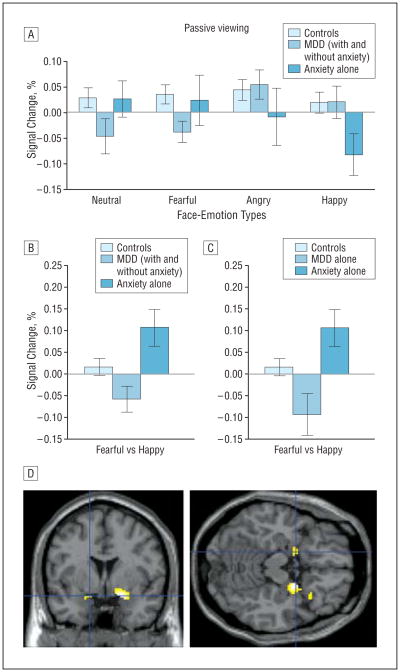
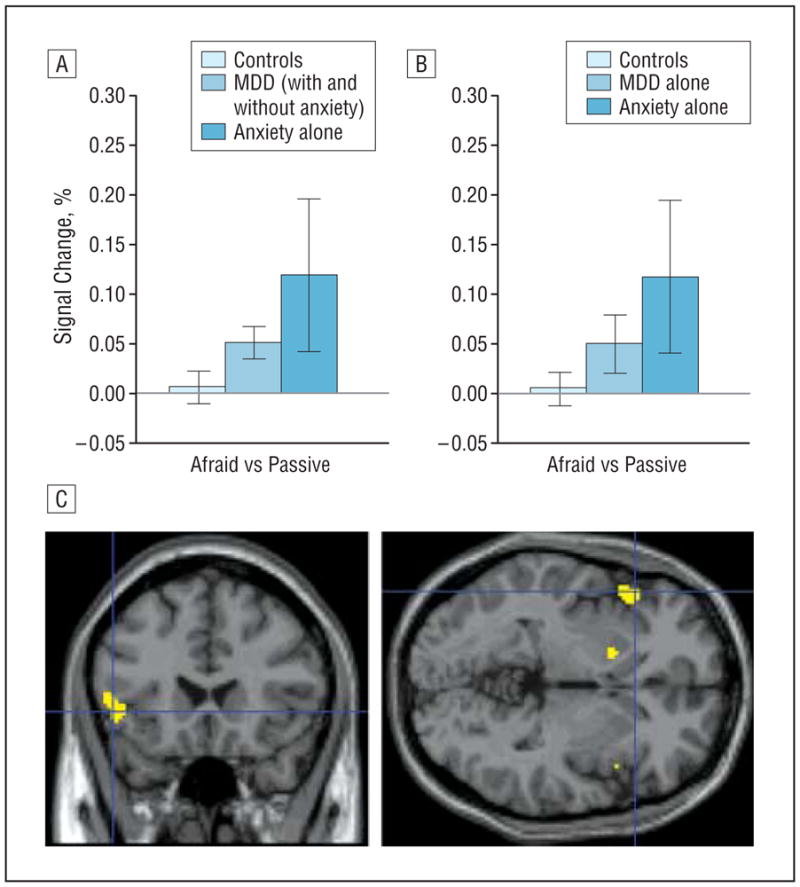
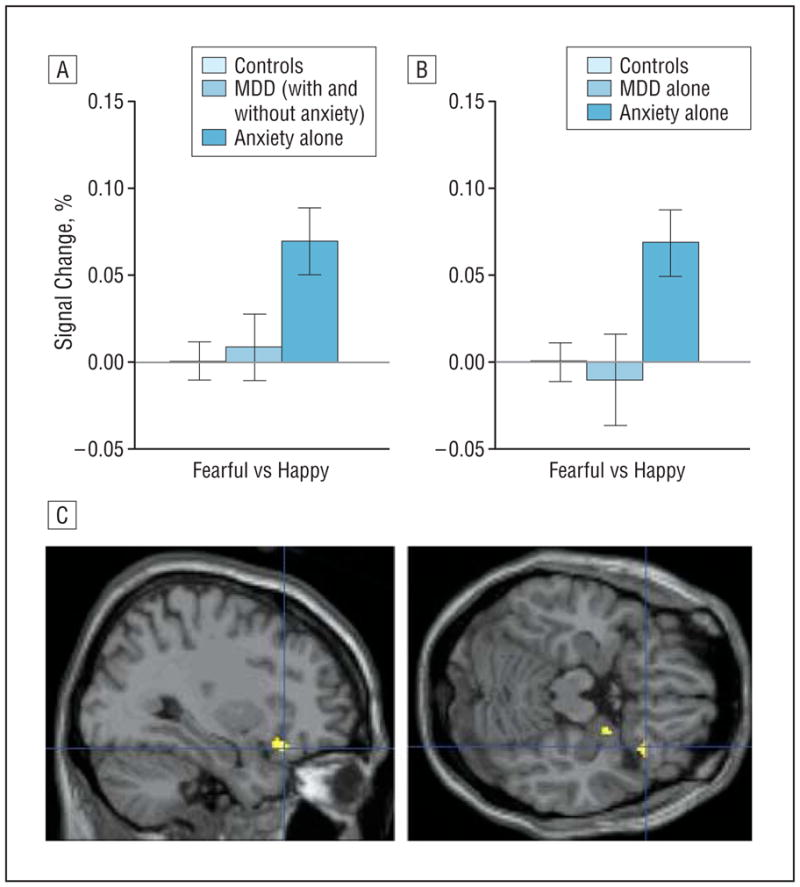
Results: Left and right amygdala activation differed as a function of diagnosis, facial expression, and attention condition both when patients with comorbid MDD and anxiety were included and when they were excluded (group x emotion x attention interactions, P < or = .03). Focusing on fearful face-viewing events, patients with anxiety and those with MDD both differed in amygdala responses from healthy participants and from each other during passive viewing. However, both MDD and anxiety groups, relative to healthy participants, exhibited similar signs of amygdala hyperactivation to fearful faces when subjectively experienced fear was rated.
Conclusions: Adolescent MDD and anxiety disorders exhibit common and distinct functional neural correlates during face processing. Attention modulates the degree to which common or distinct amygdala perturbations manifest in these patient groups, relative to healthy peers.
Figures
References
-
- Kessler RC, Berglund P, Demler O, Jin R, Merikangas KR, Walters EE. Lifetime prevalence and age-of-onset distributions of DSM-IV disorders in the National Comorbidity Survey Replication [published correction appears in Arch Gen Psychiatry. 2005;62(7):768] Arch Gen Psychiatry. 2005;62(6):593–602. - PubMed
-
- Wittchen H-U, Lieb R, Schuster P, Oldehinkel AJ. When is onset? investigations into early developmental stages of anxiety and depressive disorders. In: Rapoport JL, editor. Childhood Onset of “Adult” Psychopathology, Clinical and Research Advances. Washington, DC: American Psychiatric Press; 1999. pp. 259–302.
-
- Lieb R, Isensee B, Höfler M, Pfister H, Wittchen H-U. Parental major depression and the risk of depressive and other mental disorders in offspring: a prospective-longitudinal community study. Arch Gen Psychiatry. 2002;59(4):365–374. - PubMed
-
- Weissman MM, Wickramaratne P, Nomura Y, Warner V, Pilowsky D, Verdeli H. Offspring of depressed parents: 20 years later. Am J Psychiatry. 2006;163 (6):1001–1008. - PubMed
-
- Pine DS, Cohen P, Gurley D, Brook J, Ma Y. The risk for early-adulthood anxiety and depressive disorders in adolescents with anxiety and depressive disorders. Arch Gen Psychiatry. 1998;55(1):56–64. - PubMed
Publication types
MeSH terms
Substances
Grants and funding
LinkOut - more resources
Full Text Sources
Other Literature Sources
Medical