


Glatiramer acetate increases IL-1 receptor antagonist but decreases T cell-induced IL-1beta in human monocytes and multiple sclerosis
- PMID: 19255448
- PMCID: PMC2649955
- DOI: 10.1073/pnas.0812183106
Glatiramer acetate increases IL-1 receptor antagonist but decreases T cell-induced IL-1beta in human monocytes and multiple sclerosis
Abstract
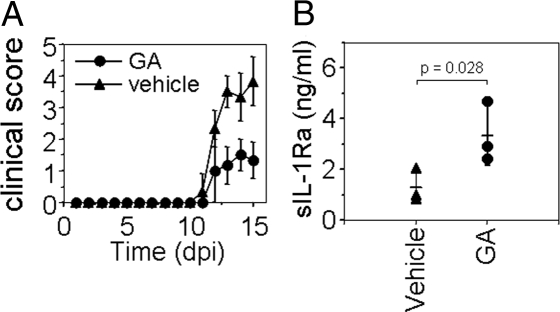
Mechanisms of action as well as cellular targets of glatiramer acetate (GA) in multiple sclerosis (MS) are still not entirely understood. IL-1beta is present in CNS-infiltrating macrophages and microglial cells and is an important mediator of inflammation in experimental autoimmune encephalitis (EAE), the MS animal model. A natural inhibitor of IL-1beta, the secreted form of IL-1 receptor antagonist (sIL-1Ra) improves EAE disease course. In this study we examined the effects of GA on the IL-1 system. In vivo, GA treatment enhanced sIL-1Ra blood levels in both EAE mice and patients with MS, whereas IL-1beta levels remained undetectable. In vitro, GA per se induced the transcription and production of sIL-1Ra in isolated human monocytes. Furthermore, in T cell contact-activated monocytes, a mechanism relevant to chronic inflammation, GA strongly diminished the expression of IL-1beta and enhanced that of sIL-1Ra. This contrasts with the effect of GA in monocytes activated upon acute inflammatory conditions. Indeed, in LPS-activated monocytes, IL-1beta and sIL-1Ra production were increased in the presence of GA. These results demonstrate that, in chronic inflammatory conditions, GA enhances circulating sIL-1Ra levels and directly affects monocytes by triggering a bias toward a less inflammatory profile, increasing sIL-1Ra while diminishing IL-1beta production. This study sheds light on a mechanism that is likely to participate in the therapeutic effects of GA in MS.
Conflict of interest statement
The authors declare no conflict of interest.
Figures


References
-
- Sela M, Teitelbaum D. Glatiramer acetate in the treatment of multiple sclerosis. Expert Opin Pharmacother. 2001;2:1149–1165. - PubMed
-
- Johnson KP, et al. Copolymer 1 reduces relapse rate and improves disability in relapsing-remitting multiple sclerosis: results of a phase III multicenter, double-blind placebo-controlled trial. The Copolymer 1 Multiple Sclerosis Study Group. Neurology. 1995;45:1268–1276. - PubMed
-
- Neuhaus O, Farina C, Wekerle H, Hohlfeld R. Mechanisms of action of glatiramer acetate in multiple sclerosis. Neurology. 2001;56:702–708. - PubMed
-
- Weber MS, et al. Multiple sclerosis: glatiramer acetate inhibits monocyte reactivity in vitro and in vivo. Brain. 2004;127:1370–1378. - PubMed
-
- Kim HJ, et al. Type 2 monocyte and microglia differentiation mediated by glatiramer acetate therapy in patients with multiple sclerosis. J Immunol. 2004;172:7144–7153. - PubMed
Publication types
MeSH terms
Substances
Grants and funding
LinkOut - more resources
Full Text Sources
Other Literature Sources
Medical
