


Extended high efficacy of the combination sulphadoxine-pyrimethamine with artesunate in children with uncomplicated falciparum malaria on the Benin coast, West Africa
- PMID: 19257898
- PMCID: PMC2653068
- DOI: 10.1186/1475-2875-8-37
Extended high efficacy of the combination sulphadoxine-pyrimethamine with artesunate in children with uncomplicated falciparum malaria on the Benin coast, West Africa
Abstract
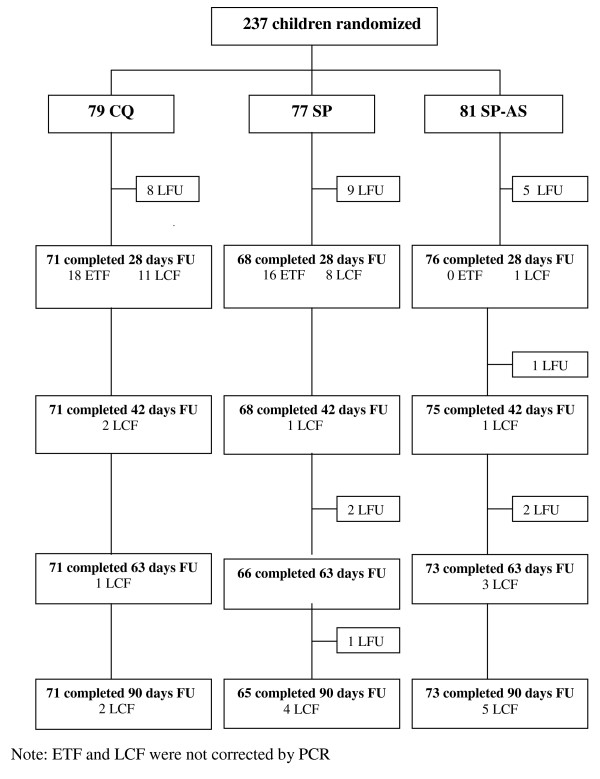
Background: A study carried out in 2003-2005 in Southern Benin showed a day-28 sulphadoxine-pyrimethamine (SP) monotherapy failure rate greater than 40%, while for SP combined with artesunate (SP-AS) the failure rate was 5.3%. Such a large difference could be explained by the relatively short 28-day follow-up period, with a substantial number of recurrent infections possibly occurring after day 28. This paper reports the treatment outcome observed in the same study cohort beyond the initial 28-day follow-up.
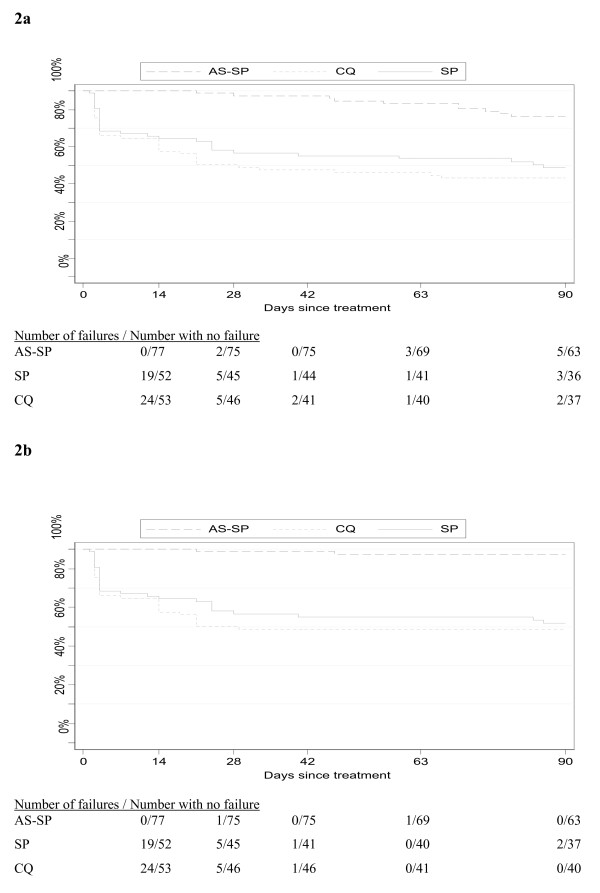
Methods: After the 28-day follow-up, children treated with either chloroquine alone (CQ), SP or SP-AS, were visited at home twice a week until day 90 after treatment. A blood sample was collected if the child had fever (axillary temperature > or =37.5 degrees C). Total clinical failure for each treatment group was estimated by combining all the early treatment failures and late clinical failures that occurred over the whole follow-up period, i.e. from day 0 up to day 90. Pre-treatment randomly selected blood samples were genotyped for the dhfr gene (59) and the dhps gene (437 and 540) point mutations related to SP resistance.
Results: The PCR-corrected clinical failure at day 90 was significantly lower in the SP-AS group (SP-AS: 2.7%, SP alone: 38.2%; CQ: 41.1%) (Log-Rank p < 0,001). The most prevalent haplotype was dhfr Arg-59 with the dhps Gly-437 mutant and the dhps 540 wild type (85.5%). The dhps 540 mutation could be found in only three (8.3%) samples.
Conclusion: Combining artesunate to SP dramatically increased the treatment efficacy, even when extending the follow-up to day 90 post-treatment, and despite the high percentage of failures following treatment with SP alone. Such a good performance may be explained by the low prevalence of the dhps 540 mutation, by the rapid parasite clearance with artesunate and by the level of acquired immunity.
Figures
References
-
- Ministère de la Santé . Atelier de consensus sur le changement de la politique de traitement antipaludique Programme National de Lutte contre le Paludisme. Cotonou: DNPS; 2004. pp. 1–10.
-
- Ministère de la Santé . Politique Nationale de Lutte contre le Paludisme et cadre stratégique de mise en œuvre Programme National de Lutte contre le Paludisme. Cotonou. DNPS; 2005. pp. 1–50.
-
- Ministère de la Santé . Programme National de Lutte contre le Paludisme. Cotonou. DNPS; 1992.
-
- Kyabayinze D, Cattamanchi A, Kamya MR, Rosenthal PJ, Dorsey G. Validation of a simplified method for using molecular markers to predict sulfadoxine-pyrimethamine treatment failure in African children with falciparum malaria. Am J Trop Med Hyg. 2003;69:247–52. - PubMed
-
- Kublin JG, Dzinjalamala FK, Kamwendo DD, Malkin EM, Cortese JF, Martino LM, Mukadam RA, Rogerson SJ, Lescano AG, Molyneux ME, Winstanley PA, Chimpeni P, Taylor TE, Plowe CV. Molecular markers for failure of sulfadoxine-pyrimethamine and chlorproguanil-dapsone treatment of Plasmodium falciparum malaria. J Infect Dis. 2002;185:380–388. doi: 10.1086/338566. - DOI - PubMed
Publication types
MeSH terms
Substances
LinkOut - more resources
Full Text Sources
Research Materials
