. 2009 May 5;160(2):348-58.
doi: 10.1016/j.neuroscience.2009.02.049. Epub 2009 Mar 1.

Ethanol-induced delta-opioid receptor modulation of glutamate synaptic transmission and conditioned place preference in central amygdala

Affiliations

Ethanol-induced delta-opioid receptor modulation of glutamate synaptic transmission and conditioned place preference in central amygdala

B Bie et al. Neuroscience. .

Abstract

Alcoholism involves compulsive behaviors of alcohol drinking, which is thought to be related at least initially to the rewarding effect of alcohol. It has been shown that mu-opioid receptors play an essential role in drug reward and dependence for many drugs of abuse including alcohol, but the function of delta-opioid receptors (DOR) in drug reward remains largely unknown at present. Previous animal studies using systemic approaches with DOR antagonists or DOR knockout animals have yielded inconsistent results, showing a decrease, an increase or no change in alcohol consumption and behaviors of alcohol reward after DOR inhibition or deletion. In the present study, we used ethanol-conditioned rats to investigate adaptive DOR function in neurons of the central nucleus of the amygdala (CeA), a key brain site for alcohol reward and addiction. We found that functional DOR was absent in glutamate synapses of CeA neurons from control rats, but it emerged and inhibited glutamate synaptic currents in CeA neurons from rats displaying ethanol-induced behavior of conditioned place preference (CPP). Analysis of paired-pulse ratios and miniature glutamate synaptic currents revealed that the recruited DOR was present on glutamatergic presynaptic terminals. Similar induction of functional DOR was also found on GABA synapses. Furthermore, microinjection of a DOR antagonist into the CeA reversed ethanol-induced CPP behavior in rats in vivo. These results suggest that repeated alcohol exposure recruits new functional DOR on CeA glutamate and GABA synapses, which may be involved in the expression or maintenance of ethanol-induced CPP behavior.


Figures
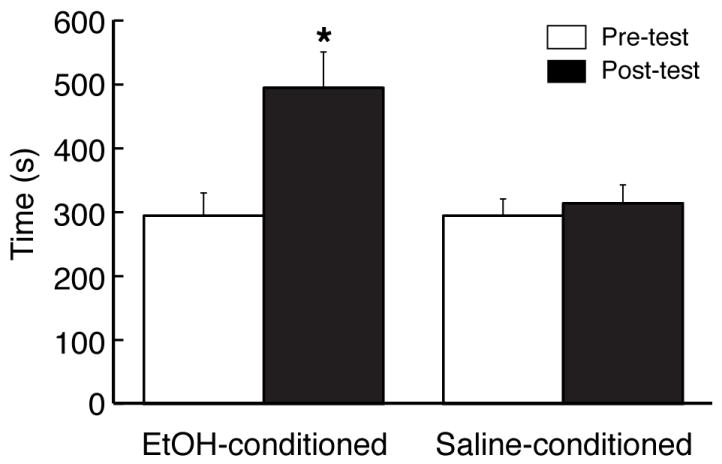
Fig. 1
Fig. 1
Ethanol conditioning induces behavior of conditioned place preference (CPP). Data are expressed as actual time in seconds a rat spent in the ethanol (EtOH)-paired chamber before (pre-test) and after (post-test) conditioning treatment with EtOH or saline. CPP was determined by comparing times between pre-test and post-test in the same animal. * p<0.05.
Fig. 2
Fig. 2
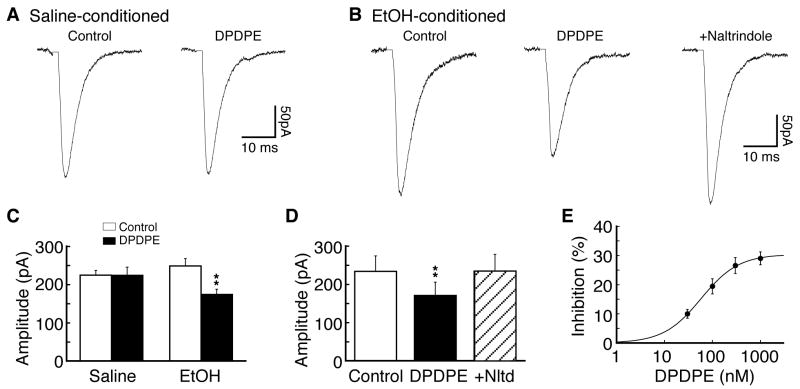
Functional delta-opioid receptors (DOR) emerge on CeA glutamate synapses in rats with ethanol-induced CPP. (A) Representative glutamate-mediated excitatory post-synaptic currents (EPSCs) in the absence (control) and presence of the DOR agonist [D-Pen2,D-Pen5]-enkephalin (DPDPE, 1 μM) in a neuron of the central nucleus of the amygdala (CeA) from a saline-conditioned control rat. (B) Representative glutamate EPSCs in control, in DPDPE and in DPDPE plus the DOR antagonist naltrindole (1 μM) in a CeA neuron from an ethanol-conditioned rats displaying CPP behavior. (C) Summarized data of the DPDPE effects on EPSCs in CeA neurons of the two rat groups. (D) Summarized data of naltrindole blockade of the DPDPE effect. (E) A dose-response curve for DOR inhibition of EPSCs in CeA neurons (n=5-10 for each dose) from ethanol-conditioned rats. The estimated EC50 was 57.9 nM. ** p<0.01.
Fig. 3
Fig. 3
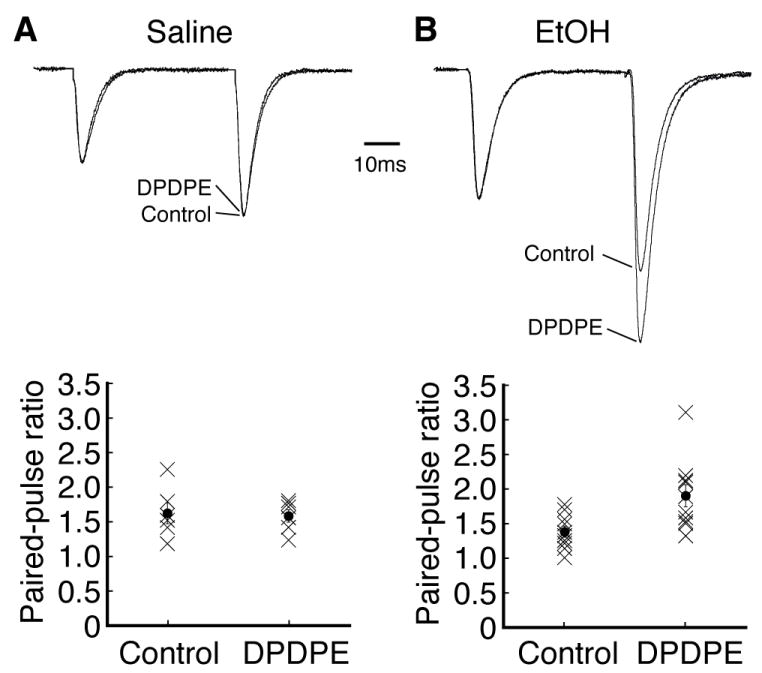
DOR activation increases the paired-pulse ratio (PPR) of EPSCs. (A, B) Representative pairs of EPSCs (upper) and PPR distributions (lower) before (control) and after addition of DPDPE (1 μM) in CeA neurons from control rats (A) and from ethanol-conditioned rats (B). The EPSC pairs were scaled to the first EPSC amplitude to show a changed ratio. Filled circles and associated vertical bars are means ± standard errors superimposed on the PPR of each cells (cross).
Fig. 4
Fig. 4
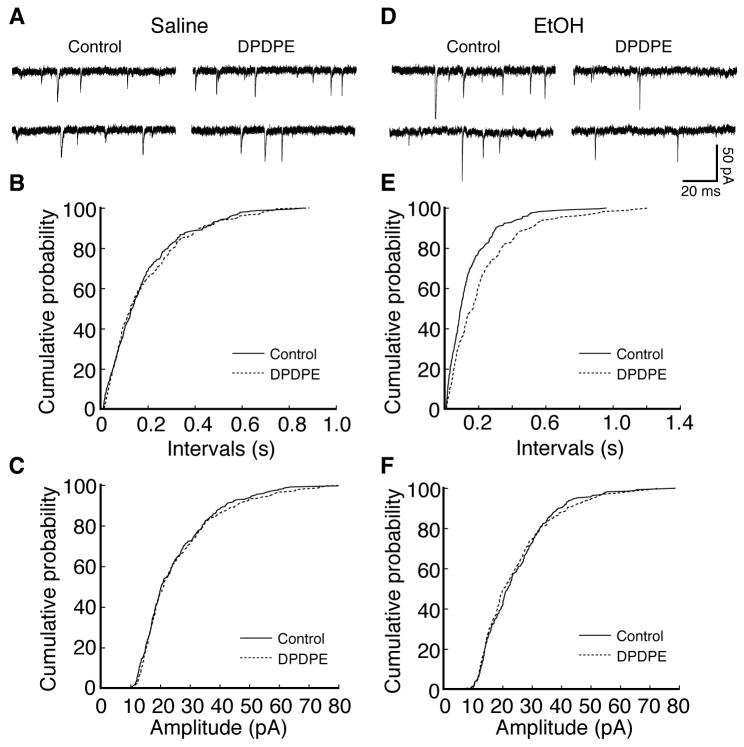
DOR activation inhibits presynaptic release of glutamate. (A-C) Current traces (A) and cumulative distributions of miniature EPSC frequency (B) and amplitude (C) in control and in DPDPE in a representative CeA neuron from a saline-conditioned rat. (D-F) Corresponding data in a CeA neuron from an ethanol-conditioned rat.
Fig. 5
Fig. 5
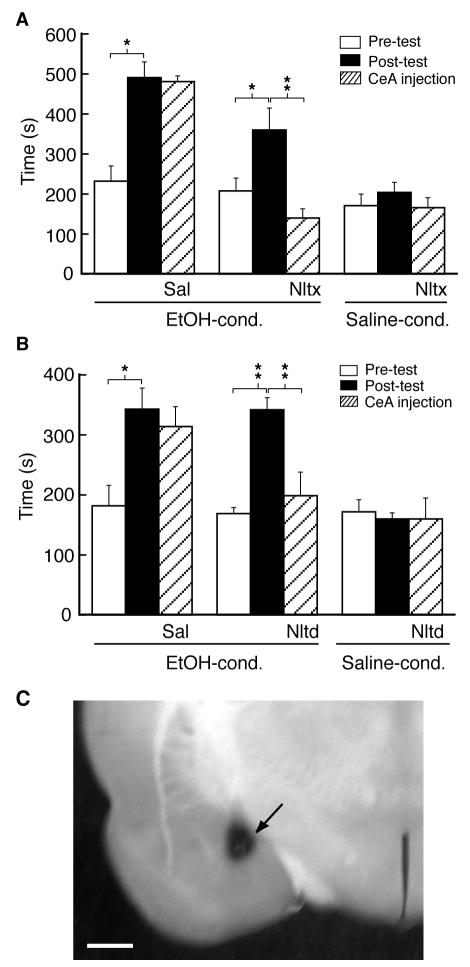
Antagonism of CeA opioid receptors and DOR inhibits ethanol-induced CPP behavior. CPP behavior was first elicited by conditioning with ethanol and comparing pre-test and post-test. One day after the post-test, saline or opioid antagonist naltrexone (A) or DOR antagonist naltrindole (B) was bilaterally microinjected into the CeA, followed by a CPP test (post-CeA injection) in both ethanol-conditioned rats and saline-conditioned rats. * p<0.05. ** p<0.01. Sal, saline, Nltx, naltrexone, Nltd, naltrindole. (C) A photomicrograph of the CeA slice showing a dye-marked microinjection site (arrow) in the CeA. The scale bar is 1 mm.
Fig. 6
Fig. 6
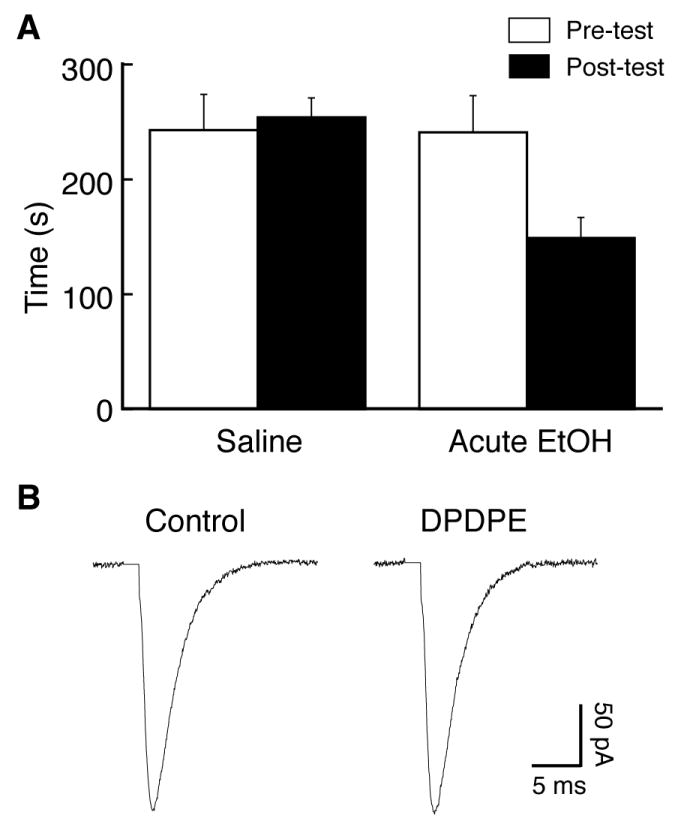
Acute ethanol treatment fails to induce CPP or functional DOR. (A) Data of CPP tests from rats conditioned with saline or with a single dose of ethanol. (B) Representative EPSCs in control and in DPDPE in a CeA neuron from a rat conditioned with a single dose of ethanol.
Fig. 7
Fig. 7
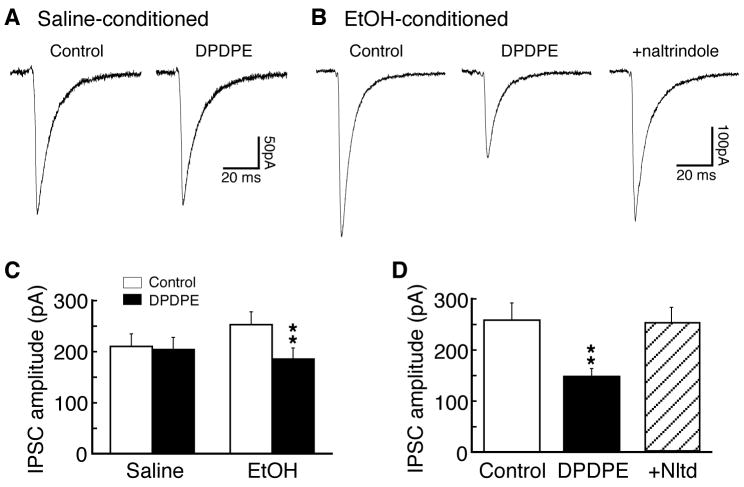
Functional DOR emerges on CeA GABA synapses in rats with ethanol-induced CPP. (A, B) Representative GABAergic inhibitory post-synaptic currents (IPSCs) in control and in DPDPE (1 μM) without or with naltrindole in CeA neurons from a saline-conditioned control rat (A) and from an ethanol-conditioned rat (B). (C, D) Summarized data of DPDPE effects on IPSCs and of naltrindole blockade of the DPDPE inhibition in CeA neurons from the two rat groups. ** p<0.01.

References

    1. Assanangkornchai S, Srisurapanont M. The treatment of alcohol dependence. Curr Opin Psychiatry. 2007;20:222–227. - PubMed
    1. Balleine BW, Killcross S. Parallel incentive processing: an integrated view of amygdala function. Trends Neurosci. 2006;29:272–279. - PubMed
    1. Baxter MG, Murray EA. The amygdala and reward. Nat Rev Neurosci. 2002;3:563–573. - PubMed
    1. Biala G, Kotlinska J. Blockade of the acquisition of ethanol-induced conditioned place preference by N-methyl-D-aspartate receptor antagonists. Alcohol Alcohol. 1999;34:175–182. - PubMed
    1. Bie B, Peng Y, Zhang Y, Pan ZZ. cAMP-mediated mechanisms for pain sensitization during opioid withdrawal. J Neurosci. 2005;25:3824–3832. - PMC - PubMed

Publication types

MeSH terms