


The minimal clinically important difference of the Michigan hand outcomes questionnaire
- PMID: 19258150
- PMCID: PMC4413464
- DOI: 10.1016/j.jhsa.2008.11.001
The minimal clinically important difference of the Michigan hand outcomes questionnaire
Abstract
Purpose: To determine the change in score required in various domains of the Michigan Hand Outcomes Questionnaire (MHQ) to indicate meaningful patient improvement, or the minimal clinically important difference (MCID), for 3 common hand conditions: rheumatoid arthritis (RA), carpal tunnel syndrome (CTS) and distal radius fracture (DRF).
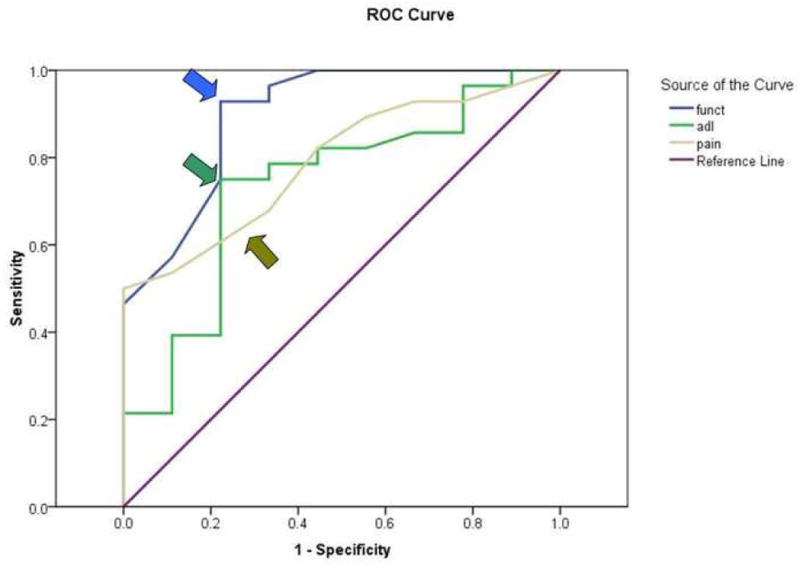
Methods: The MHQ was administered to patients at 2 time points. Patient satisfaction was defined as a satisfaction score > or =80% of the standard deviation of that patient sample. The minimal change in score in specific MHQ domains that corresponded with patient satisfaction was determined using receiver operating characteristic curves.
Results: For CTS patients, MCIDs of 23, 13, and 8 were identified for the pain, function, and work domains, respectively. For RA patients, pain and function were also identified as having discriminative ability, with MCIDs of 11 and 13, respectively. An MCID of 3 was identified for the activities of daily living domain. For DRF patients, no MHQ domains showed discriminative ability because of the ceiling effect at the 3-month assessment period.
Conclusions: Individual domains of the MHQ can be used to discriminate between patients who are satisfied and those who are not after either carpal tunnel release or silicone arthroplasty of the metacarpophalangeal joints for RA. Pain and function are the domains of the MHQ that are best able to discriminate between patients who are satisfied and those who are not. The identical function MCID for both RA patients and CTS patients, despite markedly different preoperative values, indicates that a standard amount of functional change may indicate patient satisfaction. High postoperative satisfaction, even only 3 months after surgery, prevented any domains from showing discriminative ability for the DRF patients.
Figures

References
-
- Ozyurekoglu T, McCabe SJ, Goldsmith LJ, LaJoie AS. The minimal clinically important difference of the Carpal Tunnel Syndrome Symptom Severity Scale. J Hand Surg. 2006;31A(5):733–738. - PubMed
-
- Redelmeier DA, Guyatt GH, Goldstein RS. Assessing the minimal important difference in symptoms: a comparison of two techniques. J Clin Epidemiol. 1996;49(11):1215–1219. - PubMed
-
- Davis Sears E, Burns PB, Chung KC. The outcomes of outcome studies in plastic surgery: a systematic review of 17 years of plastic surgery research. Plast Reconstr Surg. 2007;120(7):2059–2065. - PubMed
-
- Kotsis SV, Chung KC. Responsiveness of the Michigan Hand Outcomes Questionnaire and the Disabilities of the Arm, Shoulder and Hand questionnaire in carpal tunnel surgery. J Hand Surg. 2005;30A(1):81–86. - PubMed
Publication types
MeSH terms
Grants and funding
LinkOut - more resources
Full Text Sources
Medical
Research Materials
