


Diel changes in nitrogen and carbon resource status and use for growth in young plants of tomato (Solanum lycopersicum)
- PMID: 19258341
- PMCID: PMC2707904
- DOI: 10.1093/aob/mcp043
Diel changes in nitrogen and carbon resource status and use for growth in young plants of tomato (Solanum lycopersicum)
Abstract
Background and aims: Modellers often define growth as the development of plant structures from endogenous resources, thus making a distinction between structural (W(S)) and total (W) dry biomass, the latter being the sum of W(S) and the weight of storage compounds. In this study, short-term C and N reserves were characterized experimentally (forms, organ distribution, time changes) in relation to light and nutrition signals, and organ structural growth in response to reserve levels was evaluated.
Methods: Tomato plants (Solanum lycopersicum) were grown hydroponically in a growth room with a 12-h photoperiod and an adequate supply of NO(3)(-) (3 mol m(-3)). Three experiments were carried out 18 d after sowing: [NO(3)(-)] was either maintained at 3 mol m(-3), changed to 0.02 mol m(-3) or to 0 mol m(-3). Plants were sampled periodically throughout the light/dark cycles over 24-48 h. Organ W(S) was calculated from W together with the amount of different compounds that act as C and N resources, i.e. non-structural carbohydrates and carboxylates, nitrate and free amino acids.
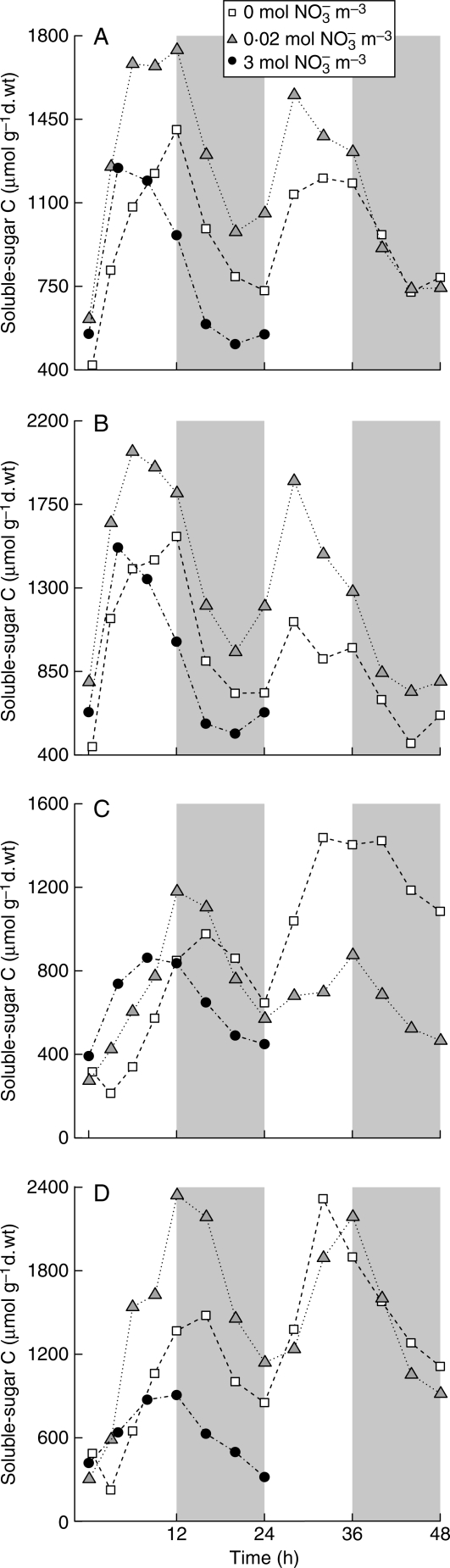
Key results: With adequate nutrition, carbohydrates accumulated in leaves during light periods, when photosynthesis exceeded growth needs, but decreased at night when these sugars are the main source of C for growth. At the end of the night, carbohydrates were still high enough to fuel full-rate growth, as W(S) increased at a near constant rate throughout the light/dark cycle. When nitrate levels were restricted, C reserves increased, but [NO(3)(-)] decreased progressively in stems, which contain most of the plant N reserves, and rapidly in leaves and roots. This resulted in a rapid restriction of structural growth.
Conclusions: Periodic darkness did not restrict growth because sufficient carbohydrate reserves accumulated during the light period. Structural growth, however, was very responsive to NO(3)(-) nutrition, because N reserves were mostly located in stems, which have limited nitrate reduction capacity.
Figures




References
-
- Adamowicz S, Le Bot J. Altering young tomato plant growth by NO3 and CO2 preserves the proportionate relation linking long-term organic-N accumulation to intercepted radiation. New Phytologist. 2008;180:663–672. - PubMed
-
- Andrews M, Sutherland JM, Thomas RJ, Sprent JI. Distribution of nitrate reductase activity in six legumes: the importance of the stem. New Phytologist. 1984;98:301–310.
-
- Ball RA, Sabbe WE, DeLong RE. Starch and nitrogen status in soybean during shading and nutrient deficiency. Journal of Plant Nutrition. 1998;21:665–685.
-
- Ben Zioni A, Vaadia Y, Lips SH. Nitrate uptake by roots as regulated by nitrate reduction products of the shoot. Physiologia Plantarum. 1971;24:288–290.
-
- Bijlsma RJ, Lambers H. A dynamic whole-plant model of integrated metabolism of nitrogen and carbon. 2. Balanced growth driven by C fluxes and regulated by signals from C and N substrate. Plant and Soil. 2000;220:71–87.
