. 2009 May;296(5):E1133-9.
doi: 10.1152/ajpendo.90944.2008. Epub 2009 Mar 3.

Diabetes induces and calcium channel blockers prevent cardiac expression of proapoptotic thioredoxin-interacting protein

Affiliations

Diabetes induces and calcium channel blockers prevent cardiac expression of proapoptotic thioredoxin-interacting protein

Junqin Chen et al. Am J Physiol Endocrinol Metab. 2009 May.

Abstract

Cardiomyocyte apoptosis is a critical process in the pathogenesis of ischemic and diabetic cardiomyopathy, but the mechanisms are not fully understood. Thioredoxin-interacting protein (TXNIP) has recently been shown to have deleterious effects in the cardiovascular system and we therefore investigated whether it may also play a role in diabetes-associated cardiomyocyte apoptosis. In fact, TXNIP expression was increased in H9C2 cardiomyocytes incubated at high glucose, and cardiac expression of TXNIP and cleaved caspase-3 were also elevated in vivo in streptozotocin- and obesity-induced diabetic mice. Together, these findings not only suggest that TXNIP is involved in diabetic cardiomyopathy but also that it may represent a novel therapeutic target. Surprisingly, testing putative TXNIP modulators revealed that calcium channel blockers reduce cardiomyocyte TXNIP transcription and protein levels in a dose-dependent manner. Oral administration of verapamil for 3 wk also reduced cardiac TXNIP expression in mice even in the face of severe diabetes, and these reduced TXNIP levels were associated with decreased apoptosis. To determine whether lack of TXNIP can mimic the verapamil-induced decrease in apoptosis, we used TXNIP-deficient HcB-19 mice, harboring a natural nonsense mutation in the TXNIP gene. Interestingly, we found significantly reduced cleaved caspase-3 levels in HcB-19 hearts, suggesting that TXNIP plays a critical role in cardiac apoptosis and that the verapamil effects were mediated by TXNIP reduction. Thus our results suggest that TXNIP reduction is a powerful target to enhance cardiomyocyte survival and that agents such as calcium channel blockers may be useful in trying to achieve this goal and prevent diabetic cardiomyopathy.


Figures
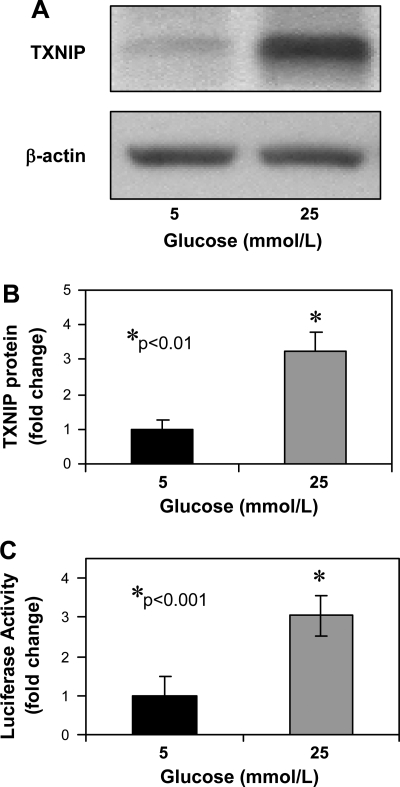
Fig. 1.
Fig. 1.
Glucose effects on cardiomyocyte thioredoxin-interacting protein (TXNIP) expression. TXNIP protein levels as assessed by immunoblotting in H9C2 cardiomyocytes incubated at low or high glucose for 24 h. A: representative blot. B: means ± SE of 4 independent experiments. C: glucose effects on TXNIP transcription. H9C2 cells were transfected with the human TXNIP reporter construct and incubated at 5 or 25 mM glucose for 24 h. Bars represent mean fold change ± SE in firefly luciferase activity. Three independent experiments were performed in triplicate.
Fig. 2.
Fig. 2.
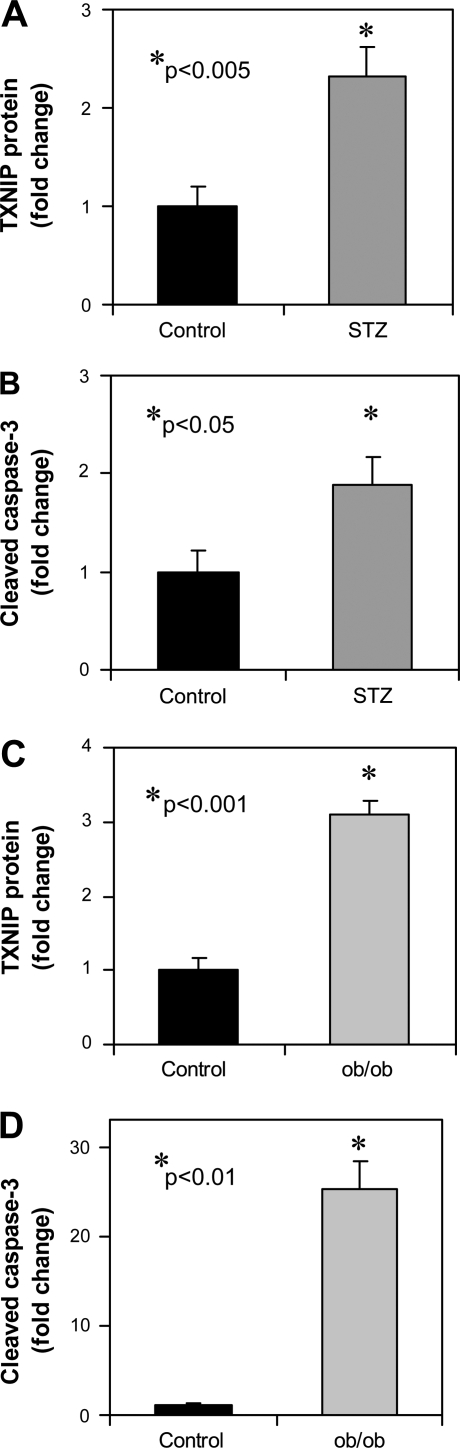
Effects of diabetes on cardiac TXNIP expression. Wild-type mice were rendered diabetic by a single intraperitoneal injection of streptozotocin (STZ; 200 mg/kg) and euthanized 4 days later. Their hearts were harvested for immunoblotting. Bars represent mean fold change ± SE (n = 6 per group) in TXNIP (A) and cleaved caspase-3 (B) protein levels compared with control mice that received vehicle alone. Obese, insulin-resistant, and diabetic BTBRlepob/ob mice were euthanized at 12 wk of age and their cardiac TXNIP (C) and cleaved caspase-3 (D) expression was compared with age-matched lean control BTBRlep+/+ mice. Bars represent mean fold change ± SE (n = 3 per group).
Fig. 3.
Fig. 3.
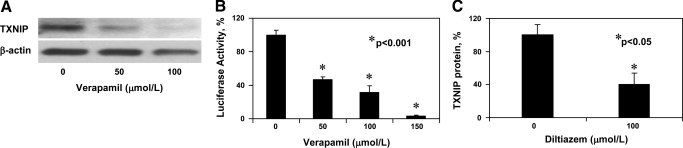
Effects of calcium channel blockers on cardiomyocyte TXNIP expression. H9C2 cardiomyocytes were incubated at 25 mM glucose and treated with the designated doses of verapamil for 24 h. A: dose-dependent decrease in TXNIP protein levels in response to verapamil as measured by immunoblotting. One representative of 2 independent experiments is shown. B: dose-dependent decrease in TXNIP transcription in response to verapamil as assessed by transfection studies using the human TXNIP reporter construct. Bars represent %transcriptional activity of the human TXNIP promoter as measured by luciferase activity. Means ± SE of 3 independent experiments performed in triplicates are shown. C: H9C2 cardiomyocytes were treated with diltiazem for 24 h and TXNIP protein levels assessed by immunoblotting. Means ± SE of 4 independent experiments are shown.
Fig. 4.
Fig. 4.
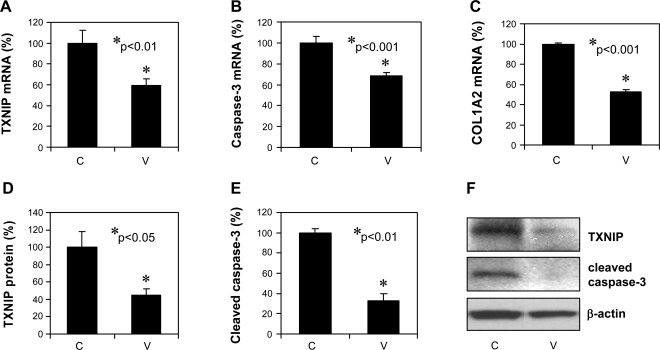
In vivo verapamil effects on the expression of cardiac TXNIP and markers of apoptosis and fibrosis. Mice were treated with or without verapamil (100 mg/kg po) for 3 wk and their hearts were harvested for RNA extraction (n = 4 per group) or for preparation of protein extracts (n = 3). Bars represent changes ± SE in TXNIP (A), caspase-3 (B), and collagen type 1 α2 (COL1A2) (C) mRNA expression as measured by quantitative real-time RT-PCR and corrected for 18S as well as TXNIP protein levels and cleaved caspase-3 levels corrected for β-actin (DF). C, untreated control; V, verapamil-treated mice.
Fig. 5.
Fig. 5.
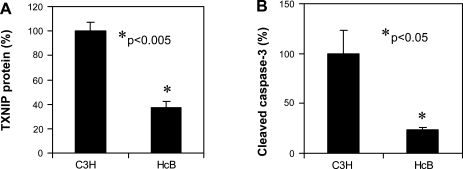
Effects of TXNIP deficiency on apoptotic factors in the heart. Expression levels of TXNIP (A) and cleaved caspase-3 (B) were assessed by immunoblotting of protein extracts from hearts of 6-mo-old TXNIP-deficient HcB-19 (HcB) and wild-type control (C3H) mice. Bars represent means ± SE; n = 3 animals per group.
Fig. 6.
Fig. 6.
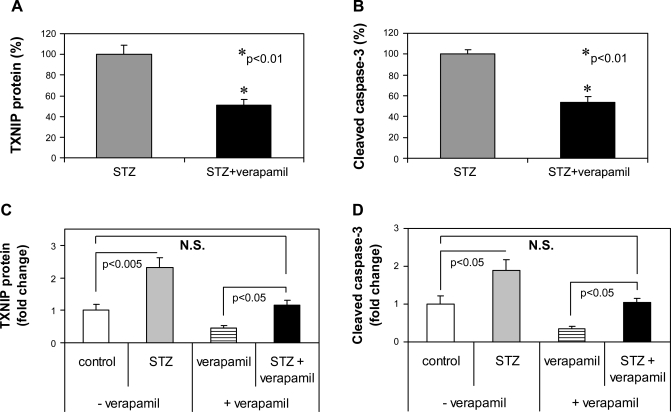
Verapamil effects on TXNIP expression and apoptosis in the diabetic heart. Wild-type mice were divided into 2 groups (n = 3) and treated with or without verapamil (100 mg/kg po) for a total of 3 wk. Four days prior to euthanasia, mice of both groups were rendered diabetic by STZ injection (200 mg/kg). After euthanasia, their hearts were harvested and assessed for TXNIP (A) and cleaved caspase-3 (B) by immunoblotting; bars represent means ± SE. Comparison of the STZ effects in the presence or absence of verapamil on TXNIP protein (C) and cleaved caspase-3 (D) levels. Bars represent fold change ± SE compared with untreated nondiabetic control mice (open bar).
Fig. 7.
Fig. 7.
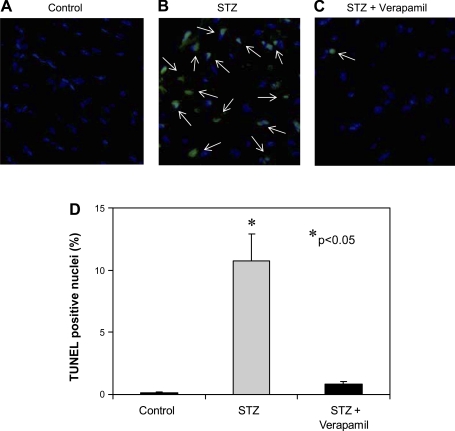
TUNEL analysis of the antiapoptotic effects of verapamil in the heart. Wild-type mice were treated with or without verapamil (100 mg/kg po) for 3 wk and were rendered diabetic by STZ injection (200 mg/kg) or were left untreated for the nondiabetic control group (n = 3 per group). After euthanasia, their hearts were harvested and processed for immunohistochemistry and TUNEL analysis. Representative pictures (×40) of nondiabetic control (A), STZ-diabetic (B), and verapamil-treated STZ-diabetic (C) heart sections are shown. White arrows point at TUNEL-positive apoptotic nuclei. D: quantification of TUNEL-positive cardiomyocytes. Three different mouse hearts and >2,000 nuclei were analyzed per group. Bars represent means ± SE.

References

    1. Afzal N, Ganguly PK, Dhalla KS, Pierce GN, Singal PK, Dhalla NS. Beneficial effects of verapamil in diabetic cardiomyopathy. Diabetes 37: 936–942, 1988. - PubMed
    1. Bodnar JS, Chatterjee A, Castellani LW, Ross DA, Ohmen J, Cavalcoli J, Wu C, Dains KM, Catanese J, Chu M, Sheth SS, Charugundla K, Demant P, West DB, de Jong P, Lusis AJ. Positional cloning of the combined hyperlipidemia gene Hyplip1. Nat Genet 30: 110–116, 2002. - PMC - PubMed
    1. Brickson S, Fitzsimons DP, Pereira L, Hacker T, Valdivia H, Moss RL. In vivo left ventricular functional capacity is compromised in cMyBP-C null mice. Am J Physiol Heart Circ Physiol 292: H1747–H1754, 2007. - PubMed
    1. Chen J, Couto FM, Minn AH, Shalev A. Exenatide inhibits beta-cell apoptosis by decreasing thioredoxin-interacting protein. Biochem Biophys Res Commun 346: 1067–1074, 2006. - PubMed
    1. Chen J, Hui ST, Couto FM, Mungrue IN, Davis DB, Attie AD, Lusis AJ, Davis RA, Shalev A. Thioredoxin-interacting protein deficiency induces Akt/Bcl-xL signaling and pancreatic beta cell mass and protects against diabetes. FASEB J 22: 3581–3594, 2008. - PMC - PubMed

Publication types

MeSH terms