


Dissociation of the effects of MTEP [3-[(2-methyl-1,3-thiazol-4-yl)ethynyl]piperidine] on conditioned reinstatement and reinforcement: comparison between cocaine and a conventional reinforcer
- PMID: 19258516
- PMCID: PMC2683783
- DOI: 10.1124/jpet.109.151357
Dissociation of the effects of MTEP [3-[(2-methyl-1,3-thiazol-4-yl)ethynyl]piperidine] on conditioned reinstatement and reinforcement: comparison between cocaine and a conventional reinforcer
Abstract
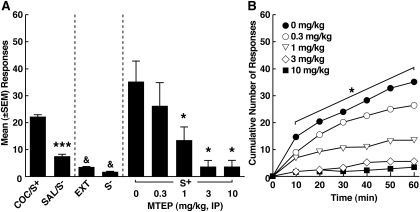
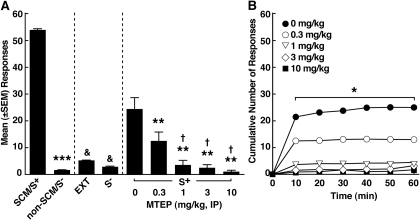
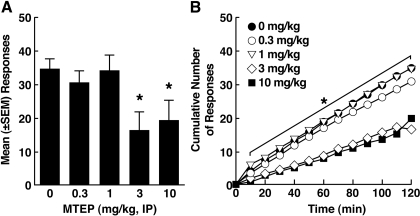
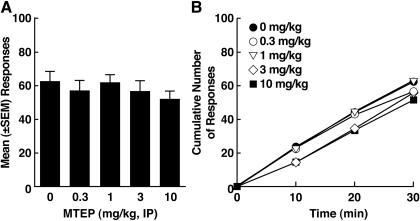
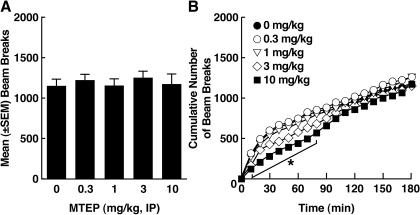
To advance understanding of the potential of metabotropic glutamate receptor (mGluR) 5 as treatment targets for cocaine addiction, the effects of MTEP [3-[(2-methyl-1,3-thiazol-4-yl) ethynyl]piperidine] (a selective mGluR5 antagonist) on conditioned reinstatement of cocaine seeking were examined. To test whether modification of conditioned reinstatement by MTEP is selective for drug-directed behavior or reflects general actions on motivated behavior, effects of MTEP on reinstatement induced by a stimulus conditioned to palatable conventional reward, sweetened condensed milk (SCM), were also evaluated. Previous data suggest that mGluR manipulations preferentially interfere with conditioned reinstatement compared with cocaine self-administration. Therefore, the effects of MTEP on cocaine self-administration were compared with MTEP's effects on SCM-reinforced behavior using the same cocaine doses and SCM concentrations employed for establishing conditioned reinstatement. Male Wistar rats were trained to associate a discriminative stimulus (S(D)) with response-contingent availability of cocaine or SCM and subjected to reinstatement tests after extinction of cocaine or SCM-reinforced behavior. MTEP (0.3-10 mg/kg i.p.) dose-dependently attenuated the response-reinstating effects of both the cocaine S(D) and SCM S(D). MTEP also decreased cocaine self-administration without a clear graded dose-response profile and did not modify SCM-reinforced responding. The findings implicate mGluR5-regulated glutamate transmission in appetitive behavior controlled by reward-related stimuli but without selectivity for cocaine seeking. However, the data suggest a differential role for mGluR5 in the acute reinforcing effects of cocaine versus conventional reward. These observations identify mGluR5 as potential treatment targets for cocaine relapse prevention, although the profile of action of mGluR5 antagonists remains to be more closely examined for potential anhedonic effects.
Figures
References
-
- Alagarsamy S, Marino MJ, Rouse ST, Gereau RW 4th, Heinemann SF, and Conn PJ (1999) Activation of NMDA receptors reverses desensitization of mGluR5 in native and recombinant systems. Nat Neurosci 2 234-240. - PubMed
-
- Anderson JJ, Bradbury MJ, Giracello DR, Chapman DF, Holtz G, Roppe J, King C, Cosford ND, and Varney MA (2003) In vivo receptor occupancy of mGlu5 receptor antagonists using the novel radioligand [3H]3-methoxy-5-(pyridin-2-ylethynyl)pyridine). Eur J Pharmacol 473 35-40. - PubMed
-
- Bäckström P, Bachteler D, Koch S, Hyytiä P, and Spanagel R (2004) mGluR5 antagonist MPEP reduces ethanol-seeking and relapse behavior. Neuropsychopharmacology 29 921-928. - PubMed
-
- Bäckström P and Hyytiä P (2006) Ionotropic and metabotropic glutamate receptor antagonism attenuates cue-induced cocaine seeking. Neuropsychopharmacology 31 778-786. - PubMed
Publication types
MeSH terms
Substances
Grants and funding
LinkOut - more resources
Full Text Sources
Other Literature Sources
