Review
. 2009 Mar;73(1):178-210.
doi: 10.1128/MMBR.00010-08.

A gripping tale of ribosomal frameshifting: extragenic suppressors of frameshift mutations spotlight P-site realignment

Affiliations
Review

A gripping tale of ribosomal frameshifting: extragenic suppressors of frameshift mutations spotlight P-site realignment

John F Atkins et al. Microbiol Mol Biol Rev. 2009 Mar.

Abstract

Mutants of translation components which compensate for both -1 and +1 frameshift mutations showed the first evidence for framing malleability. Those compensatory mutants isolated in bacteria and yeast with altered tRNA or protein factors are reviewed here and are considered to primarily cause altered P-site realignment and not altered translocation. Though the first sequenced tRNA mutant which suppressed a +1 frameshift mutation had an extra base in its anticodon loop and led to a textbook "yardstick" model in which the number of anticodon bases determines codon size, this model has long been discounted, although not by all. Accordingly, the reviewed data suggest that reading frame maintenance and translocation are two distinct features of the ribosome. None of the -1 tRNA suppressors have anticodon loops with fewer than the standard seven nucleotides. Many of the tRNA mutants potentially affect tRNA bending and/or stability and can be used for functional assays, and one has the conserved C74 of the 3' CCA substituted. The effect of tRNA modification deficiencies on framing has been particularly informative. The properties of some mutants suggest the use of alternative tRNA anticodon loop stack conformations by individual tRNAs in one translation cycle. The mutant proteins range from defective release factors with delayed decoding of A-site stop codons facilitating P-site frameshifting to altered EF-Tu/EF1alpha to mutant ribosomal large- and small-subunit proteins L9 and S9. Their study is revealing how mRNA slippage is restrained except where it is programmed to occur and be utilized.


Figures
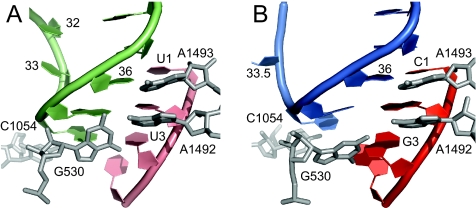
FIG. 1.
FIG. 1.
The anticodon-codon interaction in the A sites of a tRNA with a normal three-nucleotide anticodon (A) and a tRNA with a four-nucleotide anticodon (B) in the same site. (Panels B and D were modified from reference with permission of the publisher.)
FIG. 2.
FIG. 2.
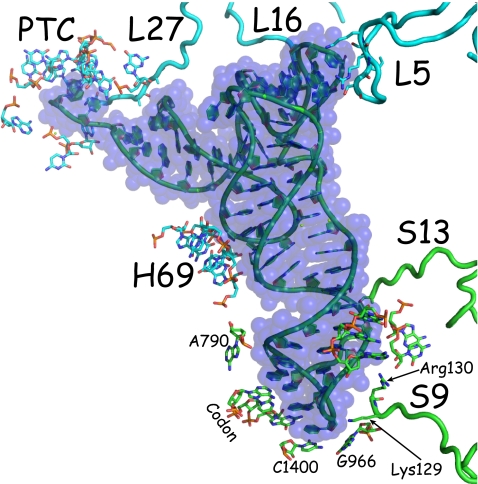
tRNAfMet in the P site of a bacterial 70S ribosome (282). Protein and rRNA residues of the 30S (with C atoms in light blue) and 50S (with C atoms in darker blue) ribosomes that have atoms within 3.8 Å of the peptidyl-tRNA are shown as stick representations and the protein chains as tubes (blue from L50 and green from S30). The image was made created by use of PyMOL (82). The last (Arg130) and the next-to-last (Lys129) amino acids are indicated. (Courtesy of J. Näsvall, Umeå University, Umeå, Sweden.)
FIG. 3.
FIG. 3.
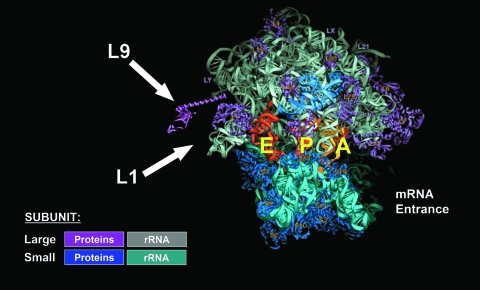
Structure of the 70S ribosome. Positions of proteins L1 and L9 are indicated with arrows. The cleft where mRNA entering occurs is also shown. (Modified from reference with permission of AAAS.)
FIG. 4.
FIG. 4.
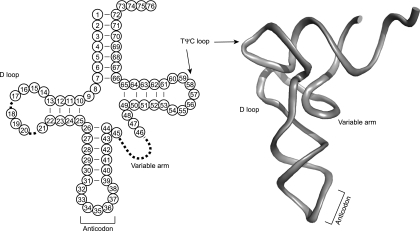
(Left) Cloverleaf structure of a standard tRNA with the conventional numbering system for the locations of the different nucleotides used in the text. (Right) Three-dimensional structure of yeast tRNAPhe with the various regions of the tRNA indicated.
FIG. 5.
FIG. 5.
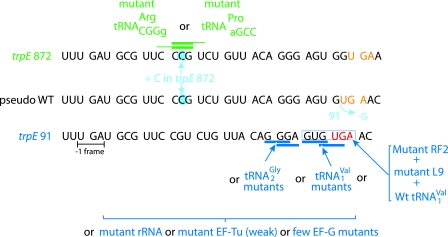
Suppressors of a −1 frameshift mutation and of a nearby +1 mutation. S. enterica trpE91 has a deletion of G400 in its anthranilate synthetase gene (blue), which if not compensated for leads to termination at a UGA codon (brown). A fast-growing (pseudo-wild) revertant on media without tryptophan had an insertion of a C at 18 nucleotides 5′ (blue). The secondary compensatory mutation was separated by transduction and designated trpE872. The anticodons of tRNA mutants which suppress trpE872 are in green. One derivative of tRNAmnm5UCCGly (tRNA2Gly) directly suppresses trpE91 by −1 frameshifting at G GGA, and others do so indirectly. An anticodon insertion mutant of tRNAcmo5UACVal causes slipping +2 from GUG to GUG, and another mutant has C74 substituted. Mutants of L9 and RF2 facilitate +2 slippage by WT tRNAcmo5UACVal from GUG to GUG.
FIG. 6.
FIG. 6.
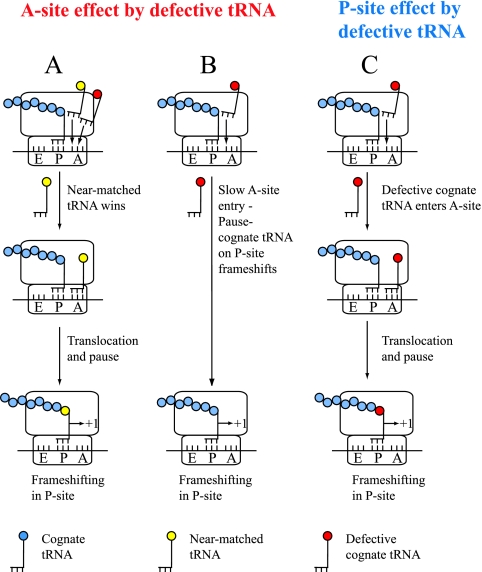
The dual-error model for frameshifting. Defects in tRNA may induce frameshifting in three different ways. (A) The defective tRNA is slow in entering the A site, allowing a third-position-mismatched tRNA to decode the A-site codon (first error). After a normal three-nucleotide translocation to the P site, the third-position-mismatched tRNA is prone to slip into an overlapping reading frame (second error). (B) The defective tRNA is slow in entering the A site (first error), providing a pause when the P-site tRNA may slip (second error). (C) The defective tRNA is not excluded by the ribosomal A site and decodes the codon in the A site (first error), but once it has been translocated into the P site, it may slip on the mRNA (second error). “Defective” can indicate either alterations in the primary sequence or hypo- or hypermodification of the tRNA. To make the figure easier to read, no tRNA has been depicted in the E site, although in all these cases when a frameshift occurs in the P site (lower part of the figure), it is likely that the E site is occupied (see text). (Adapted from reference .)

References

    1. Adamski, F. M., J. F. Atkins, and R. F. Gesteland. 1996. Ribosomal protein L9 interactions with 23 S rRNA: the use of a translational bypass assay to study the effect of amino acid substitutions. J. Mol. Biol. 261357-371. - PubMed
    1. Adamski, F. M., B. C. Donly, and W. P. Tate. 1993. Competition between frameshifting, termination and suppression at the frameshift site in the Escherichia coli release factor-2 mRNA. Nucleic Acids Res. 215074-5078. - PMC - PubMed
    1. Ambrogelly, A., S. Palioura, and D. Söll. 2007. Natural expansion of the genetic code. Nat. Chem. Biol. 329-35. - PubMed
    1. Ames, B. N., and H. J. Whitfield. 1966. Frameshift mutagenesis in Salmonella. Cold Spring Harb. Symp. Quant. Biol. 31221-225. - PubMed
    1. Anderson, J. C., T. J. Magliery, and P. G. Schultz. 2002. Exploring the limits of codon and anticodon size. Chem. Biol. 9237-244. - PubMed

Publication types

LinkOut - more resources